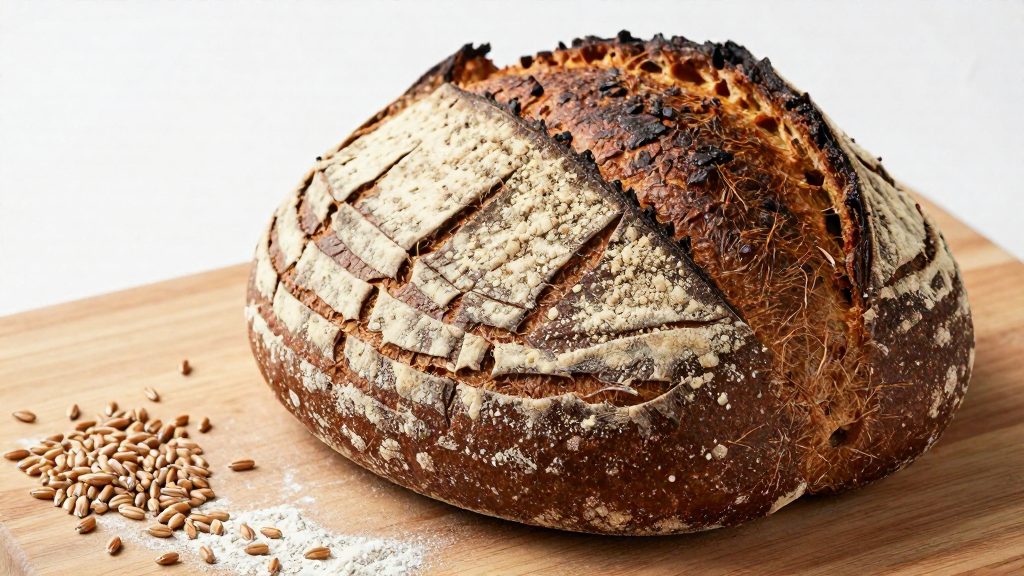
Rye sourdough is built on whole rye flour, and the fermented starter does much of the work that gluten does in wheat bread. In the reference recipe from The Fresh Loaf (2026), the levain uses 350 g whole rye flour and the final dough adds another 350 g rye, so the loaf is 100% rye. Its structure, flavour and keeping quality all depend on how the bran-rich flour and the sourdough acidity interact.
Why bake rye sourdough with whole grain flour?
How acidity supports the rye crumb
During fermentation, the starter produces lactic and acetic acids that raise the dough’s acidity (lower its pH). This acid environment helps the crumb set and gives the loaf a firmer, more stable interior. It also moderates the activity of starch-breaking enzymes, which are naturally strong in rye and can otherwise make the dough soft and sticky during baking.
Flavour benefits of whole grain rye
Whole rye keeps the bran and germ, which carry most of the grain’s earthy, nutty and slightly spicy notes. The sourdough adds a tangy, sour character on top of that. The two effects reinforce each other: the acids bring out a clean sourness, while the whole grain gives the loaf depth. A rye sourdough made with a refined flour tastes milder and less complex.
Whole grain versus refined rye: texture trade-offs
The recipe allows either type 1370 (a European designation, rarely labelled that way in Canada, where a lighter or darker rye flour is the closest substitute) or whole rye for the final dough, so the choice of flour is a direct lever on texture and flavour.
| Factor | Whole rye | Refined rye (type 1370) |
|---|---|---|
| Flavour | Earthy, nutty, deeper | Milder, lighter |
| Crumb | Denser, more closed | Lighter, more open |
| Keeping quality | Tends to stay moist | Tends to dry sooner |
Bran-rich rye tends to hold moisture. The trade-off is a heavier loaf that needs a well-fermented dough to hold its shape.
Which whole grain flours work best?
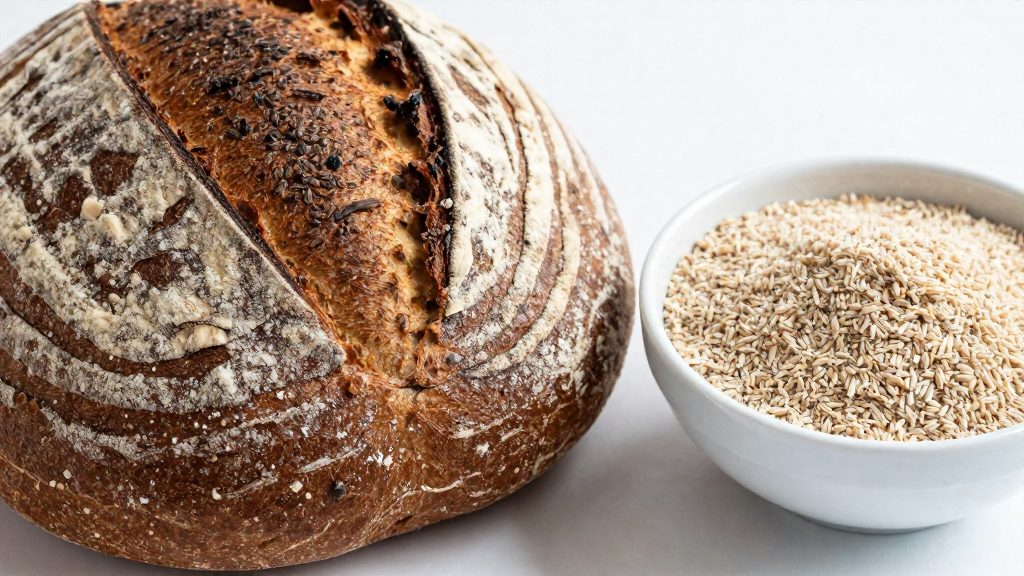
For rye sourdough, the main choice is how much of the grain’s bran stays in the flour. The Fresh Loaf (2026) lists type 1370 or whole rye as interchangeable for the final dough of its 100% rye loaf, so both fit the same role in that recipe. The difference lies in flavour, colour and how the dough handles water, not in whether the loaf can be made.
| Flour | What it is | Effect in rye sourdough |
|---|---|---|
| Whole rye | The entire rye kernel, bran and germ included | Darker crumb, stronger rye flavour, more bran particles that take up water |
| Type 1370 | A European rye flour designation based on ash (mineral content). It is not a standard Canadian label; in Canada, look for light, medium or dark rye flour instead | Lighter colour and milder flavour, with a dough that is usually less wet and sticky than whole rye |
Ash is the mineral residue left after the flour is burned, and it rises as more bran is kept. Higher-ash flours give a more pronounced rye taste and a denser, darker crumb. Lower-ash flours produce a softer, lighter loaf. Compare flours by feel and taste rather than by a number.
Water absorption between rye grades
Bran soaks up water, so whole rye usually makes a dough that feels wetter and stickier than one made with a more refined grade at the same moment of mixing. When you switch grades, hold back a small part of the water and add it gradually until the dough is workable. Aim for a dough that holds its shape without tearing when you handle it, and expect the whole-rye version to need a slightly different feel than the refined one.
Whole wheat and spelt as partial substitutes
Whole wheat and spelt can replace part of the rye for a lighter crumb and a more open structure. Whole wheat adds bran and gluten-forming protein that helps the crumb hold together. Spelt has a weaker, more extensible gluten, so it tends to relax and spread more than wheat. Use either flour as a partial share rather than a full replacement, because rye’s gums and starches do the structural work in a rye loaf, and too much wheat or spelt can change the crumb you are aiming for.
How do you build a rye levain?
According to The Fresh Loaf (2026), a 100% rye sourdough starts with a levain made from whole rye flour, water, rye starter and salt, left to ferment at room temperature for 12 to 24 hours. The levain is the pre-ferment that carries the culture into the final dough. The build works best when each ingredient is measured and the mixture is handled consistently from the start.
Levain base quantities
| Ingredient | Quantity | Note |
|---|---|---|
| Whole rye flour | 350 g | Forms the body of the levain |
| Water at 50°C | 350 ml | Sets the starting temperature of the mixture |
| Rye starter | 35 g | Live culture that begins the fermentation |
| Salt | 3.5 g | Included in the levain itself |
Building the levain step by step
- Heat the water to 50°C and measure it before adding anything else.
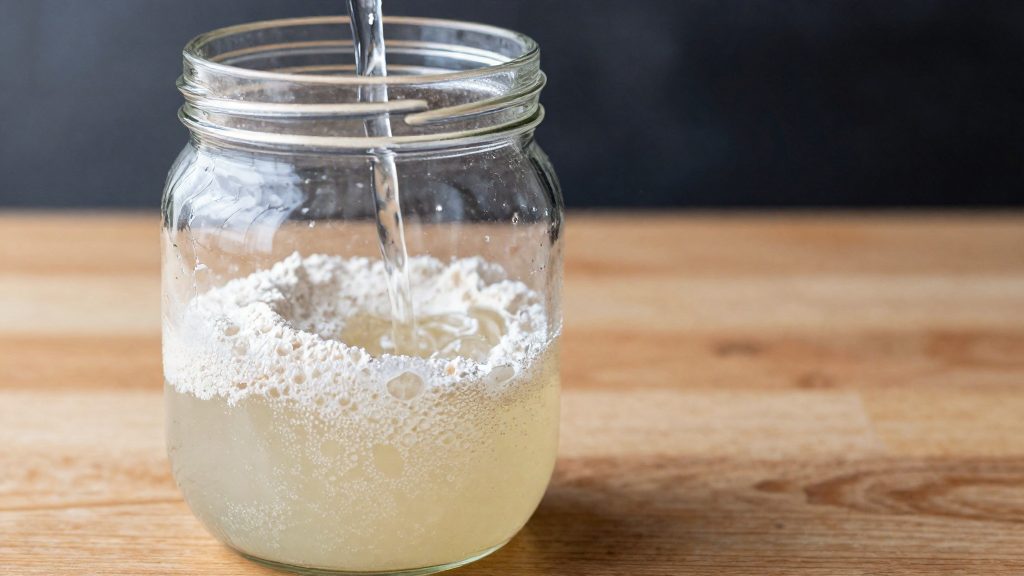
- Stir the rye starter into the warm water until no lumps remain.
- Add the whole rye flour and salt, then mix until no dry flour is visible.
- Cover the container and leave it at room temperature.
Timing and temperature decisions
The recipe gives a window of 12 to 24 hours and ties it to two variables: starter activity and room temperature. It does not assign a fixed time to either. A starter that is visibly active, with bubbles and a rise, will reach the point of readiness sooner than a sluggish one. In general, a warmer room speeds fermentation and a cooler room slows it, so the same levain can take noticeably different times in different kitchens.
Ingredients and ratios for a whole rye loaf
The final dough for this 100% rye sourdough uses 350 g of rye flour, 190 ml of water at about 40°C, 12.5 g of salt, and all of the levain. The levain itself is built from 350 g of whole rye flour, 350 ml of water at 50°C, 35 g of rye starter, and 3.5 g of salt. According to The Fresh Loaf (2026), the flour in the final dough can be type 1370 or whole rye.
| Ingredient | In the levain | In the final dough |
|---|---|---|
| Rye flour | 350 g | 350 g |
| Water | 350 ml at 50°C | 190 ml at about 40°C |
| Salt | 3.5 g | 12.5 g |
Baker’s percentages express every ingredient as a share of the flour weight, which is set at 100%. Using the figures above, the starter is 35 g on 350 g of levain flour, or 10%. The levain salt is 1% of that flour. Applying the same base to the author’s original values, 20% starter would be 70 g and 2% salt would be 7 g. These are calculations from the stated quantities, not figures from the source.
Across the whole dough, the formula contains 700 g of flour (350 g in the levain and 350 g in the final dough) and 540 ml of water. Treating 1 ml as 1 g, the overall hydration is about 77%. Total salt is 16 g, or about 2.3% of total flour.
Water temperature is the adjustable variable. The source states that the water temperature is set so the finished dough lands near 27°C, because the flour, the levain, and the room all add heat to the mix. In practice, take the dough temperature after mixing. If it is below 27°C, use warmer water next time; if it is above, use cooler water.
The author’s variant
The author uses 1% salt and 10% starter in the levain, instead of the original 2% and 20%. The source does not give a measured shelf life, so treat the author’s freshness claim as an observation.
Mixing, proofing and baking steps
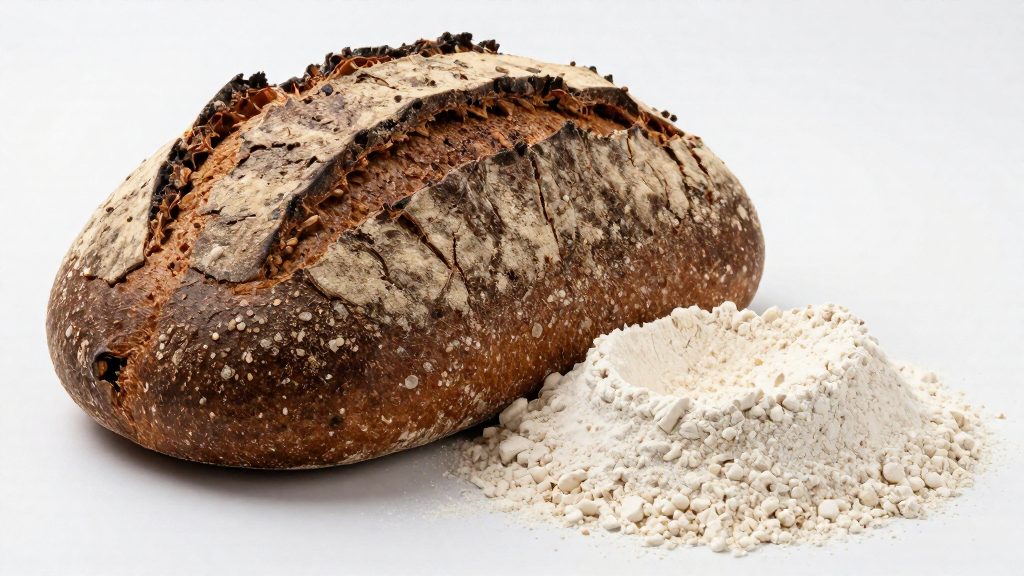
Once the final dough is mixed, the rest of the process runs as one timed sequence: a one-hour rest, shaping, a 75-minute proof, and a two-stage bake in which steam is used first and then released. The Fresh Loaf (2026) describes this sequence for a 100% rye sourdough. Keep to the order and timings, because rye dough behaves differently from wheat dough and skipping a stage changes the final loaf.
Mixing and the first rest
Combine the levain, flour and water, then mix only until no dry flour remains. A short, gentle mix is enough. Cover the dough and let it rest for one hour before shaping.
Shaping
With wet hands, gently shape the sticky dough into a round or oval. It will not tighten like wheat dough. Pinch the seams closed so the loaf keeps its form during proofing.
Proofing
Proof the shaped loaf for about 75 minutes. Rye dough rises less than wheat dough, so judge the proof by the dough’s gentle expansion and soft texture rather than by a large increase in volume.
Two-stage bake with steam
Preheat the oven and set up your steam method before the loaf goes in. Bake in two stages:
| Stage | Duration | Oven temperature | Steam |
|---|---|---|---|
| Initial bake | 10 minutes | 250°C | On |
| Final bake | About 45 minutes | 210°C | Released |
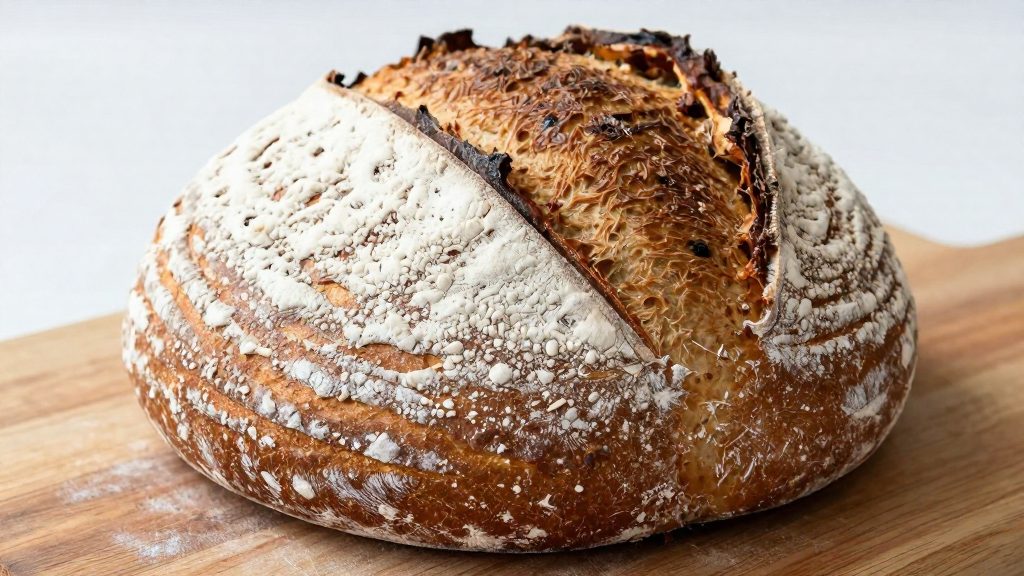
The early steam keeps the crust soft so the loaf can expand. Releasing it lets the crust dry and colour during the remaining bake.
Why is rye dough sticky and dense?
Rye dough is sticky for a different reason than wheat dough. Rye flour contains little gluten, so it cannot form the elastic network that holds water and gas in a loaf. Instead, rye carries pentosans, gum-like carbohydrates that absorb water and turn into a tacky, gel-like mass. Rye dough can feel wet and clingy even when the water quantity is correct, and it does not tighten when shaped the way wheat dough does.
Density has a separate cause, and it is linked to fermentation. Because rye dough builds less gas-holding structure, the timing of the proof matters more than in wheat baking:
- Underproofing leaves too little gas in the dough, so the crumb stays tight and heavy.
- Overproofing lets the dough lose the gas it has built, so the loaf can sink or develop a gummy, closed crumb.
The recipe from The Fresh Loaf (2026) proofs the shaped dough for about 75 minutes. Judge the dough by its appearance: it should look puffy and slightly risen, without large bubbles or a collapsing surface.
| Symptom | Likely cause | Handling fix |
|---|---|---|
| Tight, heavy crumb | Underproofing | Extend the proof until the dough looks puffy |
| Gummy crumb or sunken loaf | Overproofing | Shorten the proof and bake while the dough still springs back |
Wet-hand handling works because a thin film of water keeps the dough from sticking to your skin. Dampen your hands, use a bench scraper to lift and turn the dough, and avoid adding large amounts of flour, which changes the dough’s texture and can make the crumb dry.
How to store and slice rye bread
Rye bread is known for keeping well. The Fresh Loaf (2026) reports that this 100% rye sourdough stays fresh for a long time, and the storage and slicing steps below help protect that freshness.
Cooling before storage
Let the loaf cool completely on a wire rack before wrapping it. Trapped heat produces condensation, which softens the crust and can make the crumb gummy. A fully cooled loaf is also easier to store and to cut.
Wrapping and storing at room temperature
Three storage approaches are compared below, and they suit different goals:
| Method | How to do it | Effect on the loaf |
|---|---|---|
| Cloth or paper bag | Wrap loosely in a clean linen or cotton cloth, or keep in a paper bag | Crust stays firmer; moisture leaves gradually |
| Sealed container or bag | Close the bag or box | Crumb stays moister; crust softens over time |
| Refrigerator | Generally not recommended for everyday storage | Tends to dry the crumb faster |
Store the loaf cut side down on a board or in its wrap, so the exposed crumb does not dry out.
Slicing thickness and knife choice
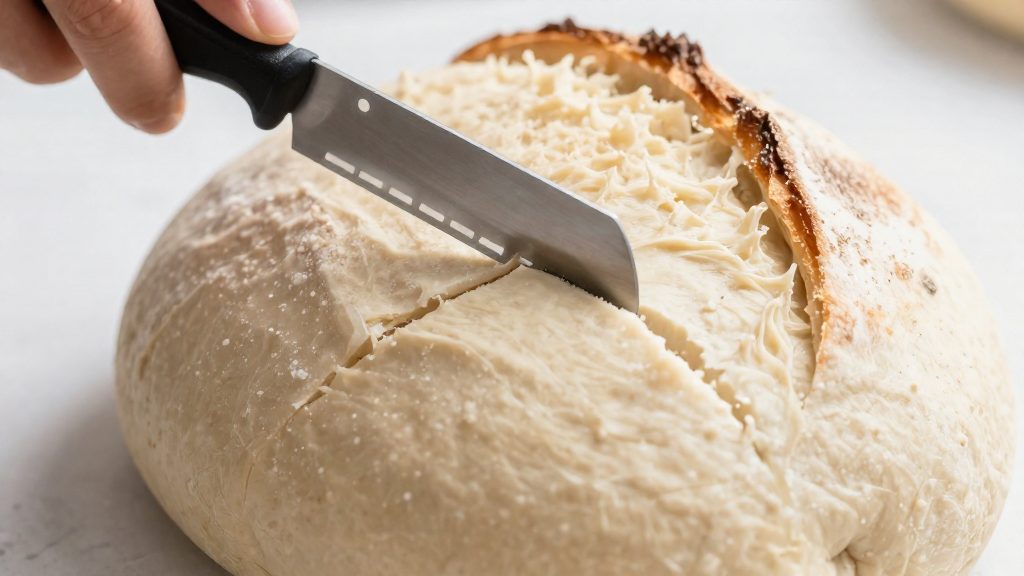
Dense rye crumb is firmer and more compact than white wheat bread, so thin to medium slices hold together best. Use a long serrated knife for a crisp crust, or a long, sharp, straight-edged knife for a smooth cut. Saw gently with long strokes rather than pressing down, which squashes the crumb. Wipe the blade between cuts to keep slices clean.
Frequently asked questions
How much levain does a 100% rye sourdough need, and how long does it rest?
The reference recipe builds a levain from 350 g whole rye flour, 350 ml water at 50°C, 35 g rye starter and 3.5 g salt. It rests 12 to 24 hours at room temperature, and the exact time depends on how active your starter is and how warm your kitchen is.
Can I use refined rye instead of whole rye for the final dough?
Yes. The final dough accepts either type 1370, a European ash-based rye flour, or whole rye. Whole rye gives a darker, earthier loaf that stays moist longer, while type 1370 produces a lighter crumb that dries out sooner.
What temperatures and times should I follow for baking?
After a 1-hour rest and about 75 minutes of proofing, the loaf bakes for 10 minutes at 250°C with steam, then for about 45 minutes at 210°C after the steam is released. Aim for a final dough temperature near 27°C, which you can reach by adjusting the water temperature.