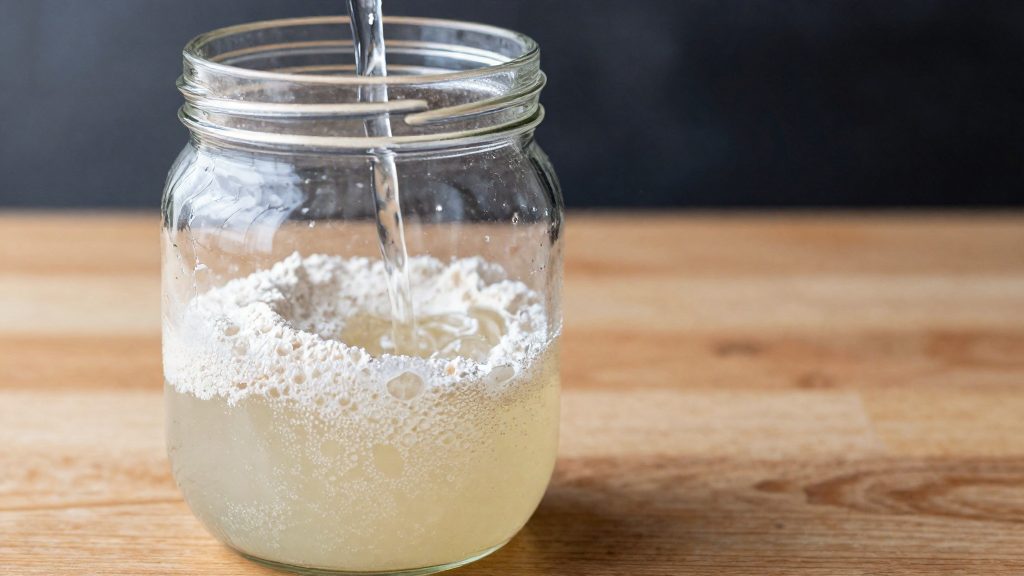
Feeding a sourdough starter at home takes only a clean jar, a kitchen scale, flour and water. According to King Arthur Baking (2024-10-02), the basic feeding uses equal parts starter, flour and water by weight: about 50g of starter (the rest is discarded), 50g of lukewarm water and 50g of unbleached all-purpose flour. The amounts are flexible, and a smaller version uses 20g of each.
What do you need to feed a sourdough starter at home?
Tools
- A kitchen scale. Food Republic (2025) advises measuring both flour and water by weight, not by volume.
- A clean jar with a loose lid. King Arthur Baking (2024-10-02) says to cover the starter without sealing it, for example with a loosely screwed jar lid.
Ingredients
- Unbleached all-purpose flour, the flour King Arthur Baking (2024-10-02) uses in its basic feeding.
- Lukewarm water. King Arthur Baking (2024-10-02) notes that tap water is fine.
Feeding ratios
| Feeding size | Starter | Water | Flour | Source |
|---|---|---|---|---|
| Standard | about 50g (the rest discarded) | 50g | 50g | King Arthur Baking (2024-10-02) |
| Small | 20g | 20g | 20g | King Arthur Baking (2024-10-02) |
Food Republic (2025) describes a related approach: discard about half the starter before each feeding, then add equal parts flour and water by weight.

What ratio of flour, water and starter should you use?
King Arthur Baking (2024-10-02) describes its basic feeding as a 1:1:1 ratio by weight, meaning equal parts starter, flour and water. King Arthur Baking (2024-10-02) describes its basic feeding as about 50g of starter, with the rest discarded, plus 50g of lukewarm water and 50g of unbleached all-purpose flour. The same page says these amounts are flexible and offers a smaller version using 20g of each.
Weigh each ingredient on a kitchen scale rather than measuring by volume, because the ratio only works when the weights match. Food Republic (2025) advises discarding about half the starter before each feeding, then adding equal parts flour and water by weight. Its guidance focuses on consistent proportions rather than fixed gram amounts.
The two approaches differ mainly in how much starter is kept:
- King Arthur, standard: 50g starter, 50g flour, 50g lukewarm water
- King Arthur, smaller: 20g starter, 20g flour, 20g water
- Food Republic: about half the starter discarded, then equal weights of flour and water (no gram amounts given)
Feeding frequency matters as much as the ratio. Food Republic aims for about 24 hours between feedings and accepts up to 30 hours. It warns that feeding too often can make the starter overly acidic, while feeding too slowly can leave it sluggish. King Arthur Baking (2024-10-02) states the starter is ready to bake about 8 hours after feeding, once it has doubled and is just starting to fall, though timing varies. Food Republic (2025) gives a broader activation window of 2 to 12 hours, depending on the starter’s health, where it is stored and the home’s temperature.
How Much Starter to Keep and How Much to Discard?
Feeding a sourdough starter means removing part of it and refreshing the remainder with fresh flour and water. The amount you keep sets the ratio of new food to old starter in each feeding. Published methods differ mainly in how much starter they keep and whether they measure by weight or by share of the jar.
King Arthur Baking (October 2, 2024) uses equal parts by weight: 50 g of starter kept with the rest discarded, then 50 g of lukewarm water and 50 g of unbleached all-purpose flour. The page says these amounts are flexible and gives a smaller version with 20 g of each ingredient. Food Republic (2025) instead advises discarding about half the starter before each feeding, then adding equal parts flour and water by weight.
| Method | Starter kept | Water | Flour |
|---|---|---|---|
| King Arthur Baking, basic | 50 g | 50 g, lukewarm | 50 g, unbleached all-purpose |
| King Arthur Baking, smaller version | 20 g | 20 g | 20 g |
| Food Republic (2025) | About half of the starter (the rest discarded) | Equal to flour, by weight | Equal to water, by weight |
The two approaches share one principle: the flour and water are matched to each other by weight.
Both sources measure by weight, so a kitchen scale is the most reliable way to repeat a feeding accurately. Once you have chosen a method, keep the same amounts from one feeding to the next so that changes in the starter’s behavior are easier to notice.
How often should you feed your sourdough starter?
The feeding interval depends on how often you bake. King Arthur Baking (2024-10-02) describes two common routines: regular bakers feed the starter daily at room temperature, while casual bakers can keep it in the refrigerator and feed it weekly. Food Republic (2025) gives its own guideline of about 24 hours between feedings, accepting up to 30 hours.
| Routine | Storage | Feeding interval | Source |
|---|---|---|---|
| Regular baking | Room temperature | Daily | King Arthur Baking (2024-10-02) |
| Occasional baking | Refrigerator | Weekly | King Arthur Baking (2024-10-02) |
| General guideline | Room temperature | About 24 hours, up to 30 hours | Food Republic (2025) |
Feeding too often or too rarely both cause problems. Food Republic (2025) warns that frequent feeding can make the starter overly acidic, while slow feeding can leave it sluggish.
Preparing a refrigerated starter for baking
To move a starter from the refrigerator back into use, follow King Arthur’s sequence:
- Feed the starter and let it sit at room temperature for a few hours before returning it to the refrigerator.
- Before baking, give it a couple of room-temperature feedings over a day or two.
- Use it once it has doubled and is just starting to fall. King Arthur notes that this takes about 8 hours after feeding, but timing varies.
Watching for activity
Food Republic (2025) reports that activation after a feeding can take 2 to 12 hours. The time depends on the starter’s health, where it is stored, and the room temperature. Judge readiness by the signs rather than the clock: the starter should be bubbly and have doubled in volume.
How to store the sourdough starter in the fridge?
Yes, a sourdough starter can be kept in the refrigerator, which slows its activity so it needs less frequent feeding. According to King Arthur Baking (2024-10-02), regular bakers feed their starter daily at room temperature, while casual bakers can keep it in the fridge and feed it once a week. The routine is to let the starter sit out for a few hours after a feeding, refrigerate it, and then give it a couple of room-temperature feedings a day or two before baking.
Storage routine
- Feed the starter at room temperature. Discard part of it, then add flour and water.
- Let it sit out for a few hours after feeding, as King Arthur Baking recommends, before placing it in the refrigerator.
- Keep the jar covered but not airtight. A loosely screwed lid works. King Arthur Baking advises against a kitchen towel, which can dry the starter out.
- Feed it weekly while it stays in the fridge.
- Revive it before baking with a couple of room-temperature feedings over a day or two.
Feeding and timing reference
| Routine | Timing | Source |
|---|---|---|
| Daily feeding for regular bakers | Every day at room temperature | King Arthur Baking (2024-10-02) |
| Casual baker keeping starter in the fridge | Once a week | King Arthur Baking (2024-10-02) |
| Target interval between feedings | About 24 hours, up to 30 hours | Food Republic (2025) |
| Activation after a feeding | 2 to 12 hours, depending on the starter’s health, storage and room temperature | Food Republic (2025) |
| Ready to bake | About 8 hours after feeding, once doubled and just starting to fall; timing varies | King Arthur Baking (2024-10-02) |
Food Republic (2025) defines readiness as the starter being bubbly and doubled in size. King Arthur Baking (2024-10-02) notes that the 8-hour mark is approximate, so the visual signs matter more than the clock.
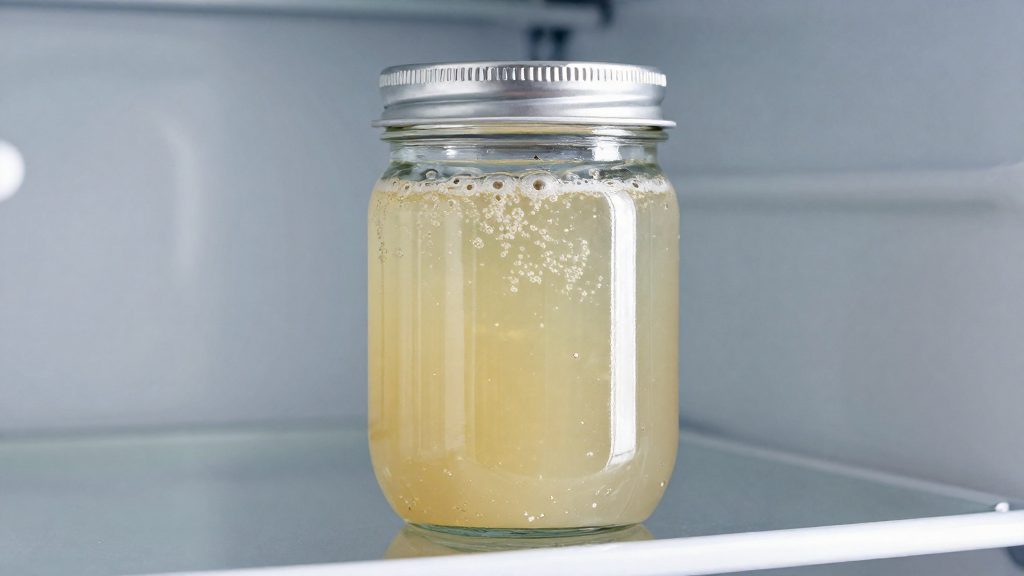
How do you know when the starter is ready to bake?
A starter is ready to bake when it has doubled in volume, is bubbly, and is just starting to fall back from its peak. According to King Arthur Baking (2024), this usually happens about 8 hours after feeding, but timing varies. Food Republic (2025) describes the same signs: the starter is ready when it is bubbly and has doubled. Use these visual cues rather than the clock alone, because timing varies with the starter’s health, where it is stored and the home’s temperature.
Visual signs to check
Compare the starter with its level right after feeding. Look for three things:
- Volume: the starter has roughly doubled.
- Bubbles: the surface and body are full of visible bubbles.
- Top: the surface has risen and is just beginning to sink.
To judge the rise more easily, you can mark the starting level on the jar with a rubber band or tape.
Timing benchmarks
| Stage | Timing | Source |
|---|---|---|
| Activation after feeding | 2 to 12 hours, depending on starter health, storage and home temperature | Food Republic (2025) |
| Peak, ready to bake | About 8 hours after feeding | King Arthur Baking (2024) |
| Room-temperature feedings before baking from the fridge | A couple of feedings over a day or two | King Arthur Baking (2024) |
Planning the bake
Work backward from your bake time. Because timing varies, feed the starter early enough that it has doubled and is just starting to fall when you plan to mix the dough. Keep the jar covered loosely during this period so it stays protected while gases can escape.
Which flour and water to choose?
A simple baseline uses plain flour and lukewarm tap water, both measured by weight. King Arthur Baking (2024) describes a basic feeding with equal parts starter, flour and water by weight, typically 50 g of starter, 50 g of lukewarm water and 50 g of unbleached all-purpose flour. The page notes that these amounts are flexible, and a smaller version uses 20 g of each. Food Republic (2025) follows the same logic, adding equal parts flour and water by weight, measured with a scale.
Unbleached all-purpose flour is the flour named in the King Arthur feeding. The consulted sources do not compare it with whole grain or rye flours, so they do not say how those would change the amounts or the timing. If you want to try them, start with a small feeding and compare how the starter rises.
Tap water is fine, according to King Arthur Baking (2024). The same source specifies lukewarm water in its feeding, so follow King Arthur’s instruction to use lukewarm water.
| Source | Starter | Flour | Water | Notes |
|---|---|---|---|---|
| King Arthur Baking (2024), basic feeding | 50 g | 50 g unbleached all-purpose | 50 g lukewarm | Amounts are flexible |
| King Arthur Baking (2024), smaller feeding | 20 g | 20 g | 20 g | Same equal-parts ratio |
| Food Republic (2025) | About half discarded before feeding | Equal weight to water | Equal weight to flour | Ratio is 1:1 by weight |
Keep the flour and water ratio equal by weight whichever amounts you choose. Changing the ratio is not covered in the consulted sources.
Common Mistakes to Avoid
Most feeding problems come from timing, measurement, the discard step, or how the jar is covered. The sources below flag these errors directly, and each one has a specific correction.
Feeding too often or too slowly
Food Republic (2025) aims for about 24 hours between feedings and accepts up to 30 hours. It warns that feeding too often can make the starter overly acidic, while feeding too slowly can leave it sluggish. If the starter seems weak, check the interval first. After a feeding, activation can take 2 to 12 hours, depending on the starter’s health, where it is stored and the home’s temperature.
Measuring by volume instead of weight
Both sources specify weight. Food Republic (2025) recommends equal parts flour and water by weight, measured with a scale. King Arthur Baking (October 2024) gives a basic feeding of 50 g starter, 50 g lukewarm water and 50 g unbleached all-purpose flour, and notes that the amounts are flexible.
| Version | Starter | Water | Flour |
|---|---|---|---|
| Basic | 50 g | 50 g, lukewarm | 50 g, unbleached all-purpose |
| Smaller | 20 g | 20 g | 20 g |
Keeping the full jar
The basic King Arthur Baking (October 2024) feeding discards the rest of the starter and keeps only 50 g. Food Republic (2025) advises discarding about half the starter before each feeding. Both sources discard part of the starter before feeding. King Arthur Baking (October 2024) then matches the flour and water to the 50 g of starter kept. Food Republic (2025) only specifies that the flour and water are equal to each other by weight.
Judging readiness by the clock alone
King Arthur Baking (October 2024) says the starter is ready to bake about 8 hours after feeding, once it has doubled and is just starting to fall, but timing varies. Food Republic (2025) describes the same signs: bubbly and doubled. Use these visual signs rather than the clock to decide when to bake.
Skipping the warm-up before baking
Regular bakers feed the starter daily at room temperature. Casual bakers can keep it in the fridge and feed it weekly. King Arthur Baking (October 2024) advises letting a refrigerated starter sit out a few hours after feeding before returning it to the fridge. Before baking, give it a couple of room-temperature feedings over a day or two. Going straight from the fridge to the dough skips this step.
Frequently asked questions
How much starter should you keep when feeding it?
According to King Arthur Baking (2024-10-02), the basic feeding is a 1:1:1 ratio by weight: about 50g of starter kept (the rest discarded), plus 50g of lukewarm water and 50g of unbleached all-purpose flour, with a smaller version using 20g of each. Food Republic (2025) takes a different route, discarding about half the starter and adding equal parts flour and water by weight, without giving gram amounts.
How often should you feed a sourdough starter, and can it go in the fridge?
Regular bakers feed their starter daily at room temperature, while casual bakers can refrigerate it and feed it weekly, letting it sit out for a few hours after feeding first. Before baking, King Arthur Baking (2024-10-02) suggests a couple of room-temperature feedings over a day or two. Food Republic (2025) aims for about 24 hours between feedings and accepts up to 30, warning that feeding too often can make the starter overly acidic.
How do you tell when the starter is ready to use?
According to King Arthur Baking (2024-10-02), the starter is ready about 8 hours after feeding, once it has doubled and is just starting to fall, although timing varies. Food Republic (2025) gives a wider activation window of 2 to 12 hours, depending on the starter’s health, storage and the home’s temperature, and says it is ready when it is bubbly and has doubled.