Why use olive oil in focaccia?
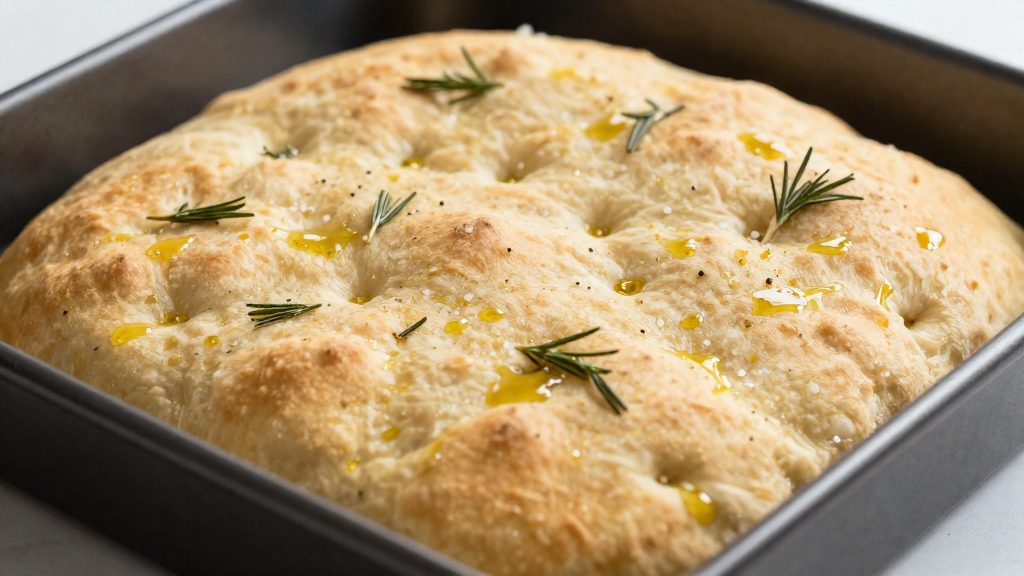
Olive oil does three jobs in focaccia: it carries flavour, it shapes the texture of the crumb, and it helps the surface brown. Love & Lemons (2024-10-09) specifies extra-virgin olive oil, and both it and Once Upon a Chef (2026-04-16) spread the oil across several stages of the recipe rather than adding it all at once. Because the dough contains few ingredients, the oil you choose has a large effect on the finished bread.
Flavour contribution
Extra-virgin olive oil is the main source of flavour in a plain focaccia. Its fruity and peppery notes stay in the bread after baking, so the taste of the loaf depends partly on the oil. Neutral oils add richness without much character, so the bread tastes of olive oil only when olive oil is used.
Effect on crumb and moisture
Oil coats the gluten strands as the dough is mixed and rests, which makes the dough easier to stretch and tends to give the crumb a softer, more tender bite. Oil also slows the loss of moisture from the interior, so the crumb stays softer than it would from a dough made without fat. Both effects come from general baking principles, not from measured results in the sources consulted.
Why the base turns golden
Oil in the pan fries the underside of the dough as it bakes, which browns the base. Oil brushed or dimpled onto the surface helps the top colour evenly. Once Upon a Chef bakes its focaccia at 425°F (220°C) for about 20 minutes, and the oil and this high heat together brown the surface.
| Where the oil goes | What it contributes |
|---|---|
| In the bowl | Coats the dough during the first rise |
| In the pan | Fries the base as it bakes |
| On top | Helps the surface brown and adds flavour |
Ingredients for homemade focaccia
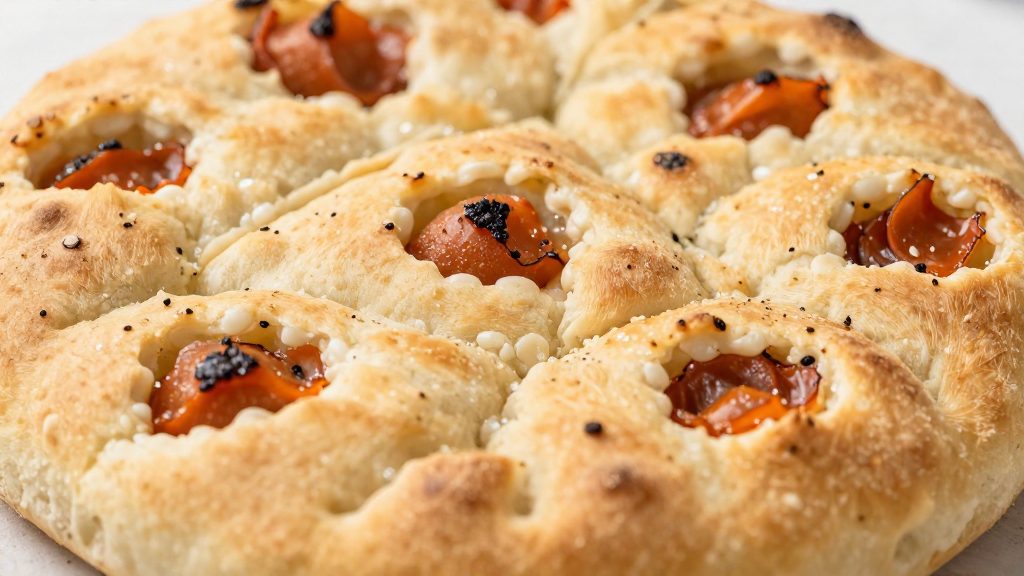
A basic focaccia dough needs three structural ingredients, flour, water and yeast, plus salt for flavour and dough control. Two recipes in the consulted sources give the same base. Love & Lemons (2024-10-09) uses 500 g of all-purpose flour, 1¾ cups of warm water and 2¼ tsp of active dry yeast. Once Upon a Chef (2026-04-16) uses 5 cups of flour and 1¾ cups of warm water. Once Upon a Chef’s quantities are sized for a 13x18 in rimmed sheet pan.
Flour, water and yeast for one tray
| Ingredient | Love & Lemons (2024-10-09) | Once Upon a Chef (2026-04-16) |
|---|---|---|
| Flour | 500 g all-purpose flour | 5 cups flour |
| Water | 1¾ cups warm water | 1¾ cups warm water |
| Yeast | 2¼ tsp active dry yeast | Not specified in the sources consulted |
The two sources give flour differently: one by weight, the other by volume. Volume measures vary with how tightly flour is packed, so the weight version is the more reliable reference. The sources consulted do not give a weight for the water, so measure it by volume as written.
Active dry or instant yeast
The Love & Lemons recipe specifies active dry yeast. Active dry yeast is usually dissolved in the warm water before the flour is added, so the granules hydrate and start working. Instant yeast is typically mixed directly into the flour. Both types are used for focaccia, but the sources consulted do not state a quantity conversion between them, so if you swap one for the other, follow the packet’s guidance rather than assuming a one-to-one replacement.
Why salt is added to the dough
Salt is part of the dough even though the two sources consulted do not give an amount for it. In bread dough, salt does three jobs:
- Flavour: Unsalted focaccia tastes flat, because salt brings out the flavour of the flour and olive oil.
- Yeast control: Salt slows fermentation. Without it, the dough can rise too fast and taste yeasty.
- Gluten structure: Salt tightens the gluten network, which helps the dough hold the gas produced during rising.
Add salt to the flour rather than directly onto the yeast or the water. Mixing it into the dry ingredients first spreads it evenly through the dough.
How to make olive oil focaccia step by step
This section follows the dough from mixing to its final rise. Love & Lemons (2024) gives the timings and water temperature for the method, so the steps below use those figures. Each stage builds on the one before it, so keep the dough warm and covered throughout.
Step 1: Mix the dough at the right water temperature
Start by setting the water temperature. Love & Lemons (2024) specifies 105–115°F (about 41–46°C) for the water. Water in this range is warm enough to activate the active dry yeast without risking the yeast being damaged. Stir the active dry yeast into the warm water, add the flour, then mix until the dough comes together into a shaggy, sticky mass.
Step 2: Complete the first rise
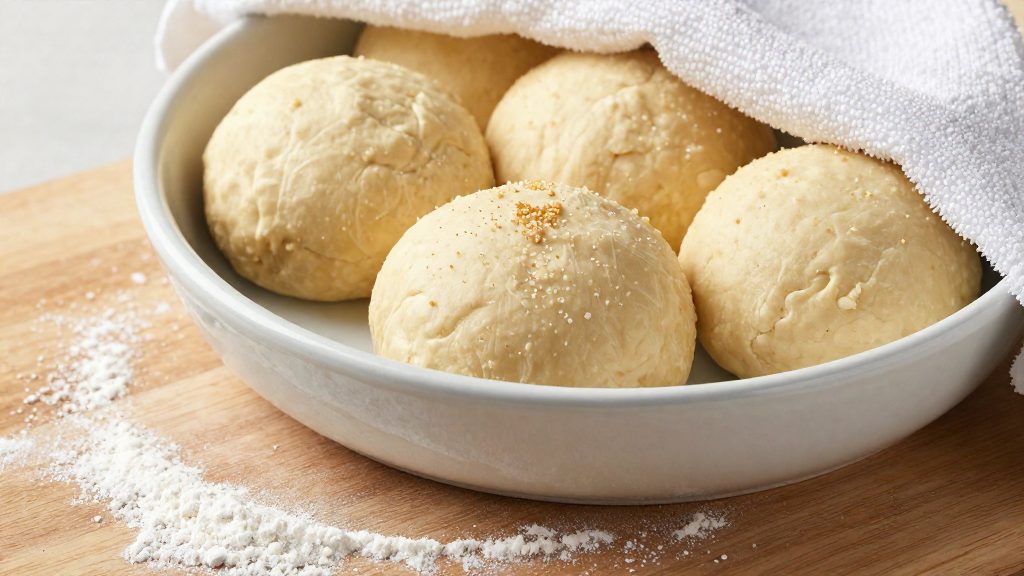
Once the dough is mixed, cover the bowl and leave it in a warm spot. Love & Lemons (2024) gives a first rise of 1 to 1.5 hours. The dough is ready when it has visibly expanded and feels airy and springy. Plan around this window, since a cooler kitchen will lengthen the rise toward the upper end.
Step 3: Shape the dough and complete the second rise
After the first rise, transfer the dough to your baking pan and gently spread it to fill the pan. Cover it again and let it rest for the second rise, which Love & Lemons (2024) gives as about 45 minutes. This second rest relaxes the gluten so the dough spreads evenly and develops an open crumb during baking.
Timing overview
| Stage | Timing | What to look for |
|---|---|---|
| Water temperature | 105–115°F (Love & Lemons, 2024) | Reading of 105–115°F (about 41–46°C) on a thermometer |
| First rise | 1–1.5 hours | Dough visibly expanded and airy |
| Second rise | About 45 minutes | Dough filling the pan and soft to the touch |
The official sources consulted do not specify an exact dough temperature after mixing, so use the visual and textural checks above as your guide.
How much olive oil should you use?
Two published focaccia recipes divide their olive oil very differently. According to Love & Lemons (2024-10-09), the recipe uses 6 tablespoons of extra-virgin olive oil in total, which is 3/8 cup. According to Once Upon a Chef (2026-04-16), the recipe uses ¾ cup, which is 12 tablespoons, twice the Love & Lemons amount. Both recipes spread the oil across the dough, the pan and the topping, but they measure each stage differently.
Love & Lemons uses the same measure at every stage: 2 tablespoons in the bowl, 2 tablespoons in the pan and 2 tablespoons on top. Because each stage gets an equal share, the bowl oil coats the dough before its first rise, and the pan oil and topping oil are measured separately from the dough.
Once Upon a Chef puts most of its oil into the dough. It uses ½ cup in the dough and ¼ cup in the pan, and it adds extra oil for the bowl and the topping. The source does not state how much that extra oil amounts to, so the stated ¾ cup total cannot be broken down fully.
Comparing the oil by stage
| Recipe | Total olive oil | Breakdown by stage |
|---|---|---|
| Love & Lemons (2024-10-09) | 6 tablespoons (3/8 cup) | 2 tablespoons bowl, 2 tablespoons pan, 2 tablespoons topping |
| Once Upon a Chef (2026-04-16) | ¾ cup (12 tablespoons) | ½ cup dough, ¼ cup pan, extra for bowl and topping (amount not stated) |
The dough amounts show the largest gap. Once Upon a Chef’s ½ cup in the dough (8 tablespoons) is more than Love & Lemons’ entire 6-tablespoon total. In the pan, the difference is 2 tablespoons versus ¼ cup (4 tablespoons).
Which flour works best for focaccia?
Flour choice matters mainly because of protein content. Protein forms the gluten network that traps gas and gives the crumb its structure and chew. Love & Lemons (2024) uses all-purpose flour, 500 g per batch, which has a moderate protein level. Bread flour contains more protein, so it builds a stronger gluten network and usually gives a chewier, more open crumb. The official sources consulted do not give protein percentages for either flour, so the comparison here stays qualitative.
How protein affects chew and structure
Higher-protein flour develops more gluten, which supports larger air pockets and a firmer, springier texture. Lower-protein flour yields a softer, more tender crumb with less pull. For a focaccia that should be light and open, the extra gluten in bread flour is an advantage. For a softer, more cake-like bite, all-purpose flour is the more forgiving choice.
Water absorption differences
Higher-protein flours generally absorb more water, so the same amount of liquid can feel stiffer in bread flour than in all-purpose flour. Love & Lemons (2024) and Once Upon a Chef (2026) both call for 1¾ cups warm water, but they measure flour differently: 500 g in one recipe and 5 cups in the other. Because the flour measures are not comparable, a precise hydration ratio cannot be calculated for either recipe.
| Recipe | Flour | Flour quantity | Water |
|---|---|---|---|
| Love & Lemons (2024) | All-purpose | 500 g | 1¾ cups warm water (105–115°F) |
| Once Upon a Chef (2026) | Type not stated | 5 cups | 1¾ cups warm water |
Switching flours
When substituting bread flour for all-purpose, hold back a small portion of the water at first and add it gradually, checking the dough’s texture as you mix. Expect a slightly firmer dough and a chewier result.
How do you get crispy edges and a dimpled top?
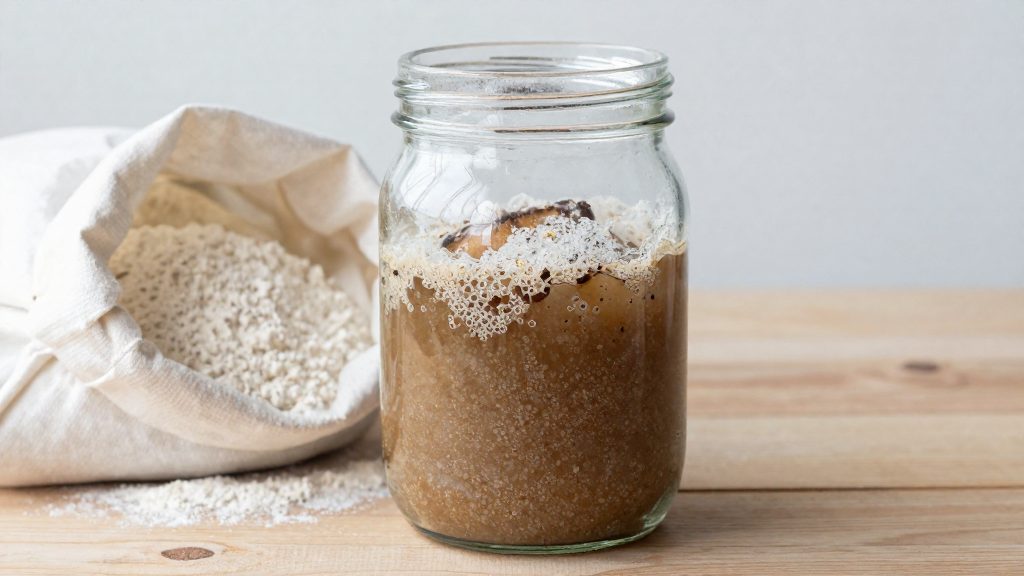
Crispy edges and a dimpled, glossy top come from three steps done once the dough is in the pan: dimpling the surface, letting pooled oil collect in the dents, and finishing with flaky sea salt. Each step does a different job. The dimples give the bread its texture, the oil crisps the base of each dent and the rim, and the salt adds seasoning and a crunchy contrast.
Pressing the dimples
Dimpling means pressing your fingertips straight down into the dough, spacing the marks evenly across the whole surface. Press until your fingers nearly reach the bottom of the pan. Shallow marks tend to close as the dough rises and bakes, while deeper ones hold their shape. Keep your fingers flat-tipped and move steadily so you do not tear the dough, and avoid pressing so hard that the surface sticks to the pan.
Pooling oil before baking
Once the dimples are formed, drizzle olive oil over the surface so it settles into each well. Oil that pools there fries the base of every dent as it bakes, which produces the golden, slightly crisp pockets typical of focaccia and a glossy finish across the top. Oil also collects along the edges of the pan, which helps the rim brown and crisp.
Love & Lemons (2024) uses 2 tbsp of extra-virgin olive oil on top of its focaccia, which is a useful reference for a single drizzle. Spread it evenly, then gently nudge any oil sitting on the flat surface into the dimples so it pools there.
Finishing with flaky sea salt
Scatter flaky sea salt over the oiled surface just before the pan goes into the oven. Flakes adhere to the oil, so applying them right after the drizzle keeps them in place. Flakes that land on the dough sit on top and stay distinct, rather than dissolving into the crumb the way fine salt does. Sprinkle lightly and evenly; a sparse distribution leaves the surface seasoned without clumps of salt on the crust.
Baking temperature and pan choice
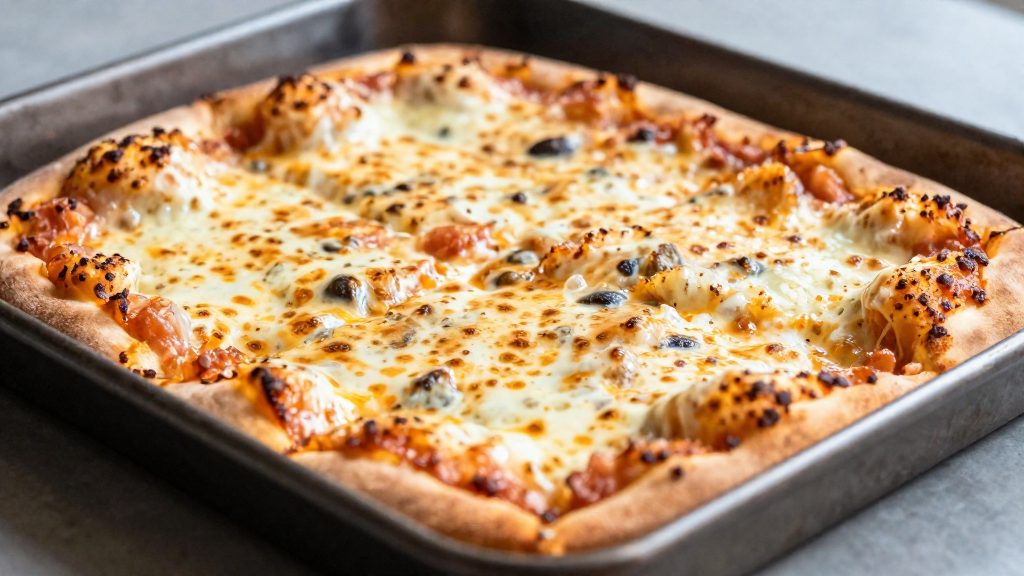
Bake focaccia at 425°F (220°C). Love & Lemons bakes at 425°F for 20–30 minutes (Love & Lemons, 2024-10-09), and Once Upon a Chef uses the same temperature for about 20 minutes in a 13x18 inch rimmed sheet pan (Once Upon a Chef, 2026-04-16). Both recipes use the same heat, so the difference lies mainly in the bake time.
Settings from Once Upon a Chef
| Setting | Value |
|---|---|
| Oven temperature | 425°F (220°C) |
| Bake time | About 20 minutes |
| Pan | 13x18 inch rimmed sheet pan |
Once Upon a Chef gives the Celsius value directly, so it is the clearest reference for metric ovens. Love & Lemons gives only Fahrenheit, and its temperature converts to the same 220°C.
Bake time window
Love & Lemons allows a window of 20–30 minutes, while Once Upon a Chef gives about 20 minutes. Start checking at the shorter end of the window, and extend the bake only if the top has not yet browned. Because both sources use 425°F, changing the time is the main adjustment, not the heat.
Pan size and metric conversion
The sources consulted give the pan size in inches only (13x18 in, roughly 33x46 cm), so measure your sheet pan before following either recipe. The 13x18 inch rimmed sheet pan is the size named by Once Upon a Chef. If your oven is marked in Celsius, set it to 220°C and use the same 20–30 minute range. The sources consulted do not specify a rack position.
How to store and reheat focaccia?
Leftover focaccia can be kept at room temperature for a few days or frozen for longer storage. Love & Lemons (2024-10-09) states that baked focaccia keeps up to 3 days at room temperature in an airtight container and recommends freezing for longer storage. Once Upon a Chef (2026-04-16) notes that focaccia is best eaten the day it is made, so storage mainly helps you enjoy the bread on later days without losing too much quality.
Storage options compared
| Method | Duration | Source |
|---|---|---|
| Room temperature, airtight container | Up to 3 days | Love & Lemons (2024-10-09) |
| Freezer | Up to 3 months | Once Upon a Chef (2026-04-16) |
Room-temperature storage
Let the focaccia cool fully before you seal it. Warm bread sealed in a container traps steam, which makes the top soft and sticky. Keep the loaf in an airtight container and store it in a cool place away from direct sunlight. Use it within 3 days.
Freezing for up to 3 months
Freezing suits focaccia you will not finish within the 3-day window. Cut the cooled bread into portions so you can thaw only what you need. Wrap each portion tightly, label it with the date, and place it in the freezer. Once Upon a Chef (2026-04-16) states that focaccia can be frozen for up to 3 months. The official sources consulted do not specify a wrapping method, so any sealed wrap that keeps out air will work.
Reheating at 350°F (175°C)
Once Upon a Chef (2026-04-16) recommends reheating focaccia at 350°F (175°C). The official sources consulted do not give a reheating time, so check the bread rather than following a fixed duration. It is ready when the centre is warm and the outside is crisp again. Reheat portions in a single layer so the heat reaches them evenly.
Frequently asked questions
Can I use a different oil, or less of it, in my focaccia?
Love & Lemons (2024-10-09) calls for extra-virgin olive oil, while Once Upon a Chef (2026-04-16) names only olive oil. The official sources consulted do not specify how a substitute oil or a smaller amount changes the result.
How long does focaccia keep, and can I freeze it?
Love & Lemons (2024-10-09) says the baked bread keeps up to 3 days at room temperature in an airtight container and recommends freezing for longer storage. Once Upon a Chef (2026-04-16) advises eating it the day it is made, and notes it can be frozen for up to 3 months and reheated at 350°F (175°C).
What size pan do I need?
Once Upon a Chef (2026-04-16) bakes its focaccia in a 13x18 in (about 33x46 cm) rimmed sheet pan. The official sources consulted do not specify a pan size for the Love & Lemons recipe.