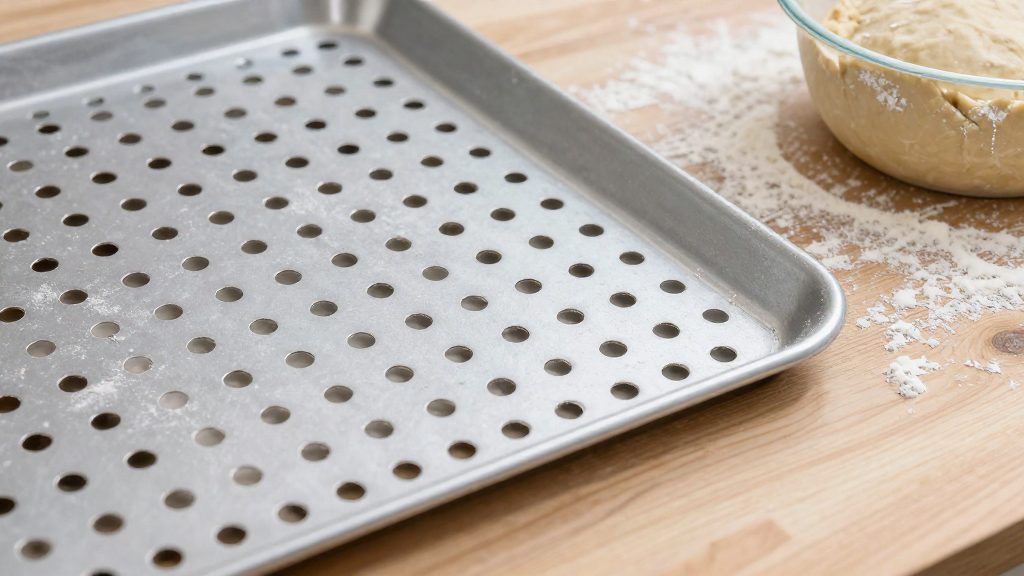
Perforated vs solid pizza pan: the key difference
A solid pizza pan has a continuous, unbroken base, while a perforated pizza pan has the same rim and body with holes punched through its base. This difference in construction determines how the dough sits on the metal. According to Foodservice Equipment Reports (2021), solid pans suit pan-style dough and typically produce a softer, chewier crust, while perforated pans produce a crispier crust, and the more perforations a pan has, the crispier the result.
Construction: solid base versus base with holes
A solid pan is one piece of metal with no openings in the base, so the dough rests on a continuous surface across its full diameter. A perforated pan keeps the same shape but the base is pierced with holes, so the dough rests on the metal between the holes and is not supported over them.
Solid pans and pan-style dough
Solid pans traditionally suit pan-style dough, which is pressed or proofed directly in the pan and then baked in it. Because the base is uninterrupted, the dough keeps its shape as a single sheet. If you want a thick, tender base with a chewy interior, a solid pan matches that goal.
Dough styles matched to each pan type
| Feature | Solid pizza pan | Perforated pizza pan |
|---|---|---|
| Base construction | One continuous, unbroken surface | Base pierced with holes |
| Traditional dough match | Pan-style dough | Not stated |
| Reported crust texture | Softer, chewier | Crispier |
| Commercial oven use | Not stated | Conveyor ovens |
For a quick decision, match the pan to the texture you want. Choose a perforated pan when a crispier base is the priority.
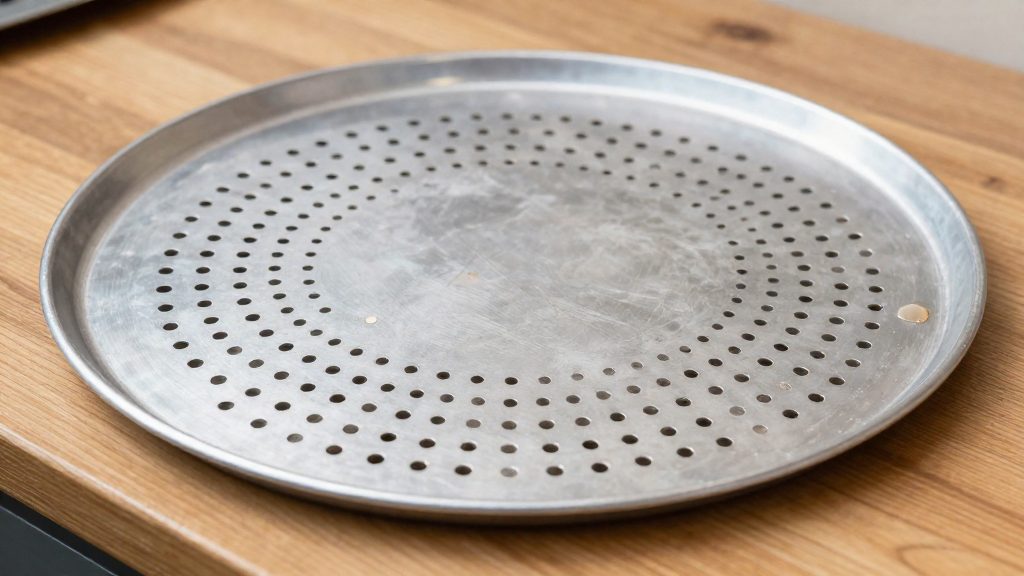
Why do holes make a crispier crust?
Perforated pans change how the base of the dough cooks. In a perforated pan, the holes increase airflow beneath the dough, whereas a solid pan has no openings for air to pass through. According to Foodservice Equipment Reports (2021), perforations increase airflow, which gives a crispier crust.
The source states only that perforations increase airflow, which gives a crispier crust. A plausible explanation is that air reaching the underside of the dough helps it dry and firm up, but the source does not detail this mechanism. The source states that the more perforations a pan has, the crispier the result. It does not compare the effect of hole count with that of hole size.
The source only says that more perforations give a crispier crust. As a practical way to compare pans, you can estimate perforation density against the pan’s surface area:
- Count the perforations across the whole base, not just the centre.
- Measure the base’s internal dimensions. For a rectangular pan, multiply length by width (in cm or inches). For a round pan, multiply π by the radius squared (same unit).
- Divide the hole count by the base area to get holes per square unit.
A higher result indicates more openings for the same footprint. Based on the source’s statement that more perforations give a crispier crust, this suggests a crispier base, though the source does not test density itself. This comparison only tells you about perforation density. It does not account for dough, oven temperature, or how long the pizza bakes, so use it as one factor among several when choosing a pan.
When is a solid pan the better choice?
A solid pan is the better choice when a soft, tender crust matters more than maximum crispness. Perforated pans work the other way.
The second case involves dough that is shaped in advance. The same source notes that perforations can let pre-prepped dough sag through the holes. A soft dough pressed into the pan ahead of time can droop into the openings, which distorts the base before it reaches the oven. The source suggests two remedies: switch to a solid pan, or choose a pan with a smaller hole pattern.
| Situation | Better pan | Reason given in the source |
|---|---|---|
| Pre-prepped dough that may sag | Solid, or a smaller hole pattern | Perforations can let pre-prepped dough sag through the holes |
To decide in practice:
- If you shape the dough ahead of time, press it into the pan and check whether it dips toward the holes before baking.
- If it sags, change pans rather than adjusting the dough alone.
- When comparing pans, use the same recipe for both so the difference in crust comes from the pan.
Which pan suits your oven and pizza style?
Pan choice depends on the oven and the crust you want. The same source links perforated pans to a specific oven design, the conveyor oven, so pan type, oven design and target crust are best considered together.
Matching the pan to the oven
Perforated pans work well in commercial conveyor ovens, where air circulates around the pan, but they are less suited to deck ovens, which lack airflow beneath the pan. Solid pans have no holes, so they do not depend on that airflow to shape the base. Choose the pan after you know which oven you are baking in, because the same pan can perform differently depending on the airflow it receives.
| Target crust | Pan type | Oven context |
|---|---|---|
| Crispier crust | Perforated | Works well in conveyor ovens |
Matching the pan to thin crisp or thick soft crust
Start from the crust you want. Solid pans lean toward a softer, chewier texture, so they fit a thicker, soft-centred pan pizza. Perforated pans push the base toward crispness, so they fit a thin, crisp style. The source does not give dough thickness figures, so judge the result by texture and bite rather than by a measurement.
Does the pan material matter?
Yes. The metal and surface finish of a pizza pan affect how durable it is and how evenly the crust bakes. Most pizza pans are aluminum. According to Foodservice Equipment Reports (2021), aluminum pans typically range from 14 to 20 gauge, and gauge works in reverse: the lower the number, the thicker the metal.
Gauge and durability
A lower gauge means a thicker pan, and thicker pans are more durable. The table below shows how the range is usually read.
| Gauge | Relative thickness | Durability |
|---|---|---|
| 14 | Thicker | Higher |
| 20 | Thinner | Lower |
The source gives no exact millimetre values or lifespan figures. A thicker pan is more durable, according to the source. Thicker pans may also be heavier to handle, though the source does not say so.
Dark hard-coat anodized finish and bake speed
Foodservice Equipment Reports (2021) states that dark hard-coat anodized pans bake faster and more evenly than other finishes. The source does not explain why. For a home baker, a dark anodized pan may suit even browning, but check the crust early on the first bake, since the source concerns commercial use.
How do you season and clean each pan?
Anodized aluminum pans are porous, so they need seasoning before their first use. According to Foodservice Equipment Reports (Beth Panitz, 2021-08-02), oiling and heating the pan several times creates a stick-resistant barrier. One likely explanation is that oil settles into the surface pores and, after repeated heating, bonds to the metal.
The process is simple but needs patience:
- Wash the new pan with warm water and mild dish soap, then dry it completely.
- Apply a thin layer of oil over the cooking surface, including the sides. Too much oil pools and leaves a sticky film, so wipe off any excess.
- Heat the pan in the oven until the oil is hot, then let it cool.
- Repeat steps 2 and 3 several times.
Once the pan is seasoned, the surface needs care to keep it that way.
Cleaning routine that protects the seasoned surface
The seasoned layer is the part you want to protect. After each bake:
- Let the pan cool before washing, so the surface does not shock or warp.
- Remove food residue with a soft sponge and warm water. Avoid scouring pads, which wear away the oiled layer.
- Dry the pan fully to prevent water spots and corrosion.
- Wipe on a light coat of oil before storing, then store the pan dry.
Follow the manufacturer’s instructions for your model for exact cleaning products and intervals, where they are available.
Can you use a perforated pan on a home oven rack?
A perforated pan can be used in a home oven, but the available sources only cover commercial equipment. According to Foodservice Equipment Reports (2021), airflow beneath the dough is what drives the difference: perforations increase airflow and produce a crispier crust. Whether this effect carries over to a domestic oven is not established by that source, so the result should be tested rather than assumed.
How home oven airflow differs from commercial equipment
A home oven should be treated as an untested environment for perforated pans.
Rack position and sizing for home ovens
A workable approach is to choose the rack position and keep it fixed for every test. Check that the pan sits fully inside the oven cavity, clears the walls and the door, and leaves space above and around it for hot air to move. Record the rack number so that any difference in the bake can be traced to the pan type and not to its position.
Testing a perforated pan against a solid pan
To compare the two pans directly:
- Divide one batch of dough into two portions of the same weight.
- Bake each portion at the same preheat setting and for the same time.
- Compare the base of each pizza.