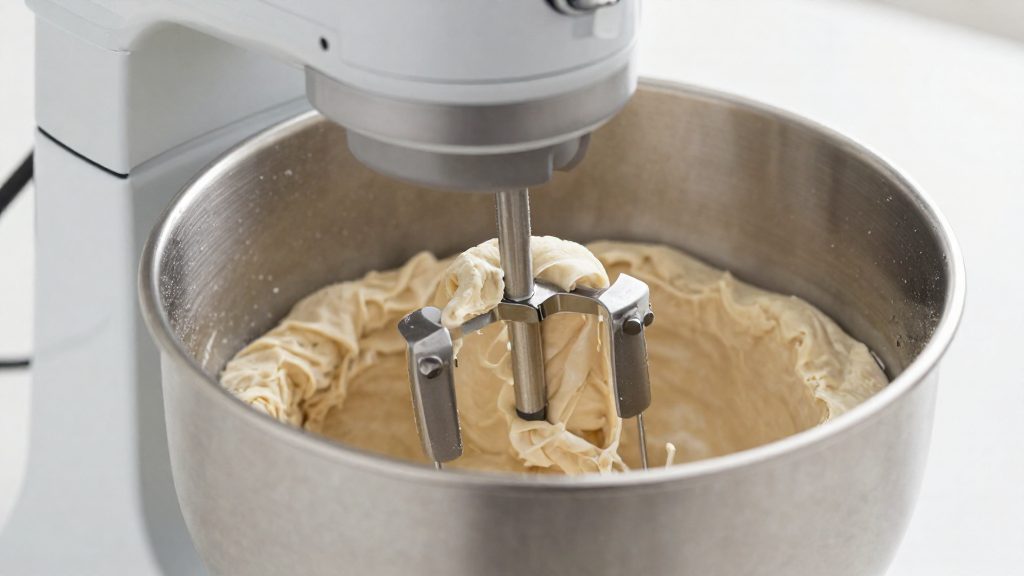
A hand mixer is a handheld motor unit with detachable beaters that you hold and move through a bowl. A stand mixer is a motorised base that holds the bowl and drives attachments from above, usually without the user holding the tool. Both use an electric motor to turn their tools, so the core difference is who supports and guides the tool: the user, or the machine’s fixed frame. This design gap defines the two categories before any judgement about pizza dough.
Hand mixer or stand mixer: what is the difference?
Hand mixer design
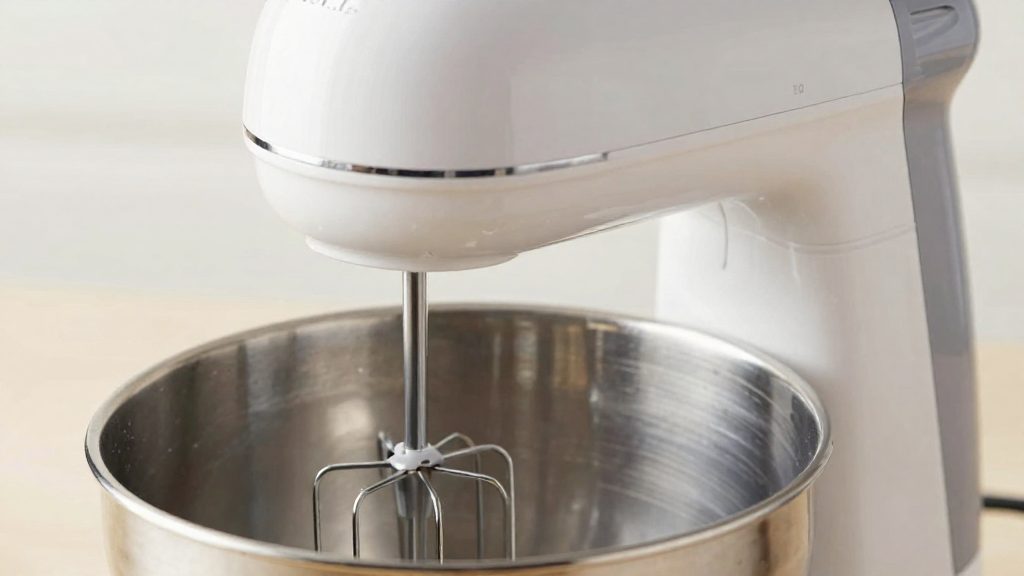
A hand mixer combines a motor and gearing in one housing with a grip and a speed control. Its beaters are detachable metal attachments that fit into the body. The bowl is separate and sits on the counter or is held by hand, so the user positions the tool and moves it around the bowl throughout the job.
Stand mixer design
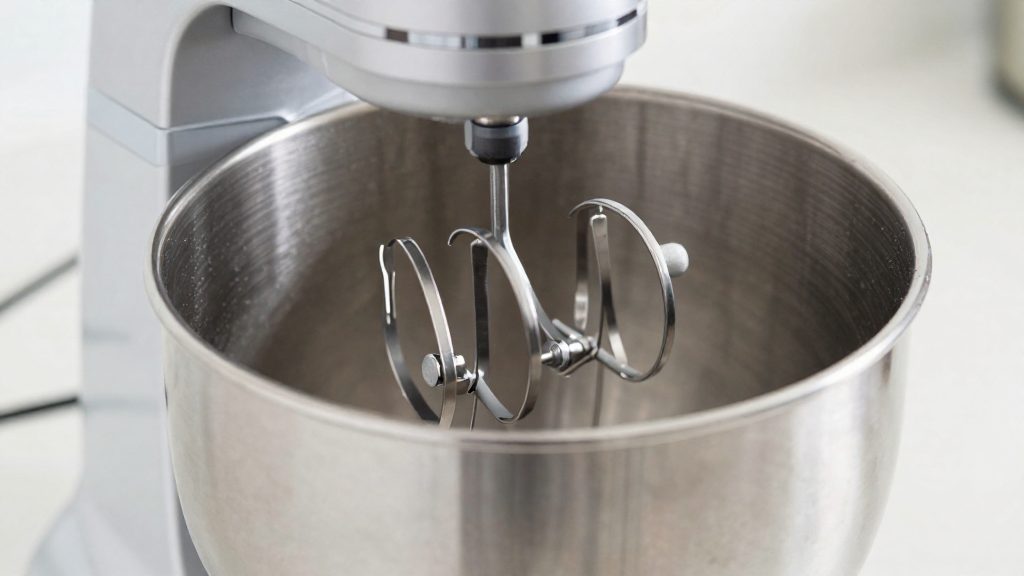
A stand mixer places the motor in a fixed base. The bowl locks onto or sits on that base, and the attachment is lowered into the bowl and driven by the motor. Common attachments include a flat beater, a whisk, and a dough hook. Stand mixers typically use a planetary action, where the attachment spins on its own axis while it travels around the bowl. Spiral mixers are a different machine type, in which the bowl turns against a fixed spiral hook. Because the frame carries the weight and movement, the operator can leave the machine running and step away.
Typical categories sold by brands
Brands such as KitchenAid and Breville are commonly named when shoppers compare these two appliance types. Stand mixers are generally grouped by their head and bowl arrangement, while hand mixers are grouped by their handheld form.
| Feature | Hand mixer | Stand mixer |
|---|---|---|
| Motor location | Inside the handheld body | Inside a fixed base |
| Tool held by | User | Machine frame |
| Bowl | Separate, moved or held by user | Locks onto or rests on the base |
| Hands-free operation | No | Yes |
| Typical attachments | Detachable beaters | Beater, whisk, dough hook |
Can a hand mixer knead pizza dough?
A hand mixer can handle small batches of pizza dough, but it is built for lighter mixing tasks, so its limits show up quickly with stiff, low-hydration dough. A hand mixer does not offer the same fixed, sustained kneading motion, so results depend heavily on the attachment and the dough.
Beaters: wire whisks versus dough hooks
Hand mixers usually come with wire beaters, and some models also include dough hooks. Only the hooks are suited to dough:
- Standard wire beaters are designed for aerating, whipping cream, and beating eggs. They cut through soft mixtures but do not knead. With stiff pizza dough they tend to wrap the dough around the wires and bring little real development.
- Dough hooks are the attachment meant for kneading. The curved hook pulls the dough over itself, which is what develops gluten. Use only the dough hooks for pizza dough, and never the whisks.
If your hand mixer has no dough hook, it is not a good choice for kneading pizza dough.
Stall risk with stiff, low-hydration dough
A stall happens when the dough is too stiff for the motor and the attachment, so the mixer strains, slows, or stops turning the dough. Low-hydration pizza dough is especially prone to this because it resists stretching. Watch for these signs:
- The motor labors or the beaters spin while the dough barely moves.
- The dough climbs the hook or collects in one clump without being worked.
- The housing feels hot, or the motor sounds strained.
If any of these occur, stop the mixer and unplug it, let the motor cool, and finish the kneading by hand. Do not force the mixer through a stall, as this can damage the motor. Switch it off, unplug it and let it cool fully before using it again, and follow the manufacturer’s manual for maximum run times.
Batch size limits
Hand mixers are best kept to small batches, such as the dough for a single pizza at a time. Larger quantities increase the stall risk and can overload the motor.
Why does a stand mixer suit pizza dough better?
A stand mixer suits pizza dough because it keeps kneading at a steady, consistent pace without the effort of kneading by hand. The manufacturer Breville (2026) states that a stand mixer can bring pizza dough to a supple, stretchy consistency without the effort of kneading by hand. It also says the machine’s consistent kneading action helps the dough develop its structure.
The structure comes from the gluten network. As flour hydrates and is worked, its proteins link into a continuous network that traps gas and holds the dough’s shape. A steady kneading action helps the gluten network develop, as Breville notes. Judge the result by feel rather than by a fixed timer.
The dough hook does the actual work. It needs to reach the dough mass in the bowl so that the dough is pulled and folded over itself, not simply turned around the bowl. When the movement is even, every part of the dough is worked to a similar degree. This prevents a dense, underworked centre alongside an overworked outer layer, a problem that often appears when kneading is uneven.
A practical sequence for pizza dough:
- Combine the flour and water first, then start the stand mixer on a low setting so the flour hydrates before the hook builds tension.
- Run the machine in steady intervals and stop to check the dough.
- Look for dough that pulls cleanly away from the bowl sides, feels smooth, and stretches without tearing.
- Once it reaches that point, move on to the next step rather than continuing to run the machine.
Because the stand mixer does the repetitive pulling and folding, your effort goes into checking texture and adjusting the next steps, not into physically working the dough.
How do you match motor load and bowl size to your batches?
Choosing a stand mixer for pizza dough comes down to two linked decisions: how much motor the machine has and how much room the bowl offers. Match both to the batches you actually make rather than to the largest model you can afford. Check the rated specifications on each manufacturer’s product page before you buy.
Start with batch size. Weigh the flour you use in a typical session, then confirm the bowl holds the finished dough with room to rise. A bowl that is only just large enough for your normal batch leaves little margin, and overfilling pushes dough up the hook and can make the mix uneven. If you regularly make several pizzas at once, a larger bowl means fewer separate mixing rounds.
Next, consider motor load. Pizza dough is dense and sticky, so the motor is under steady resistance for the whole mix, and that resistance grows with larger quantities. Compare the motor rating with the batch you plan to make, not only with the bowl volume on the box.
The main trade-offs are:
- Heavier machines stay put during long mixes, but they are harder to lift, move and store.
- Higher cost tends to come with larger bowls and stronger motors, so pay only for the capacity you use.
- More counter space is needed for a larger bowl and a taller head, which matters in small kitchens.
Does kneading by hand still make sense?
For a single pizza or a small loaf, hand kneading is often worth the effort. A small batch is quick to work with, and you stay in direct contact with the dough from the first mix to the final stretch. Hand kneading costs physical effort and attention, but it gives you direct feedback that a machine does not always show you.
Feel is the main skill that hand kneading builds. Each time you work the dough, notice how it changes. Early on it looks shaggy and sticks to the bench. As the gluten network forms, it becomes smoother, holds its shape, and pulls back slightly when stretched. Learning to recognise these stages helps you decide when to stop, whatever tool you use.
Checking the windowpane
The windowpane test shows whether the gluten has developed enough to stretch thin without tearing:
- Take a small piece of dough and dust it lightly with flour.
- Pinch and pull it gently with both hands, rotating it as you go.
- Stretch it until it is thin enough to let light through.
- If it tears before it becomes translucent, knead for a little longer and test again.
A dough that stretches smoothly and keeps a thin, even membrane is ready for shaping. A dough that tears in ragged holes usually needs more working time.
Judging tackiness
Tackiness tells you about hydration and handling more than about structure. Dough that clings to your fingers in long strands is wet and still developing. Dough that comes away cleanly from the bench but still feels slightly soft is usually in a good range. Add flour in small pinches only when the dough is truly unmanageable, because extra flour changes the final texture.
Skills gained by beginners
Hand kneading teaches several things that transfer to any method:
- Recognising when the dough is under-worked, well-developed, or over-handled.
- Adjusting the feel of a dough as flour, water, or room conditions vary.
- Shaping with a light touch, which keeps gas in the dough and helps it hold its form.
Beginners who knead by hand for a few batches usually understand their dough better when they later use a machine, because they can read the signs rather than relying only on the timer.
How do you avoid overheating the dough?
Dough heats up in a stand mixer mainly because mechanical work becomes heat. The longer and faster the hook drives the dough, the more friction heat builds inside it. You control the rise with three levers: the water temperature at the start, the target dough temperature you aim for, and the length of each mixing run with rest intervals between them.
Set the starting temperature with the water
Water is the one ingredient you can adjust before mixing begins. Measure the temperature of the flour and the room, then choose the water temperature so the finished dough lands at your target. Cooler water offsets the heat that mixing adds. The exact target depends on your recipe, so set it in advance rather than guessing during the mix.
Check the dough temperature during mixing
Stop the mixer completely before using a probe thermometer to measure the dough partway through and again at the end of the mix. Compare each reading with your target. If the dough is already above it, stop the mixer before continuing. Catching the rise early is simpler than trying to cool a warm dough afterwards.
Mix in short runs with pauses
Mixing in one long run gives friction heat more time to accumulate. Instead, mix in shorter bursts and stop between them. During each pause, the dough and bowl lose heat to the surrounding air, and you can recheck the temperature before the next run. Base the timing on your own temperature readings.
| Stage | Action | Effect on heat |
|---|---|---|
| Before mixing | Choose water temperature based on flour and room temperature | Sets the starting point |
| During mixing | Probe the dough and compare it with the target | Catches a rising temperature early |
| Between runs | Pause the mixer and let the dough rest | Lets heat leave the dough |
Which one should a Canadian home baker buy?
Choose a stand mixer if you bake pizza dough often or in larger batches, and a hand mixer if you bake occasionally and want a smaller, lower-cost tool. Three practical questions usually settle the choice: how often you bake, what you can spend, and where the machine will be kept.
| Baking pattern | Practical choice |
|---|---|
| Pizza once or twice a month, one dough ball at a time | Hand mixer: lower cost and easier to store |
| Weekly pizza nights or regular bread baking | Stand mixer: less hands-on time per batch |
| Several dough balls for guests or freezing extra portions | Stand mixer: handles larger quantities in one run |
Checking the power supply
Before buying, read the voltage and plug type on the appliance’s label and confirm they match your home outlet, especially for imported models. This matters most for imported models or units bought from overseas sellers. Rely on the label and the retailer’s listing as your reference points.
Counter space and storage
Measure the spot where the machine will sit, including clearance above it for the mixer head and the bowl. A stand mixer needs a permanent position on the counter, while a hand mixer can be stored in a drawer or cabinet between bakes. If you have limited counter room, a hand mixer is the more practical option, even if you bake regularly.
Frequently asked questions
Can a hand mixer knead pizza dough?
A hand mixer can work pizza dough, but you must hold and steer the tool for the whole job, so the physical effort stays with you. The bowl is separate and does not lock in place, which means you control both the tool and the bowl’s position. A hand mixer suits those who want a compact tool and are comfortable guiding it themselves.
Why do bakers often prefer a stand mixer for pizza dough?
According to Breville (2026), a stand mixer brings pizza dough to a supple, stretchy consistency without hand kneading. The brand also says its consistent kneading action helps the dough build structure. The fixed frame and the planetary action of the attachment keep the dough moving in a steady, repeatable way.
Should a beginner buy a stand mixer or a hand mixer first?
The choice depends on how often you make dough and how much you want to handle the tool yourself. A stand mixer frees your hands, which suits anyone who makes dough regularly and wants to step away during mixing. A hand mixer costs less space on the counter and is simpler to store, which suits occasional bakers with a small kitchen.