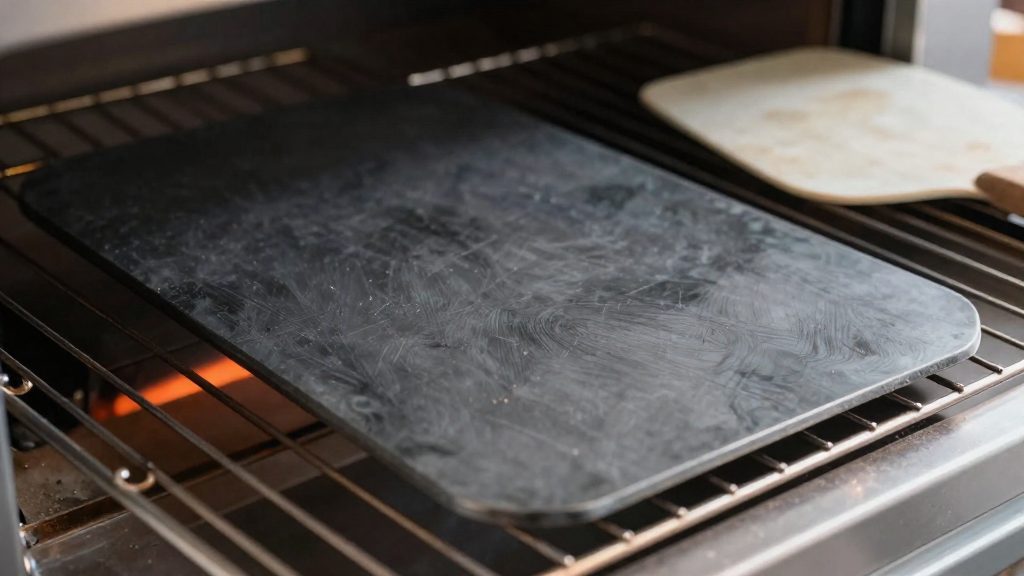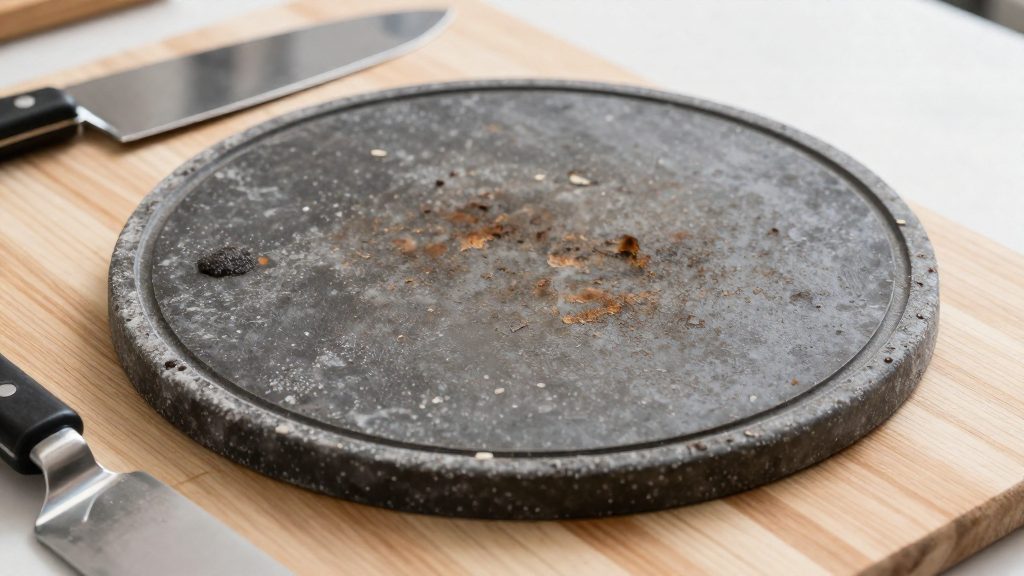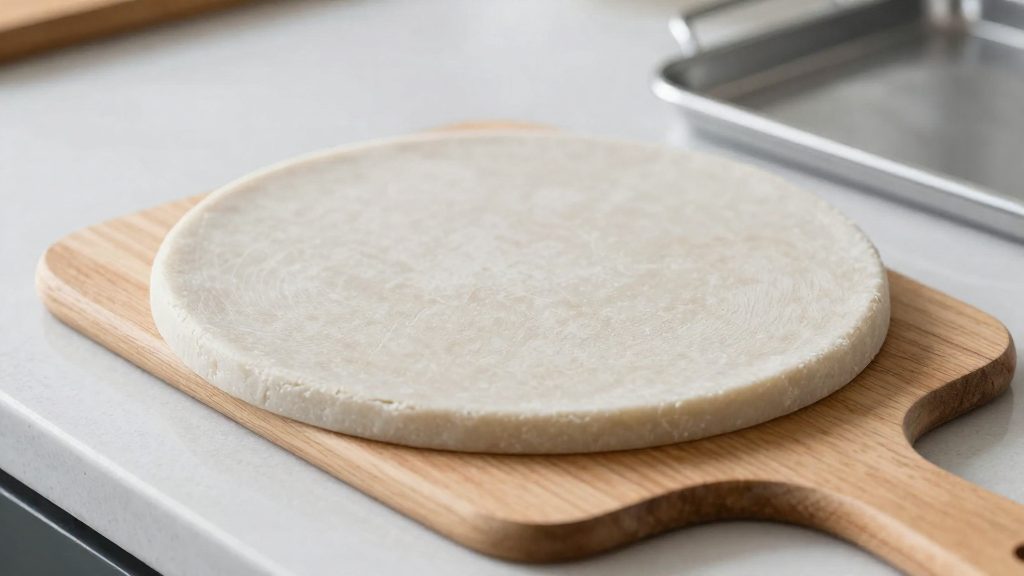
For most home bakers, the choice depends on how fast you want heat to reach the dough. According to Tasting Table (2026-02-15), a baking steel conducts heat quickly and needs very little preheating, while a cordierite stone holds heat evenly and releases it gradually, so it needs a longer preheat. Black Rock Grill (2025) matches steel to New York-style, Detroit-style and thin-crust pizza, and cordierite to standard kitchen ovens and New York-style, pan and thick-crust pizza.
Cordierite Stone or Steel: The Essentials
The two materials differ mainly in heat transfer and in how they handle thermal shock. The table below compares the points where the cited sources give specific information.
| Factor | Baking steel | Cordierite stone |
|---|---|---|
| Heat behaviour | Conducts heat quickly; heat flows into the dough faster than from a stone (NBC Select, 2024-02-12) | Holds heat well and evenly, then releases it gradually (Tasting Table, 2026-02-15) |
| Preheat | Very little (Tasting Table, 2026-02-15) | Longer (Tasting Table, 2026-02-15) |
| Durability | Extremely durable and does not crack (NBC Select, 2024-02-12) | Resists thermal shock, but can crack or shatter if used improperly (NBC Select, 2024-02-12) |
| Weight | Heavier; the Baking Steel weighs 15 lb, about 6.8 kg (NBC Select, 2024-02-12) | Sources disagree: Tasting Table (2026-02-15) calls it thicker and heavier to move, while NBC Select (2024-02-12) calls it lighter than steel |
| Price | –$$(Black Rock Grill, 2025); NBC Select (2024-02-12) says only sometimes more expensive | –(Black Rock Grill, 2025) |
| Pizza styles | New York-style, Detroit-style, thin-crust; not suited to Neapolitan (Black Rock Grill, 2025) | Standard kitchen ovens; New York-style, pan and thick-crust (Black Rock Grill, 2025) |
| Maintenance | May need occasional re-seasoning (Tasting Table, 2026-02-15) | Brush clean; never soak or wash with soap (Tasting Table, 2026-02-15) |
Heat and Crust Results
Steel delivers heat fast, which suits styles that benefit from a quick, strong bottom bake. Cordierite’s porous surface absorbs moisture, which NBC Select (2024-02-12) links to crispness. Because cordierite holds heat evenly and releases it gradually, Black Rock Grill (2025) rates it as suited to standard kitchen ovens.
Price, Weight and Handling
Black Rock Grill (2025), a manufacturer, rates steel higher in price than cordierite (–$$against–), while NBC Select (2024-02-12) describes steel as only sometimes more expensive. Steel is also the heavier option, which matters when you move a hot stone in and out of the oven. The sources disagree on cordierite’s weight, so check the listed weight of any specific model before you buy.
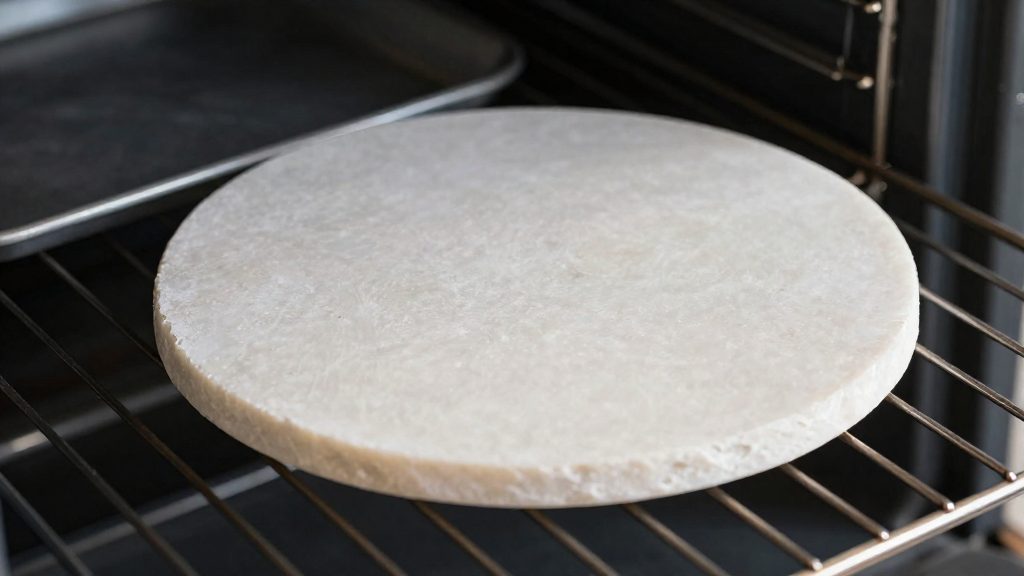
What is the difference in thermal conductivity?
Steel and cordierite stone move heat in different ways, and that difference changes how each one behaves in a home oven. A steel plate has fast heat transfer: heat moves from the metal into the base of the dough more quickly than it does from a stone (NBC Select, 2024-02-12). Because of this, steel needs very little preheating. A cordierite stone holds heat well and distributes it evenly, then delivers it through a gradual heat release. It therefore needs a longer preheat before the first bake (Tasting Table, 2026-02-15).
| Property | Steel | Cordierite pizza stone |
|---|---|---|
| Heat transfer to dough | Faster than a stone (NBC Select, 2024-02-12) | Gradual release of stored heat (Tasting Table, 2026-02-15) |
| Preheat needed | Very little (Tasting Table, 2026-02-15) | Longer (Tasting Table, 2026-02-15) |
| Heat distribution | Conducts heat quickly | Holds heat well and evenly (Tasting Table, 2026-02-15) |
| Surface | Solid metal | Porous, absorbs moisture, which helps crispness (NBC Select, 2024-02-12) |
In practice, the fast transfer of steel suits styles that need a hard, rapid bottom bake, such as New York-style, Detroit-style and thin-crust pizza, and steel is not suited to Neapolitan pizza (Black Rock Grill, 2025). Cordierite can burn pizza bottoms at very high heat (Black Rock Grill, 2025), and Black Rock Grill (2025) lists it as suited to standard kitchen ovens.
Which material gives the better crust?
Neither material wins on every measure. Steel and cordierite build the crust through different heat behaviour, so the better choice depends on the pizza style and the oven. The table summarises what the cited sources report.
| Factor | Baking steel | Cordierite stone |
|---|---|---|
| Heat behaviour | Conducts heat quickly and needs very little preheating (Tasting Table, 2026-02-15) | Holds heat well and evenly, releases it gradually, and needs a longer preheat (Tasting Table, 2026-02-15) |
| Heat into dough | Heat flows into the dough faster than from a stone (NBC Select, 2024-02-12) | Porous surface absorbs moisture, which helps crispness (NBC Select, 2024-02-12) |
| Weight | Baking Steel weighs 15 lb, about 6.8 kg (NBC Select, 2024-02-12) | Published accounts disagree: Tasting Table (2026-02-15) calls it thicker and heavier to move, while NBC Select (2024-02-12) calls it lighter than steel |
| Durability | Extremely durable and does not crack, but heavier (NBC Select, 2024-02-12) | Resists thermal shock, but is more prone to cracking or shattering if used improperly (NBC Select, 2024-02-12) |
| Price | Costs more,–$$(Black Rock Grill, 2025); NBC Select (2024-02-12) says it is only sometimes more expensive | Costs less,–$$ (Black Rock Grill, 2025) |
| Suited styles | New York-style, Detroit-style and thin-crust; not Neapolitan (Black Rock Grill, 2025) | Standard kitchen ovens, New York-style, pan and thick-crust (Black Rock Grill, 2025) |
| Maintenance | May need occasional re-seasoning (Tasting Table, 2026-02-15) | Brush clean; never soak or wash with soap (Tasting Table, 2026-02-15) |
For crust style, the table points in two directions. Steel suits pizzas that benefit from fast, intense bottom heat, such as thin or Detroit-style crusts. Cordierite suits home ovens and thicker, pan-style bases that need steadier heat. Choose based on the crust you want to make and how much weight you are willing to handle.
Is cordierite more fragile than steel?
Cordierite is more prone to cracking in practice, according to NBC Select (2024-02-12), when it is used improperly. According to NBC Select (2024-02-12), cordierite resists thermal shock well, yet it is more prone to cracking or shattering when used improperly. Steel is extremely durable and will not crack, though it is heavier. The sources only say that a stone can crack or shatter if used improperly, so follow the manufacturer’s instructions.
| Property | Cordierite stone | Steel plate | Source |
|---|---|---|---|
| Cracking risk | Higher, mainly when used improperly | Very low; extremely durable and will not crack | NBC Select (2024-02-12) |
| Heat behaviour | Holds heat well and evenly, then releases it gradually | Conducts heat quickly into the dough | Tasting Table (2026-02-15) |
| Preheating | Needs a longer preheat | Needs very little preheating | Tasting Table (2026-02-15) |
| Weight | Sources disagree: thicker and heavier to move (Tasting Table, 2026-02-15), or lighter than steel (NBC Select, 2024-02-12) | 15 lb, about 6.8 kg, for the Baking Steel | NBC Select (2024-02-12) |
| Price | – | – | Black Rock Grill (2025) |
What the differences mean in daily use
The most useful way to reduce the risk with a cordierite stone is to treat it as a piece of ceramic rather than metal. Cordierite is the safer choice if you want a lighter-cost option and a surface that holds heat steadily, but it asks for careful handling. Steel tolerates rougher use, so it suits cooks who move their equipment often or work with a single oven that gets heavy use. The trade-off is weight: the Baking Steel weighs 15 lb (about 6.8 kg), and the sources disagree on whether a cordierite stone is lighter or heavier.
Because cordierite needs a longer preheat, plan for that time instead of rushing it, and avoid soaking the stone, and follow the manufacturer’s heating instructions.
Preheating, weight and maintenance
Steel and cordierite need different preheating, and the sources do not agree on weight. According to Tasting Table (2026-02-15), steel conducts heat quickly and needs very little preheating, while a cordierite stone holds heat evenly, releases it gradually and needs a longer preheat. Set the preheat timing by your oven’s settings and the stone’s thickness.
| Factor | Steel | Cordierite stone |
|---|---|---|
| Preheating | Very little needed | Longer; holds and releases heat gradually |
| Weight | Baking Steel: 15 lb, about 6.8 kg (NBC Select, 2024-02-12) | Sources disagree: thicker and heavier (Tasting Table, 2026-02-15) or lighter than steel (NBC Select, 2024-02-12) |
| Upkeep | May need occasional re-seasoning | Brush clean only |
Weight matters mainly when you move a hot stone in and out of the oven. Because the two sources contradict each other on cordierite, weigh a specific stone before you buy if handling is a concern.
Maintenance is simple for cordierite but differs for steel. Brush off crumbs and residue once the stone has cooled, and avoid moisture or detergent, since the porous surface absorbs liquid. Steel is a different case: it may need occasional re-seasoning, so follow the manufacturer’s care instructions for that step.
Which to choose by oven and pizza style?
The choice depends mainly on how you cook and what style of pizza you make. According to Tasting Table (2026), steel conducts heat quickly and needs very little preheating, while cordierite holds heat evenly and releases it gradually, which needs a longer preheat. Black Rock Grill (2025) adds that steel suits New York-style, Detroit-style and thin-crust pizza, whereas cordierite suits standard kitchen ovens and New York-style, pan and thick-crust pizza. The table below compares the two materials.
| Criterion | Steel (e.g. Baking Steel) | Cordierite stone |
|---|---|---|
| Heat behaviour | Heat flows into the dough faster than from a stone (NBC Select, 2024) | Holds and releases heat gradually (Tasting Table, 2026) |
| Preheat time | Very little (Tasting Table, 2026) | Longer (Tasting Table, 2026) |
| Weight | Heavier: the Baking Steel weighs 15 lb, about 6.8 kg (NBC Select, 2024) | Sources disagree: NBC Select (2024) calls it lighter, Tasting Table (2026) calls it thicker and heavier to move |
| Durability | Will not crack (NBC Select, 2024) | Resists thermal shock but can crack or shatter if misused (NBC Select, 2024) |
| Price tier | Higher: two to three dollar signs (Black Rock Grill, 2025) | Lower: one to two dollar signs (Black Rock Grill, 2025) |
| Suited to | New York-style, Detroit-style, thin-crust | Standard kitchen ovens, New York-style, pan and thick-crust |
| Not suited to | Neapolitan pizza (Black Rock Grill, 2025) | Very high heat: can burn the pizza bottom (Black Rock Grill, 2025) |
Choosing for a home oven
For a standard kitchen oven, Black Rock Grill (2025) lists cordierite as suited, and it is rated cheaper; it needs a longer preheat. A steel plate suits cooks who want fast bottom heat for thin-crust or Detroit-style pizza, provided they accept the extra weight and cost.
Choosing for a pizza oven
Neapolitan pizza is the main exception in the table: Black Rock Grill (2025) states that steel is not suited to it. The sources do not recommend cordierite for that style either, since it can burn pizza bottoms at very high heat. For thin-crust pies cooked on steel, the rapid heat transfer is the advantage, and steel needs very little preheating.
Care and maintenance
Each material has its own routine. Cordierite should be brushed clean and never soaked or washed with soap, a rule Tasting Table (2026) stresses. Steel may need occasional re-seasoning to keep its surface in good condition, according to the same source.
Budget and verdict
The clearest difference between a cordierite stone and a steel is price. Black Rock Grill (2025), a manufacturer, places steel at –$$$ and cordierite at –$ on its own price scale. NBC Select (2024-02-12) describes steel as only sometimes more expensive. The two sources agree on direction but not on the size of the gap. Compare the price tiers rather than a fixed difference.
| Factor | Cordierite stone | Steel |
|---|---|---|
| Relative price | –(Black Rock Grill, 2025) | –(Black Rock Grill, 2025) |
| Weight | Disputed: Tasting Table (2026-02-15) says heavier and thicker; NBC Select (2024-02-12) says lighter | Baking Steel weighs 15 lb, about 6.8 kg (NBC Select, 2024-02-12) |
| Durability | More prone to cracking or shattering if used improperly (NBC Select, 2024-02-12) | Extremely durable and does not crack (NBC Select, 2024-02-12) |
| Upkeep | Brush clean; never soak or wash with soap (Tasting Table, 2026-02-15) | May need occasional re-seasoning (Tasting Table, 2026-02-15) |
| Best suited to | Standard kitchen ovens; New York-style, pan and thick-crust pizza (Black Rock Grill, 2025) | New York-style, Detroit-style and thin-crust pizza; not Neapolitan (Black Rock Grill, 2025) |
Choose steel if you mainly bake thin-crust, New York-style or Detroit-style pizza and want a surface that is very hard to damage. Its main drawbacks are cost and weight, and its heavy mass is a poor fit for anyone who needs to move the stone often.
Choose cordierite if you cook in a standard kitchen oven, prefer thick or pan pizza, or want to spend less. Accept that it requires gentler handling, since it is more prone to cracking, and a longer preheat, since it releases heat gradually.
Because the weight claims conflict across sources, check the actual weight of the model you are considering before buying. The price tiers and suitability notes are the most consistent points.
Frequently asked questions
Which one should a beginner choose for a standard home oven?
A cordierite stone is usually the easier starting point for a standard kitchen oven, since Black Rock Grill (2025) matches it to that setup. A baking steel transfers heat faster, which can suit bakers who want quick results and are comfortable managing timing.
Is a baking steel always more expensive than a cordierite stone?
Not necessarily. NBC Select (2024-02-12) says steel is only sometimes more expensive, while Black Rock Grill (2025) places steel in a higher price bracket (–) than cordierite (–). Treat these ranges as a guide, because prices vary by model and retailer.
How do I look after a cordierite stone so it does not crack?
Brush it clean and never soak it or wash it with soap, according to Tasting Table (2026-02-15). NBC Select (2024-02-12) notes that cordierite resists thermal shock but can crack or shatter if used improperly.