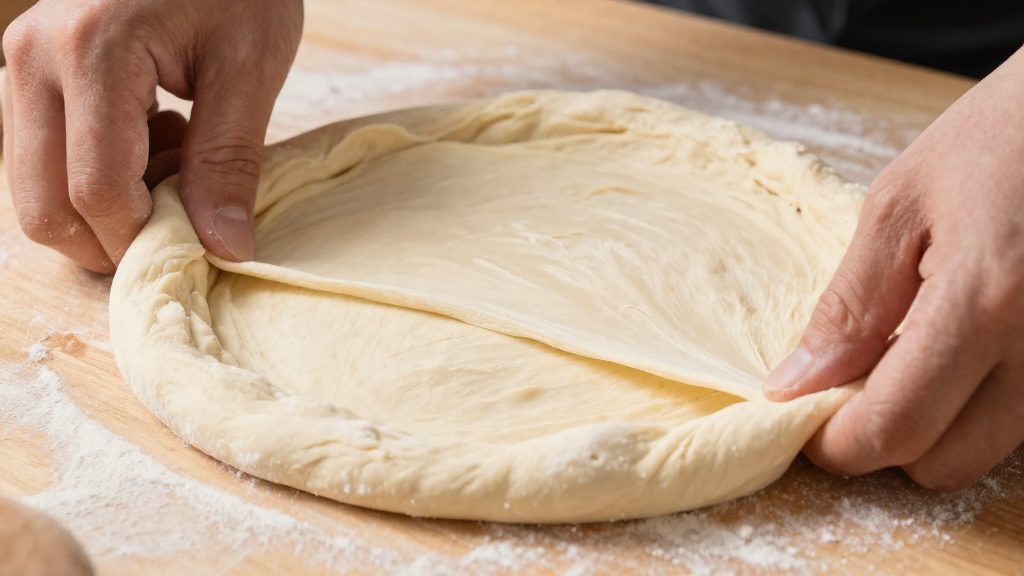
00 flour is the Italian flour grade most often named for Neapolitan pizza dough. Il Fornino’s home recipe uses 500 g of 00 flour (Caputo or San Felice) with 325 g of water, about 65% hydration. The AVPN (Associazione Verace Pizza Napoletana) figures give flour quantity per litre of water but do not specify a flour grade, so the choice of 00 is left to the baker and affects the final crust.
What does 00 flour mean for Neapolitan pizza?
Anthony Mangieri states that 00 flour produces a thinner, crisper style of pizza. He says that blending 00 with 0 flour gives a puffier result, and he recommends Italian 0 or 00 flours (Tasting Table, 2026). The flour therefore shapes the texture of the crust, while the water and salt quantities determine how the dough handles.
The consulted sources give these dough setups:
| Source | Flour | Water | Hydration | Published |
|---|---|---|---|---|
| Il Fornino home recipe | 500 g of 00 flour | 325 g | about 65% | 2026 |
| AVPN specification | 1,600–1,800 g per litre of water | 1 litre | about 55–62% | 2026 |
The AVPN data does not state the unit for flour, which appears to be grams. Mangieri describes Neapolitan dough as “not a super hydrated dough,” but the source gives no figure to compare with the AVPN range. The AVPN salt level is 40–60 g per litre of water, or roughly 4–6% relative to the water.
Fermentation also changes how a 00 dough behaves. Il Fornino’s method uses a 45-minute bulk rest, 24 hours of cold fermentation after portioning, and a 2–4 hour room-temperature proof before baking. Mangieri says his dough needs long fermentation but is not refrigerated. Both approaches rely on a long fermentation, so choose the method that suits your schedule.
Which Hydration to Choose for Neapolitan Pizza Dough?
Hydration is the weight of water divided by the weight of flour, expressed as a percentage. For a Neapolitan-style dough, the official specification and a popular home recipe land in slightly different places. According to the Associazione Verace Pizza Napoletana (AVPN, 2026), the base is 1 litre of water with about 1,600–1,800 g of flour, which works out to roughly 55–62% hydration. The source does not state the flour unit explicitly, but the figures read as grams. Il Fornino (2026) uses 325 g of water for 500 g of 00 flour, about 65% hydration, which is wetter than the AVPN range.
| Source (year) | Water | Flour | Hydration |
|---|---|---|---|
| AVPN (2026) | 1 litre (about 1,000 g) | about 1,600–1,800 g | roughly 55–62% |
| Il Fornino (2026) | 325 g | 500 g of 00 flour | about 65% |
Pizza maker Anthony Mangieri, quoted by Tasting Table (2026), describes Neapolitan dough as “not a super hydrated dough.” The source gives no hydration percentage for his dough. He says 00 flour produces a thinner, crisper base, and that blending 00 with 0 flour gives a puffier result.
Practical reading of these figures: a lower hydration is easier to shape by hand and suits a crisper, thinner base. A higher hydration, such as the 65% in the home recipe, gives a softer, more open crumb but is harder to stretch without tearing. Within the AVPN range, the choice depends on your flour’s absorption and how you plan to shape the dough.
Salt follows the same logic. AVPN specifies 40–60 g of salt per litre of water (about 4–6% of the water weight), while the home recipe uses 10 g of salt for 500 g of flour (about 2%). Treat the proportions as starting points rather than fixed rules.
Ingredients and Base Ratios
Neapolitan pizza dough uses four ingredients: 00 flour, water, salt and yeast. The Associazione Verace Pizza Napoletana (AVPN) sets its reference on 1 litre of water, with about 1,600–1,800 g of flour and 40–60 g of salt per litre. The AVPN text does not state the unit for flour, but the figures appear to be grams. According to AVPN (2026), these amounts work out to roughly 55–62% hydration and 4–6% salt relative to the water. The oven maker Il Fornino (2026) publishes a home version built on 500 g of flour and 325 g of water, about 65% hydration, which is wetter than the AVPN range.
| Ingredient | AVPN reference (per litre of water) | Il Fornino home recipe (500 g 00 flour) |
|---|---|---|
| Water | 1 litre | 325 g (about 65% hydration) |
| Flour | About 1,600–1,800 g | 500 g of 00 flour (Caputo or San Felice) |
| Salt | 40–60 g (4–6% of the water) | 10 g (about 2% of the flour) |
| Yeast | 0.1–3 g fresh brewer’s yeast, or mother yeast at 5–20% of flour weight | 3 g |
The two references express salt differently. AVPN measures it against the water, while the Il Fornino figure is a percentage of the flour, so the two numbers are not directly interchangeable.
For yeast, AVPN allows fresh brewer’s yeast, dry yeast or mother yeast (lievito madre). Dry yeast is one-third of the fresh amount, so a home baker switching from fresh to dry should reduce the weight accordingly.
Flour Choice and Its Effect on Texture
Flour type shapes the finished crust as much as the ratios do. Anthony Mangieri (Tasting Table, 2026) says Neapolitan dough is “not a super hydrated dough” and that 00 flour gives a thinner, crisper result. He blends 00 with 0 flour when he wants a puffier crust, and he recommends Italian 0 or 00 flours.
Kneading and fermentation: what schedule?
The timing of Neapolitan dough depends on which reference you follow. The AVPN (Associazione Verace Pizza Napoletana, 2026) specification calls for kneading in a spiral mixer, dividing the dough into balls of 200–280 g, and giving a second rise in boxes for 8 to 24 hours. Il Fornino (2026), an oven manufacturer, describes a home method with a 45-minute bulk rest, 24 hours of cold fermentation after portioning, and a final 2–4 hour proof at room temperature. Anthony Mangieri (Tasting Table, 2026) says his Neapolitan dough needs a long fermentation and is not refrigerated, so a long rise does not have to happen in a fridge.
Kneading
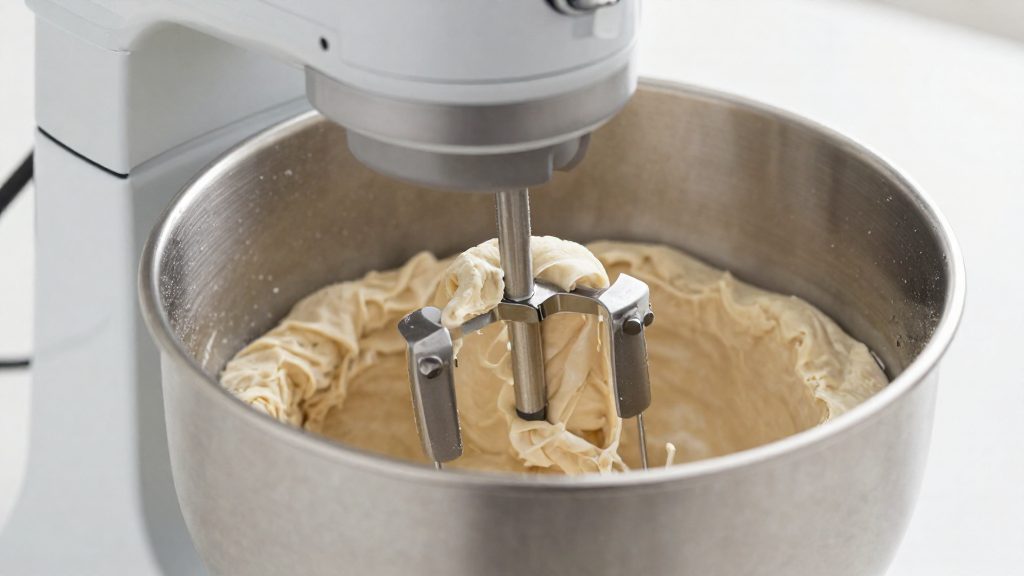
The AVPN specification names the spiral mixer as the kneading method. Home bakers kneading by hand should judge the dough by its feel rather than by a set duration.
Fermentation schedules compared
| Source | Schedule reported |
|---|---|
| AVPN (2026) | Second rise in boxes, 8 to 24 hours |
| Il Fornino (2026) | 45-minute bulk rest, 24 hours cold after portioning, then 2–4 hours at room temperature |
| Tasting Table (2026), Anthony Mangieri | Long fermentation, not refrigerated |
The two published timings differ in method. The AVPN range is the second rise in boxes, while the Il Fornino method splits the work into a short bulk rest and a long cold rest. Mangieri’s account gives no duration, so it is best read as a principle: the long rise is the important part, not a particular temperature.
Yeast or Sourdough Starter: Which to Choose?
The AVPN specification allows two leavening routes for Neapolitan pizza dough: fresh brewer’s yeast (or its dry equivalent) and mother yeast (lievito madre). Both are valid, but they set different doses, timings and flavour profiles. Commercial yeast gives a faster, more predictable dough, while a mother yeast requires more time and a steady feeding routine but adds depth of flavour. The right choice depends on how much time you can give the dough.
Dosing by leavening type
| Leavening | Dose | Source |
|---|---|---|
| Fresh brewer’s yeast | 0.1–3 g per litre of water | AVPN (2026) |
| Dry yeast | One-third of the fresh amount | AVPN (2026) |
| Mother yeast (lievito madre) | 5–20% of flour weight | AVPN (2026) |
| Home recipe, 500 g 00 flour | 3 g yeast (about 0.6% of flour weight) | Il Fornino (2026) |
The Il Fornino home recipe does not specify whether its 3 g is fresh or dry yeast, so check the product you buy before following it exactly.
Commercial yeast: the shorter route
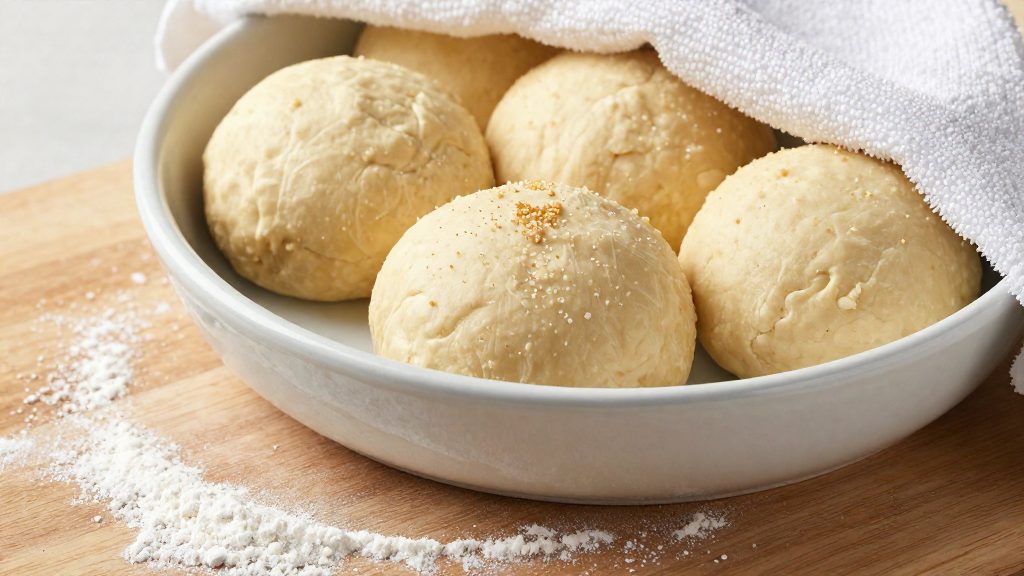
The Il Fornino home recipe, which uses 3 g of yeast of unspecified type, takes more than 24 hours in total, so plan the schedule ahead. Its method has three stages: The Il Fornino method has three stages:
- A 45-minute bulk rest after mixing.
- 24 hours of cold fermentation after portioning.
- A 2–4 hour proof at room temperature before baking.
The cold stage allows flavour to develop without the dough over-rising, which makes the timing easier to plan.
Mother yeast: the longer route
A mother yeast is a culture you keep alive by regular feeding, and it adds acidity and complexity to the crust. The AVPN process gives the second rise in boxes for 8 to 24 hours. Anthony Mangieri describes Neapolitan dough as needing long fermentation, and says his own dough is not refrigerated (Tasting Table, 2026). Treat these timings as a general guide and adjust them to the strength of your starter.
Baking at Home or in a Pizza Oven
Neapolitan pizza is traditionally baked in a wood-fired oven. The Associazione Verace Pizza Napoletana (AVPN, 2026) sets the benchmark for the style, and home cooks can use it to understand what the dough needs from the oven. Most home ovens cannot reach the same conditions, so the practical goal is to reproduce the principle: a very hot baking surface that sets the base quickly, before the toppings dry out.
AVPN Baking Benchmarks
The AVPN specification defines the following baking targets:
| Parameter | AVPN specification (2026) |
|---|---|
| Oven temperature | 430–480 °C, wood-fired |
| Bake time | 60–90 seconds |
| Finished diameter | Up to 35 cm |
| Centre thickness | No more than 0.25 cm |
A short bake at high heat produces the blistered, soft-centred crust associated with the style. A thin centre is only possible if the dough is stretched evenly and kept free of excess flour and moisture during shaping.
How the Dough Affects the Bake
The flour and fermentation choices shape how the crust behaves in the oven. Anthony Mangieri, as reported by Tasting Table (2026), says that 00 flour alone gives a thinner, crisper result, while blending 00 with 0 flour produces a puffier crust. He also describes Neapolitan dough as “not a super hydrated dough.”
The timing before baking also matters. The Il Fornino home recipe (Il Fornino, 2026) uses 24 hours of cold fermentation after portioning, followed by a 2–4 hour proof at room temperature. The dough should be shaped only after this final proof, when it is soft and extensible.
Adapting the Method at Home
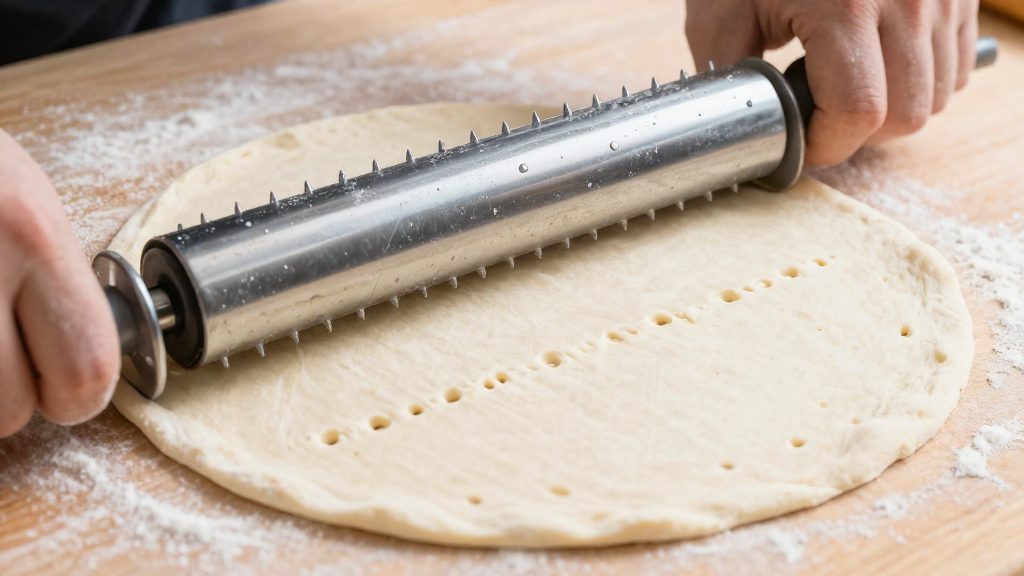
When the dough is ready, stretch it by hand, keeping the centre thinner than the rim, then launch it onto the hot surface. Rotate the pizza during the bake if your oven heats unevenly, and keep toppings light so the base sets before it gets soggy.
Can you replace 00 flour?
Yes, within limits. Anthony Mangieri recommends Italian 0 or 00 flours for Neapolitan dough (Tasting Table, 2026). Each option changes the final texture, so the table below shows what each source reports.
| Flour choice | Reported effect or use | Source |
|---|---|---|
| Italian 00 flour | Used in Il Fornino’s home recipe (500 g, Caputo or San Felice); Mangieri says it gives a thinner, crisper style | Il Fornino (2026); Tasting Table (2026) |
| Blend of 00 and 0 flour | Gives a puffier style, according to Mangieri | Tasting Table (2026) |
| Italian 0 flour | Recommended by Mangieri alongside 00 | Tasting Table (2026) |
A blend of 00 and 0 is the only substitution the sources describe with a stated result. If you want a puffier edge than pure 00 gives, this is the option to test first.
Flour is not the only variable that affects the outcome. Mangieri stresses that long fermentation is necessary for this dough and that his own is not refrigerated. Il Fornino’s method uses 24 hours of cold fermentation after portioning, followed by a 2–4 hour room-temperature proof. These are two different schedules, so a flour test is only meaningful if you keep one schedule throughout.
Common mistakes to avoid
Most problems with 00-flour Neapolitan dough come from applying one set of numbers to every kitchen. Published formulas differ on water, salt, yeast and timing. The AVPN (Associazione Verace Pizza Napoletana, 2026) base uses 1 litre of water with roughly 1,600–1,800 g of flour and 40–60 g of salt, which works out to about 55–62% hydration. Il Fornino’s home recipe (2026) is wetter, at about 65% hydration, with 500 g of 00 flour, 325 g of water and 10 g of salt. Checking which method you are following prevents most of the errors below.
- Assuming a wetter dough is more authentic. Anthony Mangieri (Tasting Table, 2026) describes Neapolitan dough as “not a super hydrated dough,” so the top of the hydration range is not automatically the target.
- Expecting a puffy crust from 00 flour alone. Mangieri (Tasting Table, 2026) says 00 flour gives a thinner, crisper style, and that blending in 0 flour gives a puffier one.
- Shortening fermentation. Mangieri says the dough needs a long fermentation. Il Fornino’s method combines a 45-minute bulk rest, 24 hours of cold fermentation after portioning, and a 2–4 hour room-temperature proof before baking.
- Mixing up salt percentages. AVPN expresses salt as 4–6% relative to the water. Il Fornino’s 10 g of salt is given as about 2%. Confirm the base before scaling a recipe.
- Scaling yeast by the wrong form. AVPN gives fresh brewer’s yeast at 0.1–3 g per litre of water and states that dry yeast is one-third of the fresh amount. Switching forms without adjusting the dose changes the rise.
- Making balls that are too large or too thick. AVPN specifies dough balls of 200–280 g and a finished diameter of up to 35 cm, with the centre no thicker than 0.25 cm.
- Treating cold fermentation as mandatory. Mangieri says his dough is not refrigerated, while Il Fornino relies on 24 hours of cold fermentation. Both approaches appear in published methods.
Frequently asked questions
Do I have to use 00 flour for Neapolitan pizza dough?
No single flour grade is mandated. Anthony Mangieri recommends Italian 0 or 00 flours (Tasting Table, 2026), and the grade mainly affects the texture of the crust.
How much yeast should a beginner use?
The AVPN specification gives 0.1–3 g of fresh brewer’s yeast per litre of water, and dry yeast is one-third of the fresh amount (Associazione Verace Pizza Napoletana, 2026). Il Fornino’s home recipe uses 3 g of yeast for 500 g of flour (Il Fornino, 2026), which falls within that range.
What salt level works for a home dough?
Il Fornino’s home recipe uses 10 g of salt for 500 g of flour, about 2% of the flour weight (Il Fornino, 2026). Expressing salt as a baker’s percentage of flour weight makes it easy to scale the recipe up or down.