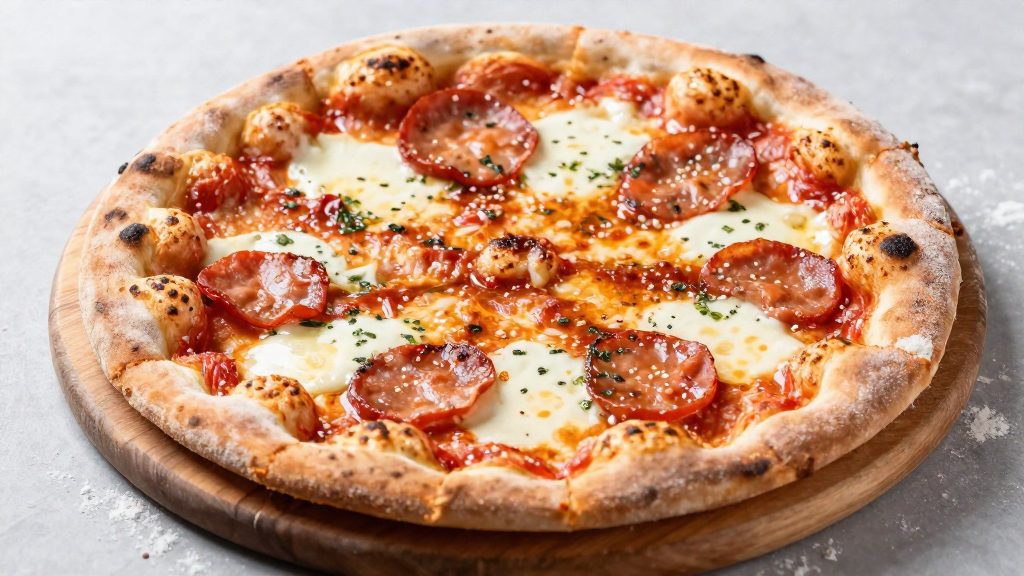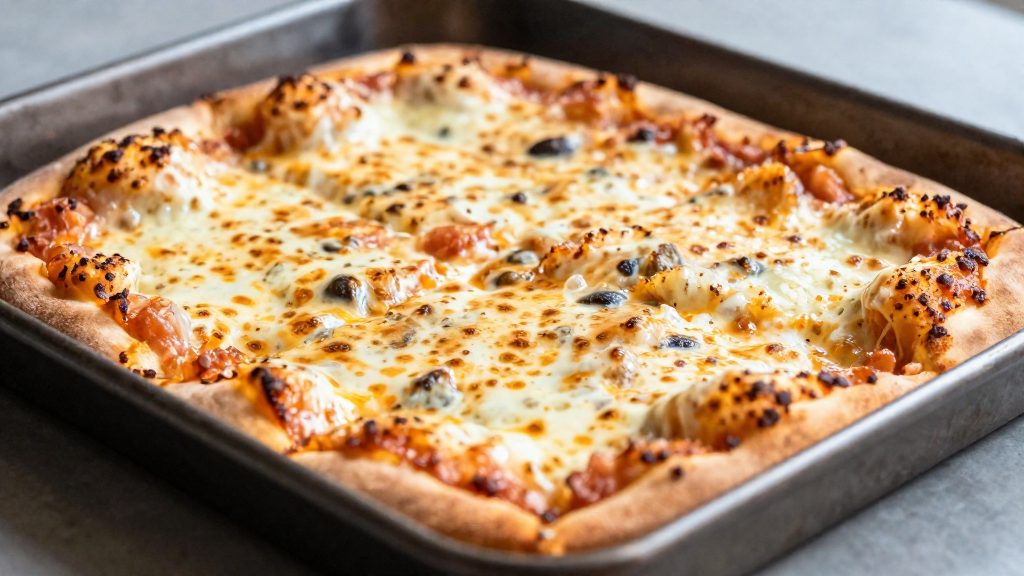
What Is Detroit-Style Pizza?
Detroit-style pizza is built around the pan. The dough is pressed into an oiled metal pan, given a second rise until it looks puffy, and then topped and baked. The recipe below comes from Bob’s Red Mill (2026). This table lists its key flour, water, rise, cheese and sauce quantities.
| Component | Specification |
|---|---|
| Flour | 300 g of ‘00’ flour |
| Water | 1 cup warm (about 237 g), roughly 79% hydration |
| First rise | 2–3 hours, until doubled |
| Pan rise | 20–30 minutes, until puffy |
| Cheese | Equal parts shredded medium cheddar and low-moisture mozzarella, about 170 g each |
| Sauce | 28 oz crushed tomatoes, simmered 30–40 minutes on very low heat, until reduced by about a third |
Why the Pan Matters
The oiled metal pan sets the shape and the crust. Because the dough rises in the pan, it fills the rectangle and takes on its edges.
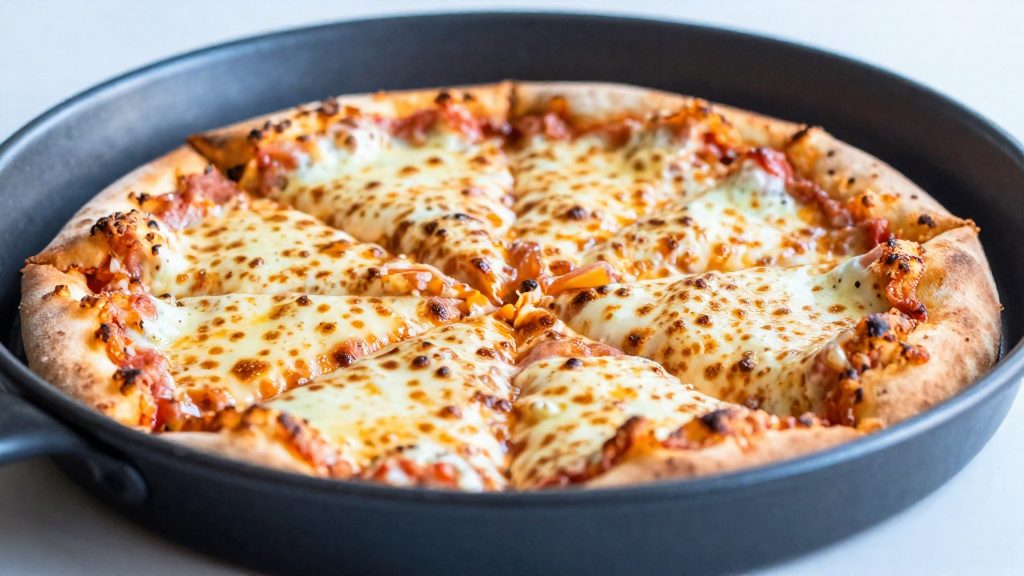
The equipment to bake it in a home oven
Home-oven Detroit-style pizza needs two things: a metal pan of the right size and an oven that can reach its highest setting. Bob’s Red Mill (2026) specifies an oiled metal pan of about 9 x 12 inches (about 23 x 30 cm) and an oven set to 500–550°F (about 260–288°C).
| Item | Specification | Source |
|---|---|---|
| Pan | Metal, about 9 x 12 inches (about 23 x 30 cm), oiled | Bob’s Red Mill (2026) |
| Oven setting | Highest setting, 500–550°F (about 260–288°C) | Bob’s Red Mill (2026) |
| Bake time | 10–15 minutes | Bob’s Red Mill (2026) |
The pan
The oiled metal pan holds the dough through its second rise and then through the bake. The dough rises 20–30 minutes in the pan until puffy before it goes into the oven. Oil the pan before the dough goes in so the crust does not stick. Keep to the stated size of about 9 x 12 inches, since the recipe’s dough and topping quantities are set for that footprint. A pan that is much smaller will not hold the full amount of dough and toppings.
The oven
The oven has to run at its highest setting, which the recipe gives as 500–550°F (about 260–288°C). Preheat the oven fully before the pan goes in. Use your oven’s own indicator to confirm it has finished preheating. Bake for 10–15 minutes and check the pizza visually: the cheese should bubble and begin to brown. The bake is complete when that happens, not when a fixed time has elapsed.
Which flour and hydration to choose?
Bob’s Red Mill’s home-oven Detroit-style recipe (2026) uses ‘00’ flour and a high-hydration dough. The dough is built from 300 g of ‘00’ flour and 1 cup of warm water (about 237 g). Dividing the water by the flour gives a hydration of roughly 79%, meaning the dough holds about 79 g of water for every 100 g of flour.
| Component | Amount in the recipe | What it does |
|---|---|---|
| ‘00’ flour | 300 g | Forms the dough’s structure |
| Warm water | 1 cup (about 237 g) | Sets the hydration at roughly 79% |
| Rise 1 | 2–3 hours, until doubled | Develops the dough before shaping |
| Rise 2 (in the pan) | 20–30 minutes, until puffy | Expands the dough before baking |
Weigh the flour and water on a kitchen scale instead of measuring by volume. A cup of water weighs about 237 g, but a cup of flour can vary widely depending on how it is scooped, so weighing keeps the hydration consistent from batch to batch.
Because the dough is wetter than a standard pizza dough, expect it to be softer and stickier to handle. Oil your hands rather than adding extra flour during shaping, since extra flour lowers the hydration and changes the final texture. Treat 79% as the baseline for this specific recipe.
Dough: Resting and Second Proof in the Pan
Bob’s Red Mill (2026) builds its home-oven Detroit-style dough from 300 g of ‘00’ flour and 1 cup of warm water (about 237 g). That gives a hydration of roughly 79%. The dough goes through two separate rises, and each one has its own cue for when it is ready.
| Stage | Duration (Bob’s Red Mill, 2026) | Sign it is ready |
|---|---|---|
| First rise, in a bowl | 2–3 hours | Dough has doubled in size |
| Second rise, in the pan | 20–30 minutes | Dough looks puffy |
First rise: Let the dough rise in a covered bowl for 2–3 hours. Judge it by volume, not by the clock alone: the dough is ready when it has doubled. A dough that has only grown slightly needs more time before it goes into the pan.
Second rise: Transfer the dough to the pan, which should be oiled metal of about 9 x 12 inches (about 23 x 30 cm). Spread it gently toward the edges, then let it rest for 20–30 minutes. This second rise is shorter than the first and happens in the pan itself, so the dough is not handled or shaped again before baking. The dough is ready when it looks puffy and light.
Cheese and Sauce: Cheddar, Mozzarella and Reduced Tomato
The Bob’s Red Mill home-oven recipe (2026) uses cheddar and mozzarella, not brick. It calls for equal parts shredded medium cheddar and low-moisture mozzarella, about 170 g of each, or roughly 340 g of cheese per pizza. The two cheeses do different jobs. Cheddar is generally chosen for flavour and mozzarella for melt. For other cheeses, the recipe’s equal weights are the reference point.
Cheese Roles at a Glance
| Cheese | Amount per pizza | Form | Role on the pizza |
|---|---|---|---|
| Medium cheddar | About 170 g | Shredded | Flavour and colour |
| Low-moisture mozzarella | About 170 g | Shredded | Melt and stretch |
Why Low-Moisture Mozzarella
Low-moisture mozzarella holds less water than fresh mozzarella. Less free water means the topping is less likely to pool or make the dough soggy in a home oven, which is why the recipe specifies this variety rather than a fresh one.
Preparing the Sauce
The sauce uses about 794 g (28 oz) of crushed tomatoes. Simmer it for 30–40 minutes on very low heat, until it has reduced by about a third. Reduction concentrates the tomato flavour and thickens the sauce, so less liquid reaches the dough during baking.
Temperature and Baking in a Home Oven
Bob’s Red Mill (2026) bakes its home-oven Detroit-style pizza at the highest oven setting, 500–550°F (about 260–288°C), for 10–15 minutes. The bake is set by a pan of about 9 x 12 inches (about 23 x 30 cm), which is the reference size for these temperatures and times. A pan of a different size may need its own test bake, because the recipe does not say how the baking time changes with size.
| Baking element | Value from Bob’s Red Mill (2026) |
|---|---|
| Pan | Oiled metal, about 9 x 12 inches (about 23 x 30 cm) |
| Oven temperature | Highest setting, 500–550°F (about 260–288°C) |
| Bake time | 10–15 minutes |
Check the cheese at the early end of the 10-minute window, since the time range is wide.
The source does not specify when to preheat the oven relative to the final pan rise, or which oven rack position to use. Keep the pan on the same rack for each bake so the results stay comparable from one pizza to the next.
How to get a crispy crust?
A crispy Detroit-style crust in a home oven depends on three things: an oiled metal pan, the highest oven setting, and a short, very hot bake. According to Bob’s Red Mill (2026), the pan measures about 9 x 12 inches (about 23 x 30 cm) and the oven runs at 500–550°F (about 260–288°C) for 10–15 minutes. Each of these settings affects the base and edges in a different way.
| Stage | Recipe specification | Why it matters for the crust |
|---|---|---|
| Pan | Oiled metal pan, about 9 x 12 in | The oil fries the base and edges |
| Dough in pan | Rises 20–30 minutes until puffy | The dough is already in its final shape before baking |
| Oven | Highest setting, 500–550°F | Strong heat sets the bottom quickly |
| Bake | 10–15 minutes | Total time in the oven |
The oil is what gives the base its fried texture. A dry pan produces a paler, softer bottom.
Give the dough its second rise in the pan. Press it gently into the corners so the edges are covered.
Choose the cheese for its moisture. Low-moisture mozzarella is the variety the recipe specifies, and it releases less water during baking than fresh mozzarella.
Frequently asked questions
How do I know when my Detroit-style pizza is done?
Bake it at the oven’s highest setting for 10–15 minutes. According to Bob’s Red Mill (2026), the pizza is ready when the cheese bubbles and begins to brown, so check the surface as well as the clock.
Should the sauce be cooked before it goes on the pizza?
Yes. Bob’s Red Mill (2026) has you simmer the crushed tomatoes for 30–40 minutes on very low heat until they lose about a third of their volume. The result is a reduced sauce that is thicker and spreads less on the dough.
What does 79% hydration mean for a beginner?
Hydration is the weight of water compared with the weight of flour. Here, 237 g of water on 300 g of flour gives roughly 79%. That makes the dough softer and stickier than many basic sandwich-bread doughs, so expect it to feel wet when you handle it.