A bare carbon steel pizza steel needs seasoning because the metal rusts quickly when it is exposed to moisture and air. Seasoning is a layer of oil baked onto the surface, and it acts as a barrier against corrosion. Most pizza steels ship as raw steel, so the buyer applies this layer before the first bake.
Does a pizza steel need seasoning?
A seasoning layer is what keeps a carbon steel surface from corroding in a home kitchen. Without it, the exposed steel is vulnerable to the humidity of the air and to moisture left behind after washing. Baking Steel (2026) identifies this moisture and air exposure as the main cause of rust, and the baked-on oil film is the protection against it.
The layer is thin by design. A thick, sticky coat does not add protection and can leave residue on your pizzas.
Raw steel versus pre-seasoned steel
Most pizza steels arrive as raw carbon steel, which means the owner must oil and bake the surface before use. Baking Steel ships its steels pre-seasoned. According to Baking Steel (2026), the company shot-blasts the steel to remove mill scale, hand-wipes organic flax oil onto it, and bakes it for about one hour before it leaves the factory. The oils listed below come from Baking Steel’s home seasoning instructions.
| Feature | Raw carbon steel | Pre-seasoned (Baking Steel) |
|---|---|---|
| Surface state at delivery | Bare steel, exposed to rust | Oil layer already baked on |
| Mill scale removal | Left to the owner | Shot-blasted before seasoning |
| Who applies the first layer | The owner | The manufacturer |
| Oil recommended by Baking Steel | Organic flaxseed oil (top choice); grapeseed, canola or vegetable oil also work | Organic flax oil (factory seasoning) |
| First-use step | Oil and bake before cooking | Already pre-seasoned by the manufacturer |
What oil is best for seasoning a pizza steel?
Baking Steel, the manufacturer, names organic flaxseed oil as its top choice for seasoning. Grapeseed oil, canola oil and vegetable oil are also listed as options that work. The manufacturer lists these three as oils that also work, with flaxseed as its top choice.
| Oil | Status according to Baking Steel (2026) |
|---|---|
| Organic flaxseed oil | Top recommended choice |
| Grapeseed oil | Works for seasoning |
| Canola oil | Works for seasoning |
| Vegetable oil | Works for seasoning |
Baking Steel’s method calls for a high smoke point oil because the steel is baked at 400°F (about 200°C) for one hour. The sources do not detail the chemistry, but an oil that tolerates sustained heat is the logical fit for this bake.
Baking Steel uses organic flax oil on its own pre-seasoned steels and also names it as its top choice for home seasoning.
Whichever oil you pick, use it sparingly. The goal is a film so thin that it looks almost dry once wiped, because excess oil is what creates a tacky finish. Whichever oil you pick, use it sparingly. The goal is a film so thin that it looks almost dry once wiped, because excess oil is what creates a tacky finish.
How to season a pizza steel step by step
Seasoning a bare pizza steel means baking a thin film of high smoke point oil onto the metal. According to Baking Steel (2026), the method takes five steps: oil the centre, spread a thin layer over both faces, wipe until only a micro-thin layer remains, bake at 400°F (about 200°C) for one hour, and let the steel cool inside the oven. The steps are simple, but the thinness of the oil layer is what makes the seasoning work.
-
Apply the oil to the centre. Place a small amount of high smoke point oil in the middle of the steel.
-
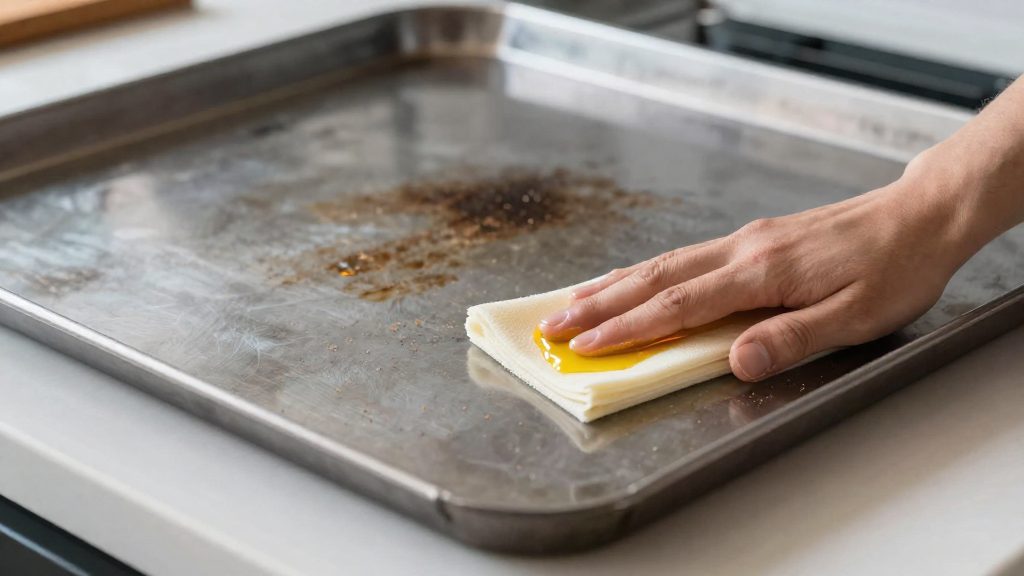
Spread the oil on both sides. Use a paper towel to spread a very thin, even layer over the top and the bottom. The underside needs the coating too.
-
Wipe off the excess. Remove as much oil as you can. Work until only a micro-thin layer remains. The goal is a film on the metal, not a pool of liquid on its surface.
-
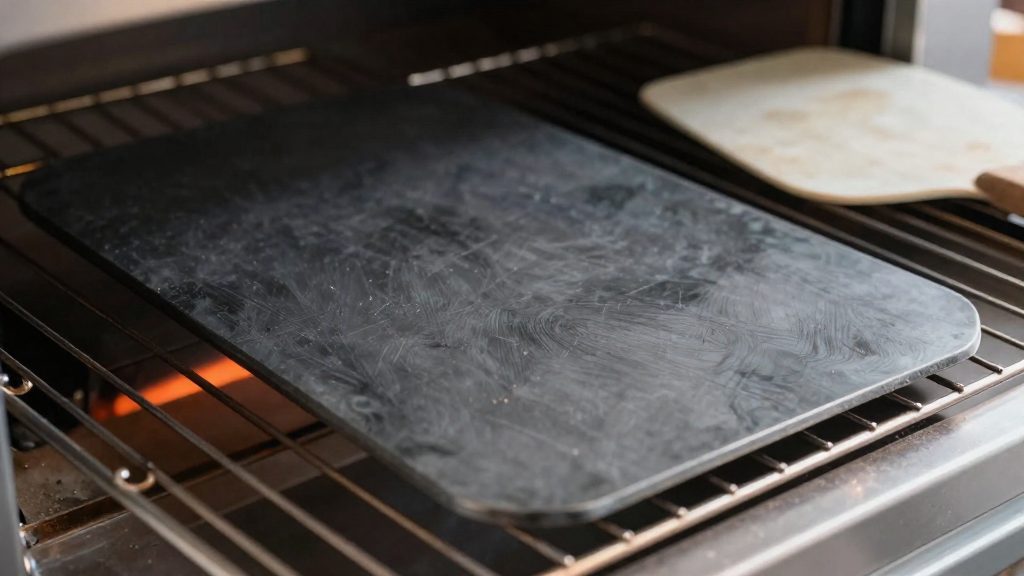
Bake for one hour. Put the steel in the oven and bake it at 400°F (about 200°C) for one hour. The bake turns the oil into the baked-on barrier layer.
-
Cool the steel inside the oven. Turn the oven off and leave the steel inside until it cools.
How do you clean a pizza steel day to day?
Routine cleaning of a pizza steel takes two steps after each bake: scrape while warm, then wipe and dry the surface completely. Baking Steel (2026) recommends scraping off debris with a bench scraper or metal spatula while the steel is still warm, then wiping it with a dry towel and drying it fully. This routine is separate from a deep clean. It handles everyday residue and does not involve scrubbing, soap or re-seasoning.
Scrape debris while the steel is warm
Scraping is most practical while the steel still holds heat, because stuck food is easier to lift from the surface then than once it has cooled. Use a bench scraper to lift debris while the steel is still warm.
Metal spatula as an alternative
A metal spatula is the other tool Baking Steel names for this job. Choose whichever tool sits more comfortably in your hand. Baking Steel names the metal spatula as an equivalent option to the bench scraper.
Wipe with a dry towel and dry fully
After scraping, wipe the surface with a dry towel to remove fine dust and remaining particles. Then make sure the steel is fully dry before storing it.
What should you do if your pizza steel rusts?
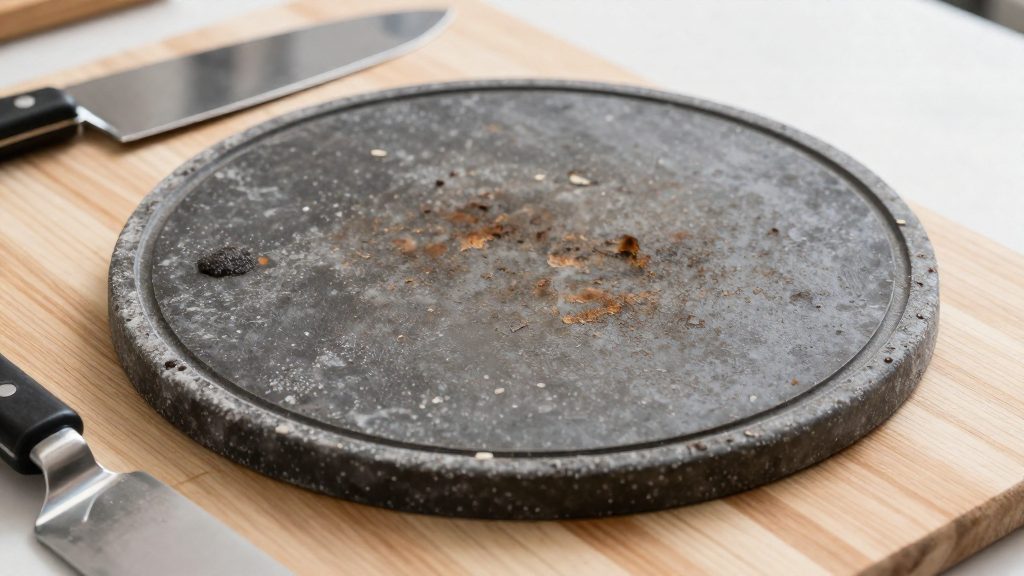
If your pizza steel rusts, do a deep clean: scrub off the rust with a cleaning brick, wash with hot soapy water and a stiff brush, rinse, dry completely, and then re-season. Baking Steel (2026) recommends this routine for rust or built-up residue.
Scrubbing off the rust
Use a cleaning brick to scrub the rust or buildup off the surface. Work it over the affected areas until the rust is gone. Baking Steel (2026) gives no fixed duration for this step, so judge by the surface itself.
Washing and drying
Wash the steel with hot soapy water and a stiff brush, then rinse it. Next, dry it completely in the oven at 200°F (about 93°C) for 10 to 15 minutes.
Summary of the deep-clean steps
| Step | Action | Key detail |
|---|---|---|
| 1 | Scrub | Use a cleaning brick to remove rust or buildup |
| 2 | Wash | Hot soapy water and a stiff brush, then rinse |
| 3 | Dry | 200°F (about 93°C) for 10 to 15 minutes |
| 4 | Re-season | Apply the seasoning layer once the steel is completely dry |
When to re-season a pizza steel
A pizza steel should be re-seasoned when its surface shows wear; Baking Steel (2026) says this is typically once or twice a year for most people. According to Baking Steel (2026), the two signs to watch for are a dull, gray surface and food that starts to stick.
Dull, gray surface
Re-season when the steel looks dull and gray. A faded, gray surface signals that the seasoning has worn down.
Food starts to stick
When food begins to stick to the steel, re-season it.
How often most people re-season
Baking Steel (2026) states that once or twice a year is typical for most people. Baking Steel (2026) notes that steels used in gas ovens may need more seasoning and drying, because gas ovens add moisture.
Clean first if rust or buildup is present
If the surface has rust or buildup, do a deep clean before re-seasoning.
Gas or electric oven: does it matter?
Possibly, mainly for seasoning and drying. According to Baking Steel (2026), gas ovens add moisture, so steels used in them may need more seasoning and drying. If you cook with gas, pay extra attention to moisture.
Heat source and the seasoning bake
The seasoning bake is the same whatever the heat source.
Moisture and drying with gas
Because gas ovens add moisture, a steel used in one may need more seasoning (re-applied as needed, always in thin layers) and more thorough drying.
Maintenance routine by heat source
| Task | Gas oven | Electric oven |
|---|---|---|
| Seasoning bake | 400°F (about 200°C) for one hour, per Baking Steel (2026) | Same |
| Extra seasoning and drying | Recommended, because gas adds moisture | Not stated |
The daily routine does not change with heat source.
Frequently asked questions
Do I have to season my pizza steel before the first bake?
It depends on the steel you buy. Most pizza steels ship as raw carbon steel, so the owner must bake a seasoning layer onto the surface before cooking. Baking Steel (2026) sells pre-seasoned steels, which arrive with that layer already in place.
Which oil should I use to season a pizza steel?
Baking Steel (2026) recommends organic flaxseed oil as its top choice. Grapeseed, canola or vegetable oil also work, and the manufacturer’s method calls for a high smoke point oil.
Does a gas oven change how I season or dry my pizza steel?
Baking Steel (2026) notes that gas ovens add moisture, so a steel used in one may need more seasoning and more thorough drying.