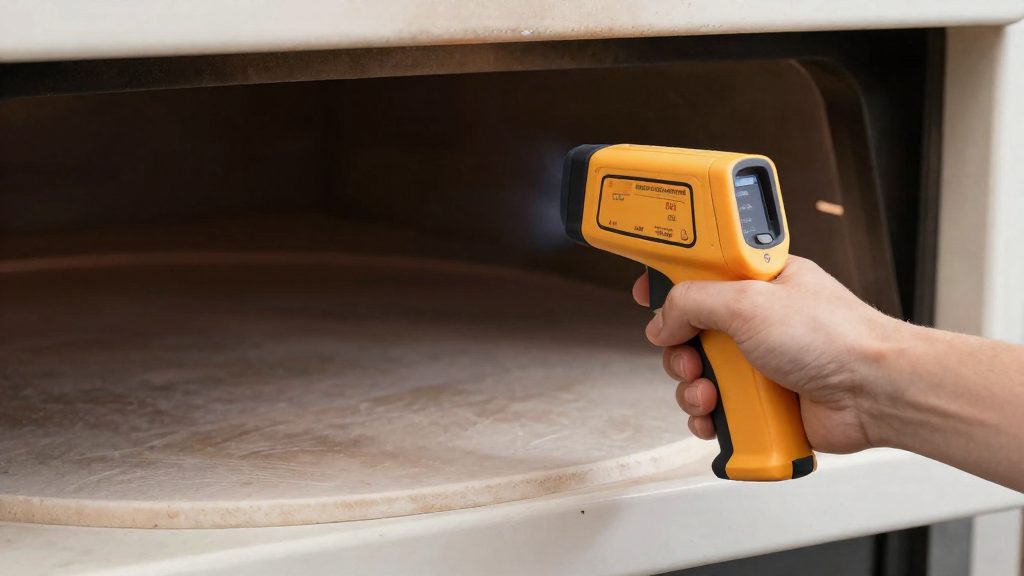
Why check a pizza oven with an infrared thermometer?
A pizza oven’s built-in thermometer reads air temperature, not the temperature of the stone the pizza sits on, and the two can differ. That gap is why the stone is checked directly with an infrared thermometer. According to Fontana Forni USA (2026), home ovens rarely exceed 500°F (about 260°C), while pizza ovens often reach or exceed 900°F (about 480°C), so the temperatures a pizza base faces are far beyond what a kitchen dial is built around.
Why check a pizza oven with an infrared thermometer?
Air temperature and stone temperature are different readings
The dial on a pizza oven reports the air temperature inside the chamber. The stone is a dense mass that absorbs and holds heat, so its surface can read differently from the air around it. Fontana Forni USA (2026) states that the oven’s built-in thermometer can differ from the stone temperature, which is why the stone is checked with an infrared gun.
Why the gap matters for pizza
| Reading source | What it reports |
|---|---|
| Built-in oven thermometer | Air temperature inside the chamber |
| Infrared thermometer | Surface temperature of the stone |
Home ovens rarely exceed 500°F, while pizza ovens often reach or exceed 900°F (Fontana Forni USA, 2026). Habits learned from a kitchen oven therefore do not transfer directly. A dial that suits home baking does not describe what happens on a pizza-oven stone.
How stone heat shapes the base
The base of a pizza touches the stone directly, so heat moves into the dough by conduction. Air heat reaches the top of the pizza in a different way. This contact is what drives base browning on the underside and helps set the structure of the crust as the base cooks. Because the air reading does not capture that contact heat, a stone reading tells you more about how the base will turn out than the dial does.
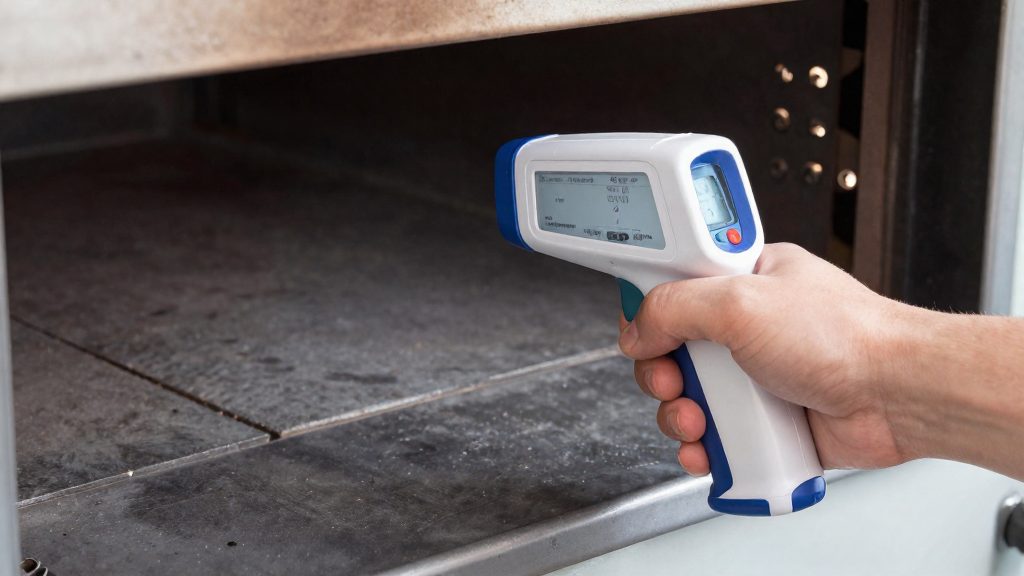
What an infrared thermometer measures, and what it doesn’t
An infrared thermometer measures surface temperature: the temperature of the face it is pointed at. It does not measure the temperature inside the object. In a pizza oven, this distinction matters because the gun tells you how hot the cooking surface is, not how hot the air is.
How the sensor reads heat
Every object with a temperature gives off infrared radiation. The sensor collects this emitted heat from the surface in its field of view and converts it into a temperature reading. A stone can be hot on its face while its underside is still cooler, and the gun reports only the face.
Distance-to-spot ratio
The distance-to-spot ratio describes how large an area the sensor averages into one reading. The farther the gun is from the target, the wider the measured spot. A distant reading can therefore blend the stone with nearby surfaces, such as the oven walls or the edge of the opening, which pulls the number away from the stone’s true surface temperature. Holding the gun closer narrows the spot, so the reading reflects a smaller, more specific area.
Check each manufacturer’s manual for the exact distance-to-spot ratio before measuring from a distance.
Range and the limits of the reading
Pizza-oven readings sit well above kitchen ranges. Fontana Forni’s model reads up to 986°F (Fontana Forni USA, 2026), and Gozney’s infrared thermometer covers -50 to 800°C (Tucker BBQ, Australian retailer quoting Gozney’s specifications, 2026).
| Measurement target | Read with infrared gun? | Tool to use |
|---|---|---|
| Stone surface | Yes | Infrared thermometer |
| Air inside the oven | No | Oven’s built-in thermometer |
| Internal food temperature (e.g., steak) | No | Probe thermometer |
How to take a reading on the stone
Checking a pizza stone with an infrared gun takes about three actions: aim, hold, and sample. The method matters because the gun reads only the surface it is pointed at. According to Fontana Forni USA (2026), you should aim at the stone itself, not at a nearby surface, and hold the trigger until the reading stabilizes. Each action affects how much you can trust the number on the display.
| Step | Action | What to check |
|---|---|---|
| 1. Aim | Point the gun at the stone surface only | The beam lands on stone, not on the oven wall, door, or air gap |
| 2. Hold | Keep the trigger pressed | The number stops changing before you read it |
| 3. Sample | Take readings at several spots | Differences between points across the surface |
Aim at the stone itself
Stand at a steady angle to the hearth and aim at the stone, not at the walls or the door opening. A nearby surface can read hotter or cooler than the stone, which gives a misleading figure. Aim through the oven opening at the stone from a safe position, keeping your hand and the gun clear of the hot opening, and make sure the beam lands on the stone rather than on the walls or the door.
Hold until the reading stabilizes
Press the trigger and keep it pressed while the number settles. Releasing too early can capture a value that is still moving. Gozney’s infrared thermometer offers single or continuous readings and a 15-second auto shut-off, according to Tucker BBQ (2026), quoting Gozney’s specifications. If you use continuous mode, read the figure before the shut-off engages, then press again for a fresh reading.
Sample several points across the surface
A single reading describes one spot. Gozney says its thermometer lets you check heat across the stone (Tucker BBQ, 2026). Since a single reading covers only one spot, it is prudent to check several points. Take readings at several points spread across the surface, including the centre and areas toward the edges, and compare them. Large differences between points tell you where the heat is uneven and where your pizza may cook faster.
Which stone temperature should you aim for?
The right stone temperature depends mainly on the pizza style you are making. Fontana Forni USA (manufacturer, 2026) gives an overall stone range of 650–900°F (about 345–480°C), with the exact target set by style. For Neapolitan style it cites a narrower, hotter band of 700–900°F. Gozney recommends 399–499°C for pizza in its ovens, as quoted by Tucker BBQ (Australian retailer, 2026). Gozney publishes its figure only in Celsius, so the same band converts to roughly 750–930°F.
| Source | Target stone temperature | Context |
|---|---|---|
| Fontana Forni USA (2026) | 650–900°F (about 345–480°C) | Overall range across pizza styles |
| Fontana Forni USA (2026) | 700–900°F | Neapolitan style |
| Gozney, quoted by Tucker BBQ (2026) | 399–499°C | Pizza in Gozney ovens |
Why targets vary by style
The width of the range reflects how differently each style is cooked. A Neapolitan pizza bakes in a very short time, so it relies on a stone near the top of the band to set the crust quickly. Styles that bake for longer at lower heat need less intense stone heat, which helps prevent the base from scorching before the toppings are cooked through.
Why targets vary by oven
Two ovens set to the same figure do not behave identically. Stone thickness, the oven’s construction and how it is fired all affect how quickly the stone heats and how evenly it holds that heat. A manufacturer’s band is therefore a reference point, not a universal setting.
What specs matter when buying one?
The most important specifications are the measuring range, the laser aiming system, the temperature units, the reading mode, the power source and the auto shut-off. Together they determine whether the gun can read a stone heated far beyond a home kitchen oven’s limit, and whether you can take a reading quickly and accurately.
Measuring range
The range must reach well above home-oven temperatures.
Aiming and display units
Gozney’s gun includes a laser for aiming, and it switches between °C and °F. The Fontana Forni USA specifications consulted do not mention a laser or unit switching, so verify these features on the product you are considering.
Reading mode, power and shut-off
| Criterion | What to check | Documented example |
|---|---|---|
| Measuring range | Maximum reading above your stone target | Fontana: up to 986°F; Gozney: -50 to 800°C |
| Aiming | Laser pointer | Gozney: laser included |
| Units | °C/°F switching | Gozney: switchable |
| Reading mode | Single or continuous readings | Gozney: both available |
| Power | Battery type | Fontana: 9-volt battery |
| Auto shut-off | Automatic shutdown after inactivity | Gozney: 15 seconds |
Can it replace the oven’s built-in thermometer?
No. The two instruments answer different questions, so they work best together. Neither one reads the inside of the dough.
The built-in gauge is best used for repeatable cycle-to-cycle comparisons. Because it reports air temperature in a consistent way, you can compare one preheat with the next, although it will not tell you what the stone is doing.
The infrared gun is for stone checks before each bake. Point it at the stone’s surface after preheating to confirm that the stone, not just the air, has reached the temperature you want.
| Tool | What it reads | Best use | Cannot tell you |
|---|---|---|---|
| Built-in oven gauge | Air temperature inside the oven | Comparing preheats over time | Stone temperature |
| Infrared gun | Surface temperature of the stone | Checking the stone before each bake | Temperature inside the dough |
| Probe thermometer | Internal temperature of a food item | Checking the core of cooked food, such as steak, per Fontana Forni USA (2026) | Stone or air temperature |
Neither reading shows the crumb temperature of your dough. The crumb is the interior of the bread or pizza base, and it is not visible to either instrument. A surface reading on the stone or an air reading in the cavity says nothing about how far the heat has penetrated the dough. For internal food temperature, Fontana Forni USA (2026) points to a probe thermometer rather than an infrared gun.
Safety and common mistakes
Using an infrared thermometer at a pizza oven involves three hazards: the laser beam, the very hot stone and oven walls, and readings taken from the wrong surface. Follow the manufacturer’s safety instructions for your gun and your oven. At those stone temperatures, the surfaces around the gun can cause serious burns on contact.
Laser and eye exposure
The laser only marks the spot being measured, but it is still a light beam. Never point the laser at eyes, including your own, a child’s, or a pet’s. Keep the gun pointed away from faces while you work, and do not look down the beam to line up a spot.
Burns from the stone and oven walls
The hot stone and oven walls are the main burn risk. Keep your hand clear of the opening while you take a reading, and use heat-resistant gloves when you load or turn pizzas.
Reflective or dirty surfaces distort readings
Ash, flour or soot on the stone may affect what the gun reads, so brushing the stone clean before you measure is a sensible precaution.
Common mistakes to avoid:
- Treating a stone reading as the internal temperature of food.
- Pointing the laser at people or leaving it on while you are not aiming.