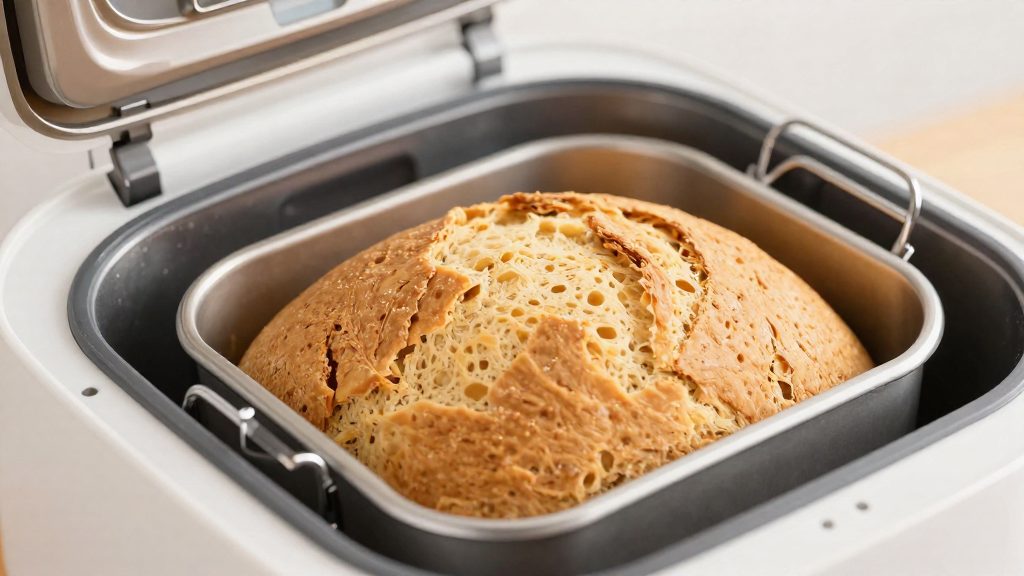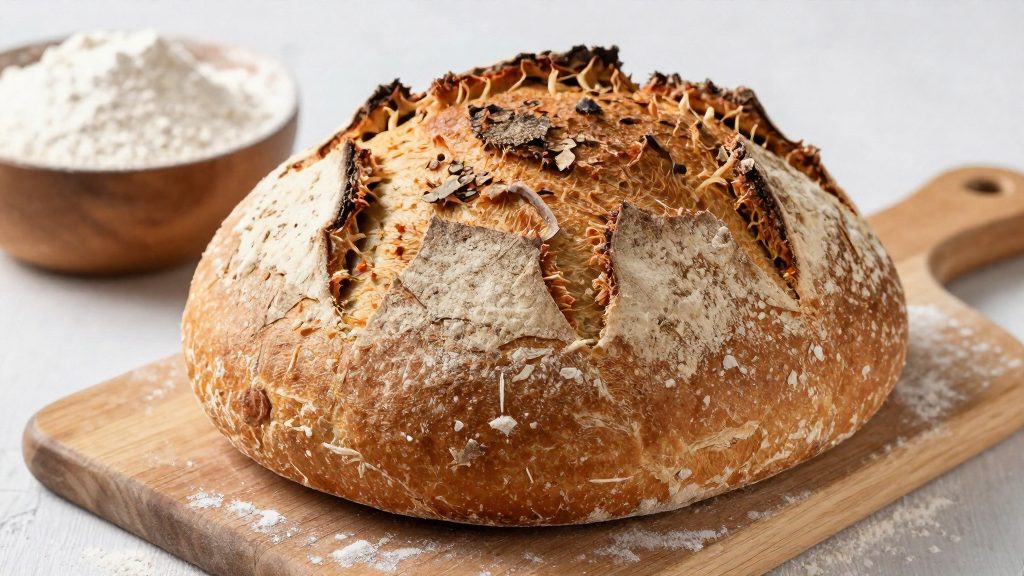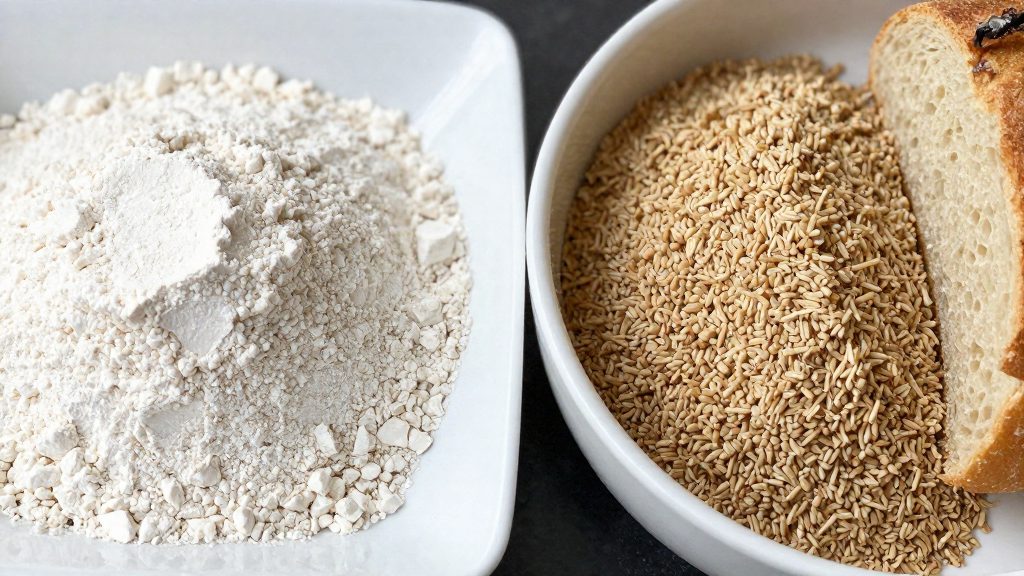
Bread flour and whole wheat flour produce different sandwich loaves. Bread flour gives a lighter, softer crumb that rises higher. Whole wheat keeps more of the grain, so the crumb is darker and usually denser. The Red Star Yeast (Lesaffre) (2026) whole wheat sourdough sandwich loaf relies mainly on white whole wheat flour, with bread flour as a smaller share.
Whole wheat vs bread flour: what changes in a sandwich loaf?
Protein, bran and fibre
This comparison is qualitative:
- Bread flour is milled to remove most of the bran and germ, which leaves a refined flour that is easier to shape into a tall, even loaf.
- Whole wheat flour keeps the bran and germ, which adds fibre and flavour but also weighs down the dough.
- White whole wheat flour is milled from a lighter-coloured wheat, so it looks closer to white flour while still containing the whole grain.
Crumb colour, height and softness
Whole wheat produces a darker, denser crumb, while bread flour gives a paler, finer, softer crumb.
Which flour suits which sandwich loaf style
- Soft, tall, white-style sandwich loaf: bread flour as the main flour.
- Wholesome, darker sandwich loaf: white whole wheat flour as the main flour, as in Red Star’s recipe.
How bread flour builds structure and rise
Bread flour is milled to contain more protein than general-purpose flour, and that protein is what makes a sandwich loaf hold its shape. When flour meets water and is kneaded, two proteins, glutenin and gliadin, link into gluten, a stretchy network of strands. Check the bag label for the flour type, and judge the dough by how it behaves.
During proofing, yeast produces carbon dioxide. The gluten strands stretch around these gas bubbles and keep them from escaping, so the dough grows and becomes airy. A dough with weak gluten lets gas leak out and collapses or spreads sideways.
In the oven, the trapped gas expands quickly in the early heat, which produces oven spring, the fast rise before the crust sets. The gluten network sets as the crust forms, fixing the loaf’s final height. A well-built network gives a tall, even loaf with a fine crumb.
In Red Star Yeast’s (Lesaffre, 2026) whole wheat sourdough sandwich loaf, the bread flour is the structural part of the blend:
| Component | Amount in the recipe | Role in the loaf |
|---|---|---|
| Bread flour | About 2 cups | Supplies the gluten network that traps gas |
| White whole wheat flour | 4 to 5 cups | Provides the bulk and whole-grain flavour |
| Total flour | Roughly 6.5 to 7 cups | Forms the dough together |
What whole wheat adds, and what it takes away
Whole wheat flour keeps the bran and germ that white flour removes, so it brings more fibre, minerals and a toasty, nutty taste to a sandwich loaf. Whole wheat sandwich recipes often blend in a stronger flour instead of relying on whole wheat alone.
How bran affects gluten
The bran is the tough outer layer of the grain. Bran particles are commonly said to interfere with gluten development as the dough is mixed and kneaded, and the gluten strands that hold gas end up weaker. A weaker network holds less gas, so the loaf rises less and its crumb is denser than a white loaf made with the same method.
What the germ and bran contribute
| Part of the grain | What it contributes | What it costs |
|---|---|---|
| Bran (outer layer) | Fibre and minerals | Cuts gluten strands and limits volume |
| Germ (embryo) | Minerals and a nutty, toasty flavour | Works mainly on taste and nutrition, not structure |
Because the germ affects flavour more than structure, it is the reason whole wheat loaves taste richer even when the crumb is tighter. Bread made only from the whole grain tends to be denser, so the balance of bran and germ is a choice between nutrition and lift.
Is a blend the best choice for soft sandwich bread?
Pure whole wheat dough is heavy. Red Star Yeast’s whole wheat sourdough sandwich loaf sidesteps this by mixing in bread flour.
Why bread flour supports whole wheat
Bread flour is milled to be strong, so its proteins form a stretchy gluten network that can hold the carbon dioxide produced during fermentation. A portion of bread flour gives the dough enough structure to rise high and keep a fine, soft crumb, while the rest of the flour still provides whole grain flavour and colour.
What the blend cannot tell you about pure whole wheat
If you make a loaf only from traditional whole wheat, treat any change from Red Star’s blend as an experiment. For a soft loaf, use mostly bread flour. For a whole-grain loaf, use a blend with some bread flour, as Red Star does.
How should you adjust hydration and kneading?
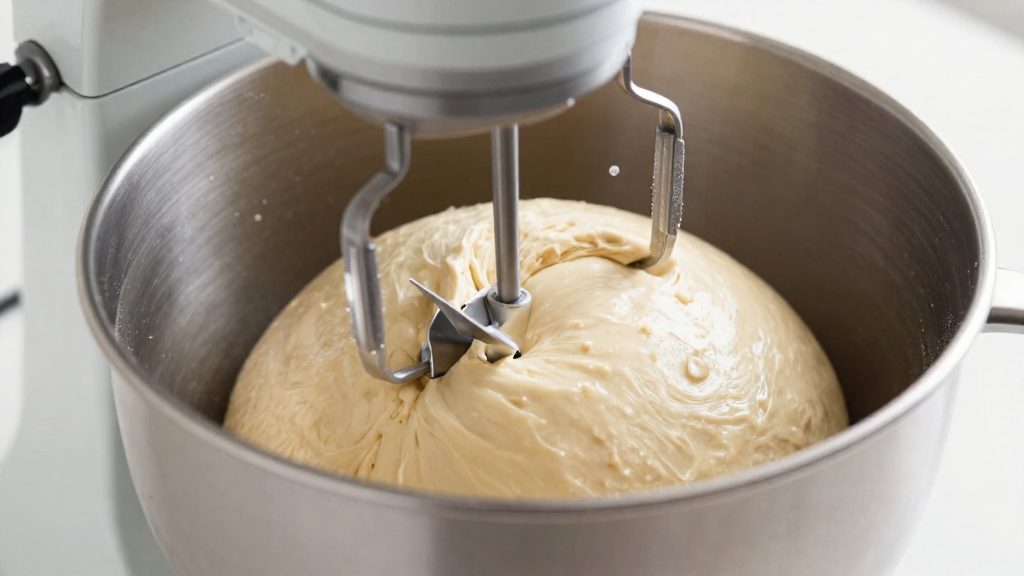
Red Star Yeast (Lesaffre) (2026) directs bakers to add flour until the dough is no longer sticky, while keeping it quite soft. For a whole wheat sandwich loaf, the goal is a dough that handles cleanly and still stretches, not one that feels stiff. Adjust in small steps and check the dough’s feel at each stage.
Adding flour until the dough is no longer sticky
- Add flour in small portions while the mixer or your hands are working the dough.
- Let each addition mix in fully before you decide whether more is needed.
- Stop when the dough pulls away from the sides of the bowl and no longer clings heavily to your fingers.
- Do not keep adding flour past that point. The recipe describes the dough as staying soft at this stage.
Keeping the dough soft with added whole wheat
| Dough feel | What to do |
|---|---|
| Sticky, clings to fingers and the bowl | Add flour a little at a time, mixing between additions |
| Pulls from the bowl, slightly tacky | Stop adding flour and keep the dough soft |
| Stiff, tears when gently stretched | Too much flour was probably added; the sources give no fix, but working in a little water gradually is a common baker’s adjustment |
Kneading time and the windowpane test
Judge the dough by its condition rather than by the clock. Use the windowpane test to check gluten development:
- Pinch off a small piece of dough.
- Stretch it gently between your fingers into a thin sheet.
- If it stretches thin enough to let light through without tearing, the dough is ready.
- If it tears early, knead for longer and test again.
Repeat the test at intervals during kneading rather than only once at the end. Each check tells you whether to keep working the dough or stop.
Why does whole wheat dough rise differently?
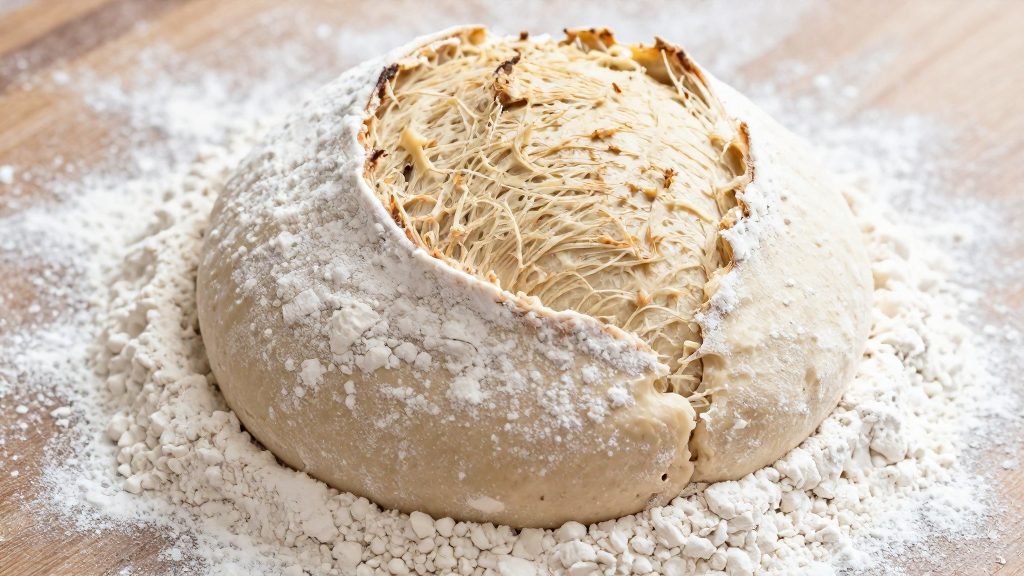
The Red Star Yeast recipe for a whole wheat sourdough sandwich loaf, published by Red Star Yeast (Lesaffre) (2026), asks the baker to judge each stage by appearance, so the kitchen timer is a weak guide. The same page includes a commenter’s report that stone-ground wheat rose much more slowly. That is one user’s experience, not a measured result.
Judging the first rise
Use appearance rather than the clock. Red Star’s guidance is that the first rise is complete when the dough has almost doubled and a two-finger imprint remains after you press it.
To test, dust two fingers with flour and press gently into the dough:
- If the dent springs back quickly and fills in completely, the dough needs more time.
- If the dent stays and the surface holds its shape, the dough is ready.
- If the dent stays but the surface sags or collapses, the dough has gone too far.
Judging the second rise
After shaping, the second rise is finished when the loaves sit just above the pan tops. Check this visually, and avoid pushing the loaves past that point, because an over-risen loaf can collapse in the oven.
| Rise | What to look for |
|---|---|
| First rise | Almost doubled in volume, with a two-finger imprint that remains |
| Second rise | Shaped loaves sitting just above the pan tops |
White whole wheat or traditional whole wheat?
Red Star Yeast’s whole wheat sourdough sandwich loaf specifies white whole wheat flour, not traditional whole wheat. The two are different products, so a straight swap is an untested change. According to Red Star Yeast (Lesaffre, 2026), bakers should check the flour manufacturer’s guidance before substituting one for the other. This guidance concerns only the swap between white whole wheat and traditional whole wheat. If you only have traditional whole wheat, treat the result as a new test rather than a faithful reproduction of the recipe.
Colour and flavour differences
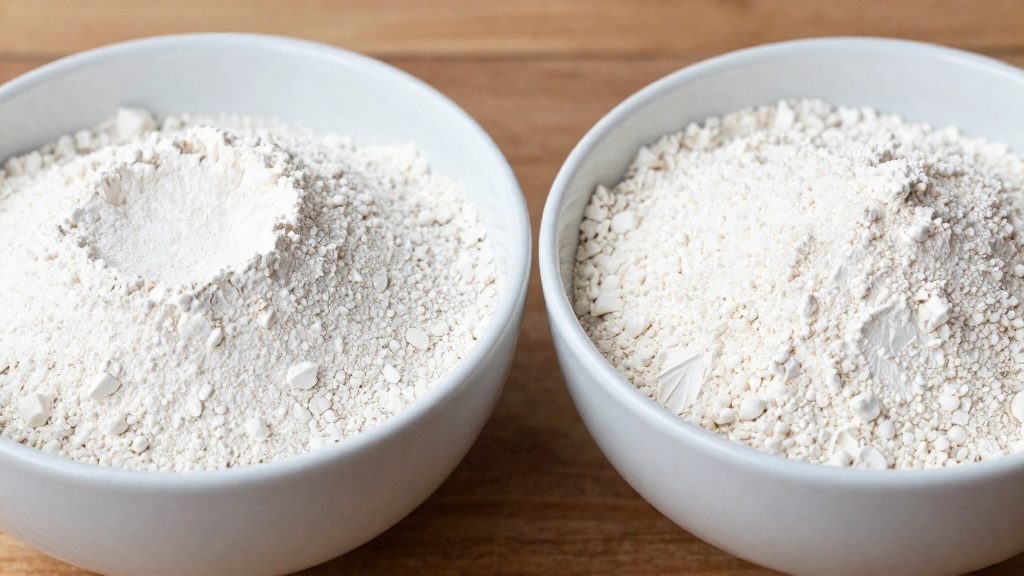
You can compare white whole wheat and traditional whole wheat yourself:
- Place a small pinch of each flour side by side on a white plate and note the shade.
- Smell each flour and compare the aroma, but do not taste raw flour, because uncooked flour can carry harmful bacteria.
- Record what you observe in your baking notes, next to the bag name and brand.
What to check before swapping
- Wheat type on the bag: Confirm whether the bag says white whole wheat or traditional whole wheat before you buy or measure.
- Manufacturer guidance: Look for the miller’s own baking advice, since Red Star defers to it for any swap.
Storing whole wheat flour
Whole wheat flour keeps the bran and germ, and the germ contains germ oils. Once the grain is milled, those oils are exposed to air, and over time they can oxidize and turn rancid. This is why whole wheat flour typically goes off faster than white flour. The flour is not dangerous in the way spoiled food can be, but it loses its fresh, nutty smell and can make bread taste bitter or stale. A simple smell test works well: fresh whole wheat flour smells mild and slightly sweet, while rancid flour smells sharp and unpleasant, like old nuts or stale oil.
Why germ oils cause rancidity
Oxidation speeds up with three things: contact with air, exposure to light, and warmth. Milling also breaks open the grain structure, so more of the oil reaches the air than it would in whole grain. Keeping the flour sealed, dark, and cool slows this process, but it cannot stop it, so buying smaller quantities and using them within a reasonable period is the simplest protection.
Airtight container in a cool, dark place
Store the flour in a lidded container or a sealed bag, pressing out as much air as possible. The main controls are:
| Factor | Why it matters | Practical step |
|---|---|---|
| Air | Drives oxidation of the germ oils | Use a container with a tight seal and keep it closed between uses |
| Light | Can accelerate rancidity | Keep the container in a cupboard or drawer |
| Warmth | Speeds up oil breakdown | Store away from the oven, stove, and sunny windows |
| Moisture | Causes clumping and encourages spoilage | Use a dry scoop and keep the container dry |
Freezing whole wheat flour
Freezing slows the chemical changes that lead to rancidity, which makes it a practical option for flour you will not use quickly. Divide the flour into smaller freezer bags, press out the air, label each bag with the date you froze it, and place it in the freezer. Before opening a bag that has been frozen, let it come to room temperature while still sealed, which helps prevent moisture from condensing on the flour. Avoid repeated thawing and refreezing. Judge the flour by smell and appearance before use.
Frequently asked questions
Can I swap bread flour for whole wheat flour one-for-one?
Not with any confidence. Red Star Yeast (Lesaffre) (2026) advises checking the flour manufacturer’s guidance when moving between white whole wheat and traditional whole wheat. Treat any swap as a test batch, since whole wheat tends to produce a darker, denser loaf.
How much flour does a whole wheat sandwich dough need?
Red Star’s whole wheat sourdough sandwich loaf uses about 2 cups of bread flour and 4 to 5 cups of white whole wheat flour, roughly 6.5 to 7 cups in total. Add flour until the dough is no longer sticky but still quite soft. As a general baking tip, add flour in small amounts, because a stiff dough that tears when stretched usually means too much has gone in.
How do I judge the rises without fixed times?
Red Star Yeast (Lesaffre) (2026) judges the first rise by sight, when the dough has almost doubled and holds a two-finger imprint. It judges the second rise when the loaves sit just above the pan tops. The page gives no fixed times, and one commenter reported that stone-ground wheat rose much more slowly, so the pace may differ from that of white dough.