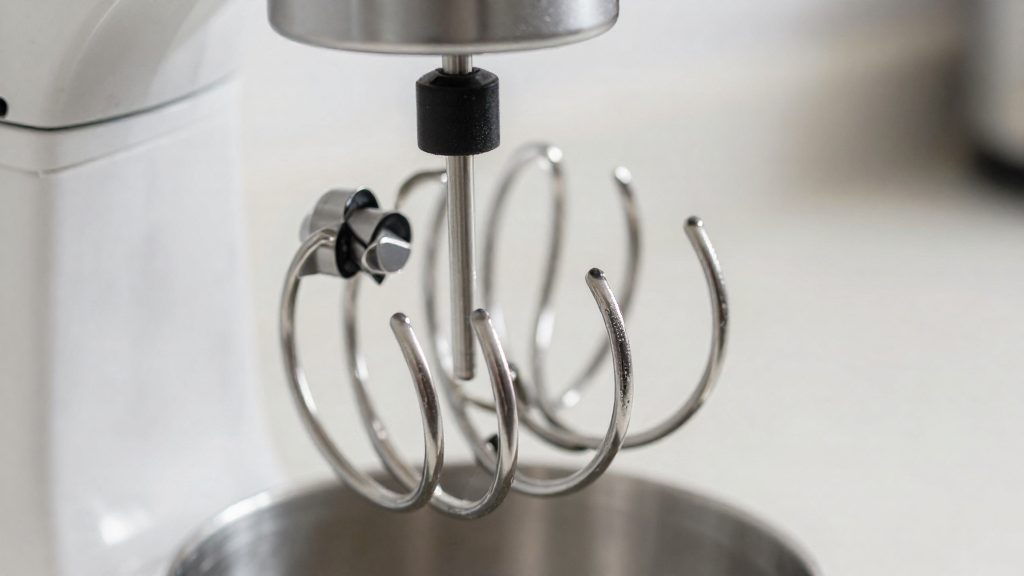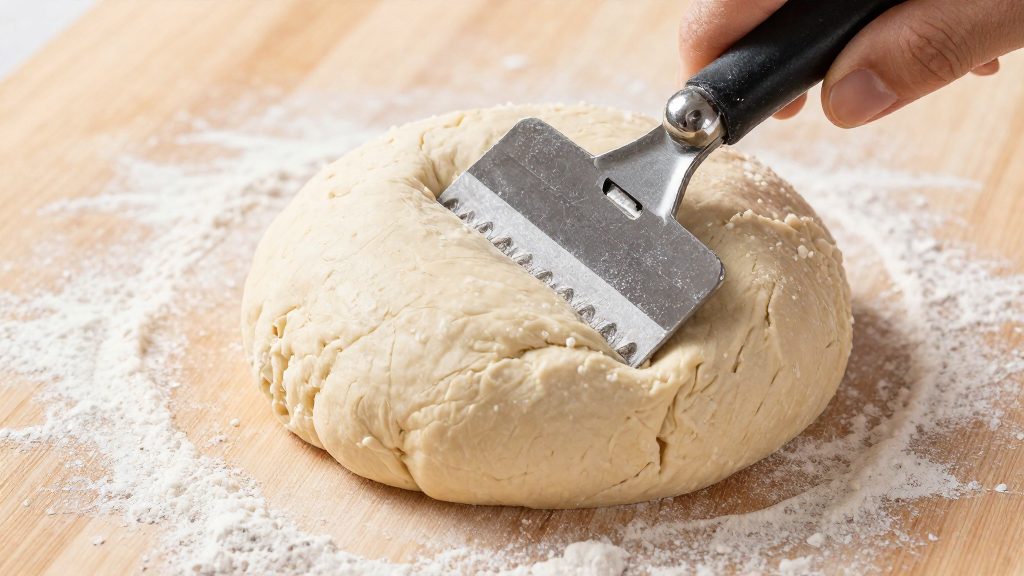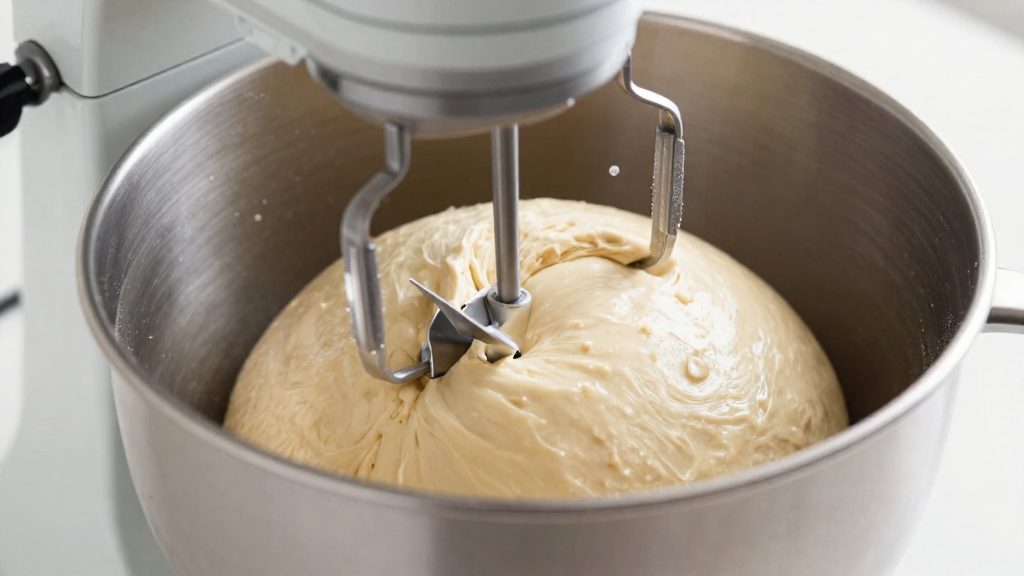
A stand mixer takes over the repetitive stretching and folding that hand kneading demands, so the dough is worked for a steady period, more evenly, and with less strain on your hands and arms. For most home bakers, the main gains are less effort on wet doughs, more consistent gluten development, and results that are easier to repeat from one bake to the next.
Why use a stand mixer for bread dough?
Gluten development is the main reason. When you knead by hand, you push, fold and stretch the dough in short bursts, and the gluten network builds up gradually as you check the texture. A stand mixer keeps the dough in continuous contact with the kneading tool at a set speed, so you can time the process rather than estimate it. Consumer Reports judges kneading on two points: how evenly the dough is mixed and how well it rises after kneading (Consumer Reports, 2026). Those are the same signs a baker looks for by hand, so they give you a practical yardstick for judging machine results.
Effort on wet, sticky doughs is where the difference is most noticeable. Higher-hydration doughs cling to the hands and the work surface, and hand kneading then depends on repeated lifting and slapping. In a mixer, the dough stays in the bowl while the tool does the work. Stability matters here too: Consumer Reports notes that for thick doughs such as pizza dough, a heavier mixer, or one with suction cups, stays put on the counter instead of moving during kneading (Consumer Reports, 2026).
Batch-to-batch consistency matters when you bake the same loaf regularly. Hand kneading varies with the baker’s pressure and rhythm on the day. A mixer lets you repeat the same speed and time with the same flour, water and bowl, which gives each batch a more comparable starting point.
| Factor | Hand kneading | Stand mixer |
|---|---|---|
| Effort on sticky dough | Repeated lifting, folding and slapping | Dough stays in the bowl while the tool works |
| Gluten development | Built in short, uneven bursts, judged by feel | Continuous at a set speed you can time |
| Repeat bakes | Depends on technique on the day | Easier to match speed and time between batches |
What to look for in a bread-dough mixer
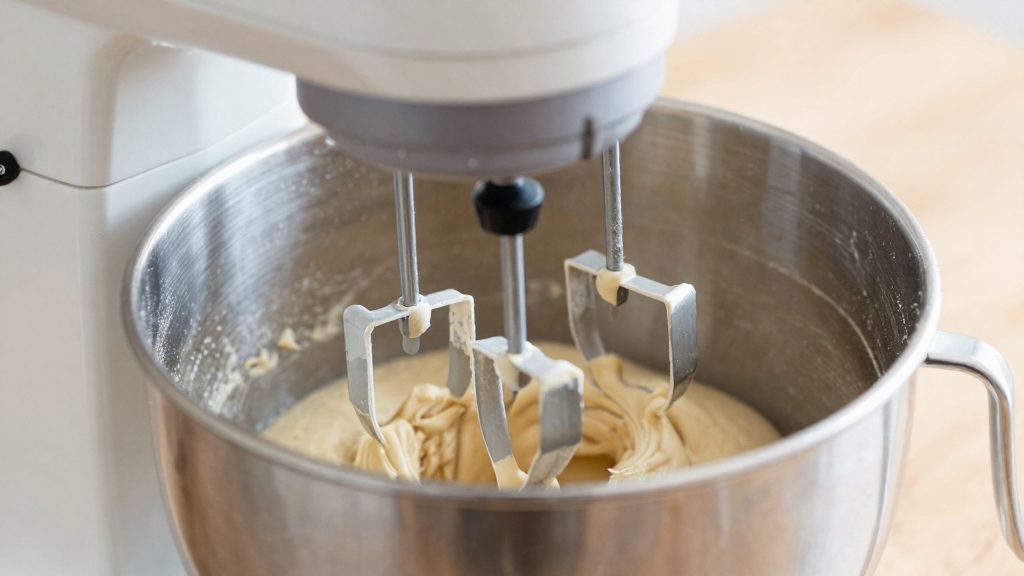
A stand mixer for bread dough should be judged on three things before you buy: the motor, the build quality of the body and gears, and the bowls and attachments in the box. Use the checks below to confirm what you are buying.
Motor power and torque
Motor power is usually advertised in watts. Torque describes the turning force the motor delivers to the dough, especially at low speed, where bread dough is worked. Find both figures in the manufacturer’s specification sheet.
Gear and metal build quality
Build quality affects how a mixer handles stiff dough over repeated batches. Check these points:
- Whether the body and bowl support are metal. Consumer Reports (2026) rated the Hamilton Beach Professional All-Metal 63240 and the Martha Stewart CC010830-001 as excellent for kneading dough, and the Smeg Forte SMF05 and Beautiful by Drew Barrymore 19113 as very good, but the sources do not say that metal construction explains these ratings.
- The drive gears sit inside the head and cannot be inspected by eye. Rely on the brand’s warranty terms and independent test results.
- Whether the base is heavy or has suction cups. This keeps the machine steady while thick dough is worked.
Bowls, hooks and included attachments
Included attachments determine whether the mixer is ready for bread out of the box. Confirm that a dough hook is supplied, not only a general-purpose beater, and check whether the bowl material and any extra attachments are listed on the product page. Compare the included items against the dough you plan to make, and ask the seller which parts are sold separately if a replacement is needed.
Bowl-lift or tilt-head: how the two layouts differ in use
For bread dough, how well a mixer holds up under load matters more than the head design alone. The consulted sources do not specify the head design of each model, so the comparison below describes how each layout behaves in use. A bowl-lift mixer raises the bowl into the mixing tool and locks it on the base. A tilt-head mixer keeps the bowl on the base and swings the head back to open the work area.
| Criterion | Bowl-lift | Tilt-head |
|---|---|---|
| Stability under heavy dough | Bowl is clamped during kneading, which suits stiff dough | Depends on the base weight and feet |
| Bowl access | Bowl must be lowered to add or remove dough | Head tilts back for direct access |
| Dough removal | Lower the bowl, then lift the dough out | Tilt the head, then lift the dough out |
| Scraping clearance | Tool sits close to the bowl wall | Usually more room to scrape by hand |
Bowl access and dough removal
A tilt-head design makes it easier to reach a sticky batch and to scrape the bowl. Tilt the head back, scrape with a spatula while the motor is off, then lift the dough out.
Which stand mixers knead best in tests?
Consumer Reports tests stand mixers on kneading bread dough (Consumer Reports, 2026). Two models earned the top rating of excellent: the Hamilton Beach Professional All-Metal 63240 and the Martha Stewart CC010830-001. Both earned the top kneading rating in the test, so they are a strong starting point for bread bakers who knead by machine.
The next tier is very good, which means solid kneading that falls just short of the top rating. The Smeg Forte SMF05 and the Beautiful by Drew Barrymore 19113 both fall into this group.
At the bottom of the comparison is the KitchenAid Commercial Series KSM8990ER, which Consumer Reports rated only so-so at kneading bread dough. Its result shows that a higher price or a heavy-duty build does not automatically translate into better kneading. When choosing a stand mixer for bread, the kneading rating matters more than the model’s reputation.
| Stand mixer | Consumer Reports kneading rating (2026) |
|---|---|
| Hamilton Beach Professional All-Metal 63240 | Excellent |
| Martha Stewart CC010830-001 | Excellent |
| Smeg Forte SMF05 | Very good |
| Beautiful by Drew Barrymore 19113 | Very good |
| KitchenAid Commercial Series KSM8990ER | So-so |
How much dough can a stand mixer handle?
The bowl sets the first limit. Each stand mixer has a capacity stated by its manufacturer. Dough needs room to expand as it kneads and rises, so a batch that fills the bowl to the rim leaves little margin.
Bowl capacity and batch size
Treat the bowl’s stated capacity as the ceiling, not the target. Leave visible space above the dough so it can climb the sides and the hook has room to fold it. If the dough struggles to turn, or stays stuck to the bottom while the hook spins, the batch is probably too large for that bowl.
Hydration effects
Hydration, the ratio of water to flour, changes how much room a batch needs. A wetter dough spreads and climbs the bowl more easily, so it fills more space than a stiff one of the same flour weight. Stiffer doughs stay compact but put more strain on the motor and hook. Reduce the batch when working with a very wet dough, and check the bowl at the start of kneading.
Scaling recipes for smaller bowls
To fit a smaller bowl, multiply every ingredient by the same factor. This keeps the flour, water, salt and leaven in their original ratios. If the scaled batch still feels crowded, divide it and knead in two rounds rather than overfilling the bowl.
Spiral hook or planetary mixer: what is the difference?
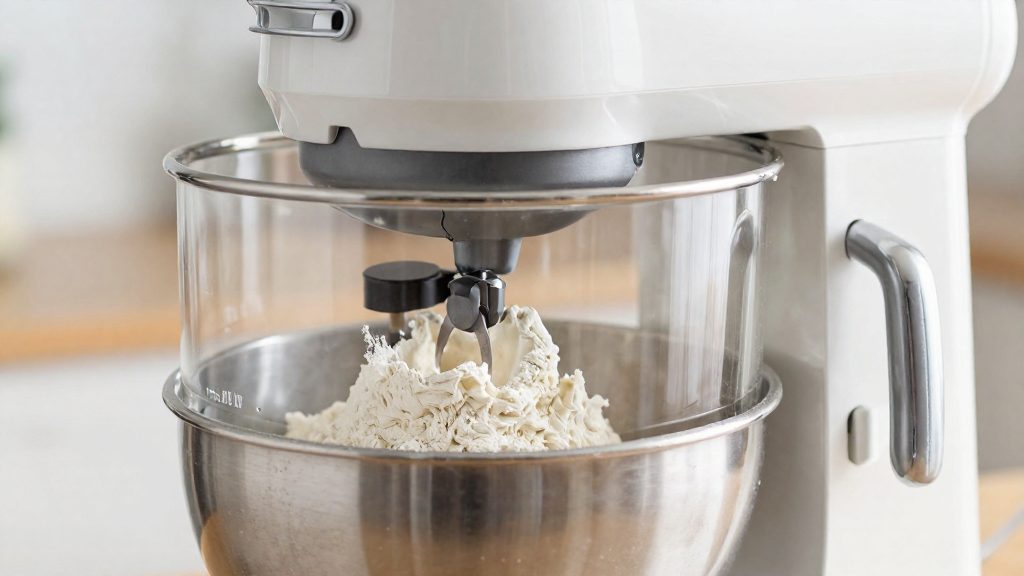
A spiral hook is a fixed-shape arm that turns in the bowl. In most spiral designs the bowl also rotates, so the dough is carried around and pressed against the wall with each pass. The dough tends to stay together as one cohesive mass that is stretched and folded over itself as it moves around the bowl. Because the contact is concentrated in one area, the mixer works the dough in a fairly predictable loop.
A planetary hook spins on its own axis while also travelling around the centre of the bowl, like a planet orbiting a sun. The dough is lifted, pulled off the wall and folded through the middle of the bowl. Its path crosses more of the bowl, so the dough is handled in more varied directions.
These different paths affect gluten development. The spiral action builds gluten through repeated stretching of one mass, which keeps the dough compact. The planetary action works the dough through more changing folds and tears, which can spread the work more evenly across the bowl. Neither motion is better on its own. The result depends on the dough’s hydration and the time you give the machine.
| Feature | Spiral hook | Planetary hook |
|---|---|---|
| Main movement | Hook turns; bowl usually turns too | Hook spins and orbits the bowl |
| Path through dough | Dough is carried around and pressed against the wall | Dough is lifted and folded through the centre |
| Gluten development | Builds through repeated stretching of one mass | Builds through varied folds across the bowl |
Checking the result: Stop kneading when the dough looks uniform, with no dry pockets, and when a small piece can be stretched thin without tearing.
Do you need a stand mixer for pizza dough?
A stand mixer is not strictly necessary for pizza dough, but it helps with larger batches or stiffer doughs. Whether a model suits pizza dough depends mainly on motor load and stability, not on price alone.
Motor load from stiff, low-hydration dough
Low-hydration pizza dough contains less water relative to its flour, so it is firm and resists the hook. The motor has to work harder to turn it, and the machine can slow or strain if the dough is kneaded at high speed for too long. Start on a low speed, add water gradually, and stop once the dough pulls cleanly away from the bowl. An even mix matters more than a long knead.
Suction cups and a heavier base
Suction cups grip the counter, and a heavier base resists the push of the hook against firm dough. If the mixer walks across the counter during kneading, it is not stable enough for that dough.
| Stability feature | What it does | What to check before buying |
|---|---|---|
| Suction cups | Hold the mixer in place on the counter | Whether the feet grip your work surface |
| Heavier base | Resists movement under a stiff load | Whether the unit is heavy enough for your typical batch |
Hand kneading for small pizza batches
For one or two pizzas, hand kneading is a practical alternative. Mix flour, water, salt and yeast until a shaggy dough forms, then rest it so the flour fully absorbs the water. Stretch and fold the dough on the counter until it becomes smooth and elastic. A short rest between sets of folds makes the gluten easier to stretch. This takes more time and effort, but it needs no machine, so there is no stability or motor load to manage.
Tips for kneading dough without straining the motor
Stand mixers usually strain when they are asked to move a stiff, dry mass of dough at full power. The habits below reduce that load without changing the recipe. They matter most for dense doughs such as pizza dough.
Start low and raise the speed gradually
Begin at the lowest speed setting so the flour hydrates before the hook has to stretch the dough. Increase the speed only once the ingredients have come together into a cohesive mass. Starting fast can throw flour around and strain the motor before the dough has come together.
Kneading time is also a strain factor. The target is smooth, elastic dough rather than the longest possible run. Stop once the dough has reached that texture. Extra minutes add motor time without improving the result.
Use an autolyse rest to shorten kneading
An autolyse is a rest in which flour and water are combined and left to sit before the salt, yeast, or levain are added. During the rest, the flour absorbs the water and gluten begins to form without mechanical work. The dough then needs less kneading to become smooth. This is especially useful for wetter bread doughs, which can otherwise require long, hard kneading to come together.
Pause to let the motor cool
For long or stiff kneads, stop the mixer at intervals and let the motor cool. Use each pause to scrape the bowl and hook, lift any dough caught on the hook, and check the texture. If the motor housing feels warm, let it cool before continuing. Resuming on a warm motor adds heat on top of an already heavy load.
| Habit | What it reduces |
|---|---|
| Low starting speed | Peak load at the start, when the flour is dry and stiff |
| Autolyse rest | Total kneading time needed to reach a smooth dough |
| Scheduled pauses | Heat building up in the motor during a long knead |
| Stopping at the target texture | Run time that adds no benefit to the dough |
Frequently asked questions
Which stand mixers did best at kneading dough in Consumer Reports’ tests?
The Hamilton Beach Professional All-Metal 63240 and the Martha Stewart CC010830-001 earned excellent scores for kneading. The Beautiful by Drew Barrymore 19113 and the Smeg Forte SMF05 were rated very good, so they are solid options if you want a slightly different price or design (Consumer Reports, 2026).
Does a more expensive or heavier-duty mixer knead bread better?
Not necessarily. Consumer Reports rated the KitchenAid Commercial Series KSM8990ER only so-so at kneading bread dough, even though it is a premium heavy-duty model. Check the kneading rating for a specific model rather than assuming that price or size predicts how well it will handle a loaf.
My mixer shifts across the counter when I knead thick pizza dough. What should I look for?
Consumer Reports suggests choosing a heavier mixer or one fitted with suction cups to keep it anchored during kneading of stiff doughs (Consumer Reports, 2026). If your current model moves, adding weight to the base or placing a non-slip mat underneath may also help.