Can a bread machine make good gluten-free bread?
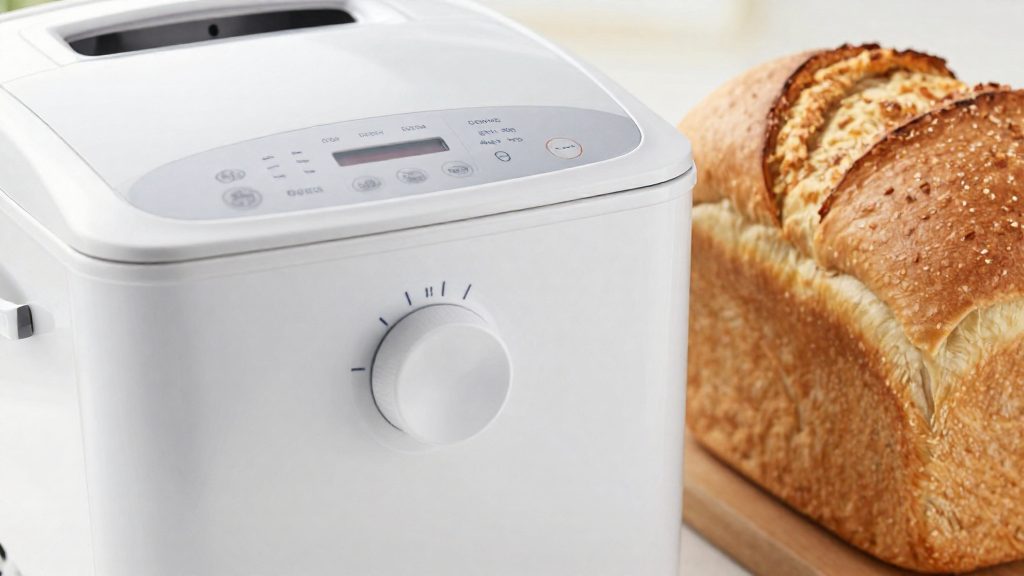
Yes, a bread machine can produce a good gluten-free loaf, but the result will differ from wheat bread. Wheat dough traps gas in a stretchy gluten network, while gluten-free flours lack that network, so the loaf is usually softer, more crumbly and less open-textured. The best results come from choosing a cycle and recipe built for gluten-free dough and judging the loaf by its own standard rather than against a wheat loaf.
Can a bread machine make good gluten-free bread?
Why gluten-free dough behaves like a thick batter
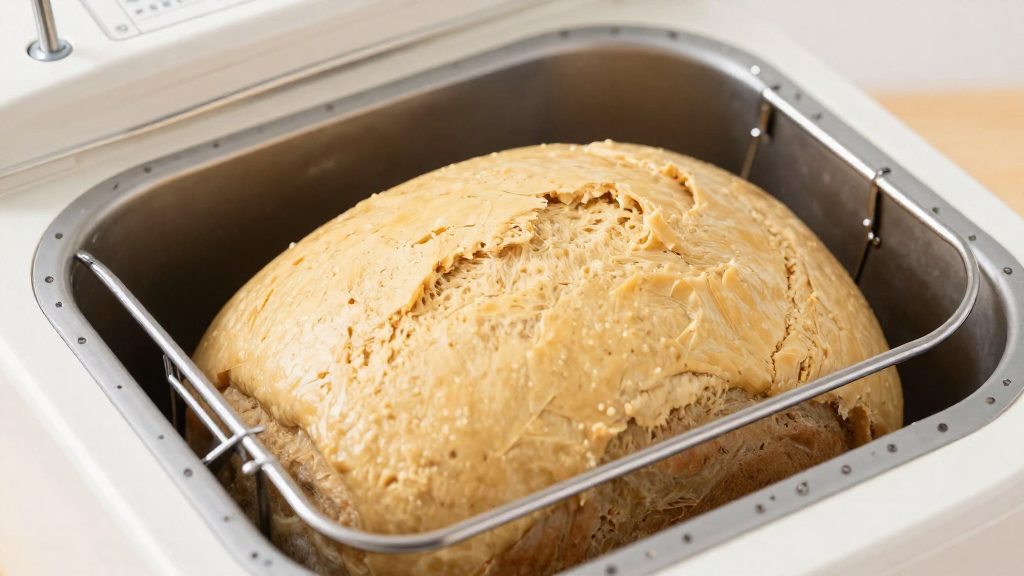
Gluten-free dough is wetter and looser than wheat dough, closer to a thick batter than a kneadable ball. It cannot be stretched and folded into a structure, so extra kneading does not improve it. According to Gluten Free Palate (2023), gluten-free bread needs only one mixing cycle and no second rise, which is why a machine’s standard wheat program often produces a poor loaf.
The table below shows how the two dough types differ in the machine.
| Step | Wheat dough | Gluten-free dough (Gluten Free Palate, 2023) |
|---|---|---|
| Mixing | Extended kneading to build gluten | One mixing cycle |
| Second rise | Usually included | Not needed |
Typical texture limits compared with wheat loaves
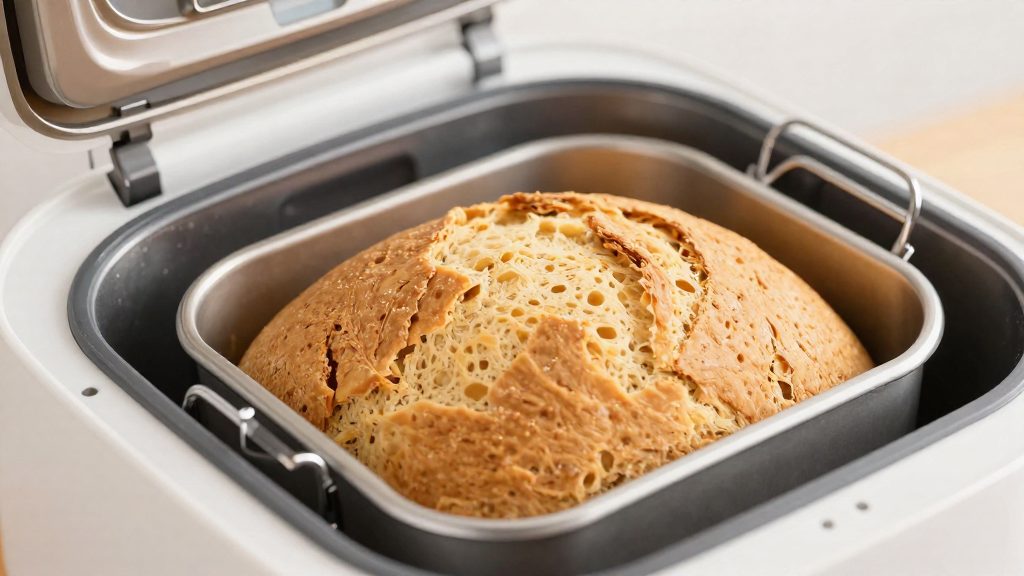
Expect a moister, more tender crumb that can crumble when sliced, and a crust that is often softer than a wheat crust. Gluten-free loaves also tend to be denser and rise less high. Cooling the loaf fully before slicing helps the crumb set and reduces crumbling.
The role of binders such as xanthan gum
Recipes rely on binders to hold gas and moisture inside the dough. Xanthan gum is a common example: it thickens the batter and helps the crumb hold together after baking. Follow the amount the recipe specifies, since adding more binder does not reliably produce a better loaf.
What features matter in a gluten-free bread machine?
The hardware traits that matter most for gluten-free dough are loaf size, paddle design, and how easily the pan and paddles come clean. Gluten-free batters are wetter and stickier than wheat doughs, so the machine’s shape and mixing action affect the result more than they do with standard bread. Pay closest attention to loaf capacity and paddle design, where there is a clear preference.
Loaf size range
According to The Daring Kitchen (2020), gluten-free bread machines have loaf capacities from 1 lb to 2.5 lb. Choose a size that matches how much bread your household eats. A smaller loaf suits one or two people, while a larger one suits families or batches you plan to freeze. Check that the recipe is sized for your machine’s stated capacity.
Dual paddle versus single paddle
The Daring Kitchen (2020) states that dual paddles work best. Dual paddles mix the batter at two points in the pan, while a single paddle leaves one central mixing point. The paddle count is one of the features the Gluten Free Palate (2023) guide asks readers to compare.
Pan shape and cleaning
The Gluten Free Palate (2023) lists pan shape and ease of cleaning among the features to compare. Look for a removable pan and paddles, which make it easier to wash batter from the seams.
| Feature | What the sources state |
|---|---|
| Loaf size | 1 lb to 2.5 lb capacity (The Daring Kitchen, 2020) |
| Paddles | Dual paddles work best (The Daring Kitchen, 2020) |
Best bread machines for gluten-free loaves
This article compares three machines drawn from two specialist guides, and each suits a different kitchen. The Zojirushi Home Bakery Virtuoso Plus (BB-PDC20BA), the Hamilton Beach #29885 and the Breville BBM800XL cover three priorities: the most features, the lowest entry cost, and a built-in power reserve. Gluten Free Palate (2023) names the Zojirushi its top pick and the Hamilton Beach its budget pick. The Daring Kitchen (2020) highlights the Breville’s recipe library and backup power.
Zojirushi Virtuoso Plus BB-PDC20BA: top pick
- Heaters sit at the bottom and in the lid, a design Gluten Free Palate (2023) lists among the features of its top pick.
- A ‘homemade’ course lets you set custom knead, rise and bake times, and the machine uses double kneading blades.
- The Daring Kitchen (2020) lists 13 settings.
- Trade-offs: the premium price and the large footprint, which matters on a small counter.
Hamilton Beach #29885: budget pick
- Offers three crust settings and 1, 1.5 and 2 lb loaf sizes.
- Gluten Free Palate (2023) notes that it may need extra bake time on its gluten-free setting, so check the loaf’s internal temperature or appearance before removing it.
- Gluten Free Palate (2023) names it the budget pick, with a more limited feature set than the Zojirushi.
Breville BBM800XL: recipe library and backup power
- Lists four loaf sizes and 46 recipes, according to The Daring Kitchen (2020).
- Includes backup power of 60 minutes, which is the feature the source highlights most for this model.
- Confirm the gluten-free setting and bake-time behaviour for the BBM800XL in the manual before baking gluten-free loaves.
Do you need a dedicated gluten-free setting?
A dedicated gluten-free setting is convenient, but it is not strictly required. The real question is whether your machine’s cycle avoids a second rise. If the machine has no gluten-free program, a basic, quick or one-rise cycle can stand in, according to Gluten Free Palate (2023-03-15). Check your manual to confirm the cycle has only one rise.
| Option | What the source says | Practical use |
|---|---|---|
| Dedicated gluten-free setting | The Hamilton Beach #29885 has one preset, and the Zojirushi Home Bakery Virtuoso Plus has a gluten-free setting | The simplest choice: select the preset and follow the recipe |
| Basic, quick or one-rise cycle | Can stand in when a machine has no gluten-free setting | Use when the machine lacks a gluten-free program |
Gluten Free Palate (2023-03-15) lists gluten-free or adjustable cycles among the features to compare, so check which cycles a model offers before you buy.
Budget or premium: how much should you spend?
Gluten-free bread machines typically cost roughly $60 to $300, according to The Daring Kitchen (2020-11-13). Within that range, the difference between models is less about the loaf and more about how much you can control the baking process. A budget machine offers a short list of preset options. A premium machine adds hardware and programming that you can adjust yourself. Paying the top price makes sense only if those extras match how you bake.
What each price tier buys
| Tier | Example from Gluten Free Palate (2023-03-15) | What it offers |
|---|---|---|
| Budget | Hamilton Beach #29885 | One preset gluten-free setting and three crust settings |
| Premium | Zojirushi Home Bakery Virtuoso Plus (BB-PDC20BA) | Heaters in the bottom and lid, a ‘homemade’ course with custom knead, rise and bake times, and double kneading blades |
Heaters and custom programs
The second premium feature is the custom programs. This helps when a recipe needs a longer bake or a different rise than the preset allows. A budget machine with one gluten-free setting cannot offer that flexibility, so you would need to adjust your recipe to fit the machine.
Warranty and long-term value
Check the warranty length and coverage in the manufacturer’s documentation before buying. Gluten Free Palate lists warranty alongside loaf size, number of paddles, ease of cleaning and price as features to compare (2023-03-15).
Long-term value depends on how often you bake and which settings you use. If you make the same preset loaf each week, a budget model covers that need. A premium model justifies its cost mainly when you regularly use the custom programs and the extra heater.
Tips for better gluten-free bread in a machine
Most of the work in a gluten-free loaf happens before the machine starts. Three hands-on habits make the biggest difference: taking out the paddles before the bake stage, loading ingredients in the sequence the manufacturer specifies, and starting from a tested recipe.
Remove the paddles before baking
Kneading paddles are needed during mixing, but they should not stay in the pan for baking. According to The Daring Kitchen (2020), leaving them in can leave a hole in the finished loaf. Check whether your model lets you pause the cycle before the bake stage. If it does, use that pause to lift the paddles out. If it does not, read the manual for the recommended method, because stopping a cycle partway can affect the result.
Load ingredients in the manufacturer’s order
Gluten-free dough is more sensitive to how it is assembled than a wheat dough, so the sequence matters. Follow the order printed in your bread machine manual, as The Daring Kitchen (2020) advises, rather than the order in a recipe written for an oven. Place each ingredient exactly where the manual indicates, and avoid adding a forgotten item later unless the manual describes how to do so. Keeping the same order every time makes it easier to tell which change caused a difference in your results.
Start from a gluten-free recipe
Some machines come with recipes designed for gluten-free baking. The Zojirushi Virtuoso includes a dedicated gluten-free recipe chapter, according to The Daring Kitchen (2020). The Breville BBM800XL offers 46 recipes. Use the recipe’s flour, liquid and sequence unchanged for your first bake. This gives you a baseline loaf to compare against before you adjust anything.
Is gluten-free bread from a machine safe for celiacs?
A bread machine can bake a loaf without wheat, barley or rye, but the machine alone does not make the bread safe for someone with celiac disease. Safety depends on three factors: whether the pan and paddles have touched gluten, whether every ingredient is labelled gluten-free, and whether the baker follows official guidance on home baking. A gluten-free setting, such as the one on the Zojirushi Home Bakery Virtuoso Plus (BB-PDC20BA), controls the mixing and baking program. Do not assume the setting removes gluten contamination.
Shared pans and paddles
The pan and kneading paddles are the main point of cross-contact. Flour dust and crumbs from a previous wheat loaf can remain in the paddle housing and in the seal around the paddle shaft, where a quick wipe does not reach. Those crumbs can then end up in a gluten-free loaf.
Flour and ingredient labels
Check every ingredient, not only the flour. Malt, wheat starch and some seasonings can contain gluten, so read the full ingredient list.
| Item | What to check |
|---|---|
| Flour | An explicit gluten-free claim on the packaging |
| Yeast, malt, seasonings | Full ingredient list for wheat, barley or rye |
| Mixes and add-ins | Whether the label mentions shared production equipment |
Rely on the gluten-free wording on the package itself.
Official guidance on home baking
For current rules, check official US health guidance and ask your doctor or a registered dietitian before relying on a home-baked loaf.
Frequently asked questions
Do I need a gluten-free setting on my bread machine?
Not always. According to Gluten Free Palate (2023), a machine without a gluten-free program can still work if you select a one-rise cycle, a basic cycle or a quick cycle. Choose the program that mixes once and bakes, rather than a standard wheat program that adds extra kneading and proofing.
Which bread machine should a beginner buy for gluten-free bread?
For a budget option, the Hamilton Beach #29885 has one preset gluten-free setting and 1, 1.5 and 2 lb loaf sizes, but it may need extra bake time, according to Gluten Free Palate (2023). If you can spend more, the Zojirushi Home Bakery Virtuoso Plus (BB-PDC20BA) offers a gluten-free setting and a custom “homemade” course, though its price and large footprint are drawbacks.
What should I check before baking a gluten-free loaf in a bread machine?
Dual kneading paddles work best for gluten-free dough, and The Daring Kitchen (2020) advises removing the paddles before baking to avoid a hole in the loaf. Add ingredients in the order the manual specifies, and confirm that the loaf size suits your batch, since machines range from 1 lb to 2.5 lb.