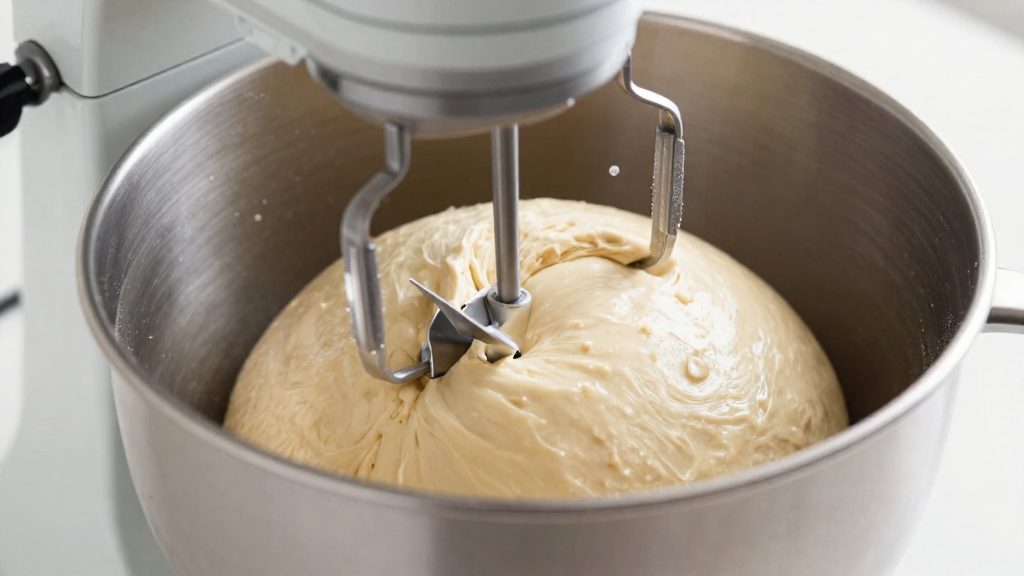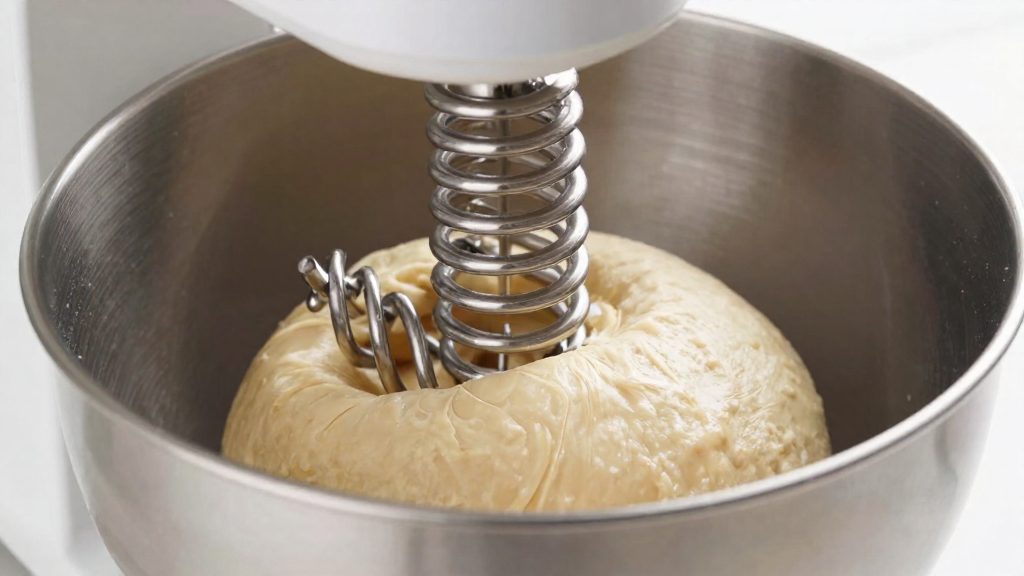
A spiral mixer is a dough mixer in which both the bowl and the hook rotate, and the dough is worked against a stainless steel breaker bar in the centre. According to Ooni (2026), the design has three parts that work together: a spiral hook, a central breaker bar and a rotating bowl. Each part has a specific job, and together they determine how bread and pizza dough develops at home.
What is a spiral mixer?
The spiral hook, the central breaker bar and the rotating bowl each contribute a different action to the mix:
| Part | Role in the mix (according to Ooni, 2026) |
|---|---|
| Spiral hook | Turns while the bowl turns, working the dough |
| Central breaker bar | Stainless steel; the dough is worked against it |
| Rotating bowl | Turns together with the hook, reducing friction and heat |
How the breaker bar builds gluten strands
The breaker bar is the fixed point the dough is worked against. Ooni (2026) states that this contact builds the long gluten strands that bread and pizza dough need.
Why bowl rotation reduces friction and heat
In a spiral mixer, the bowl does not stay still while the hook moves. Ooni (2026) explains that when the bowl turns with the hook, friction and heat are reduced. This matters for two reasons. First, less friction means less gluten tears during mixing, so the strands stay intact. Second, less heat means the yeast is less likely to activate early, so fermentation starts at the point you intend, not during kneading.
How does a spiral mixer differ from a stand mixer?
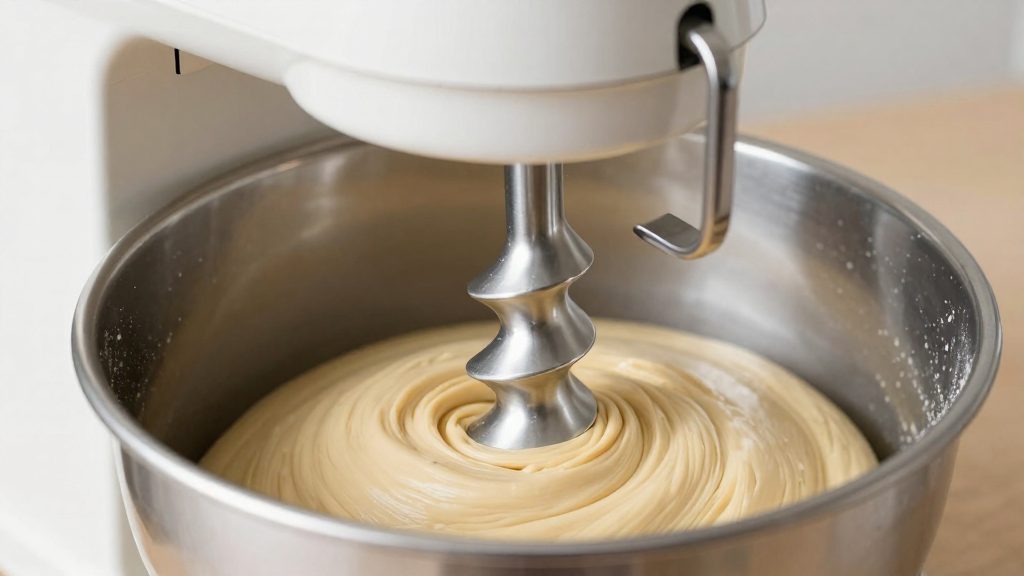
A spiral mixer and a planetary stand mixer both knead dough, but they move it differently. A planetary motion mixer turns its tool around its own axis while the tool also travels around the bowl, so the dough is pushed around a bowl that stays in place. A spiral mixer uses a different layout: the bowl and the hook both rotate. The rotating bowl is what sets the spiral mixer apart in how the dough moves.
| Feature | Planetary stand mixer | Spiral mixer |
|---|---|---|
| Motion | Tool orbits a stationary bowl | Bowl and hook both rotate |
Motor strain with stiff dough
A stiff dough resists movement, so the mixer has to work harder to turn it. Ooni (2026) says a standard planetary stand mixer can struggle with stiff dough, and that the spiral design makes better dough with less strain. For home bakers, this means a planetary machine may labour on a dense, low-moisture dough, while a spiral mixer is built for that load.
Is a spiral mixer worth it for home bakers?
A spiral mixer is worth buying when you make stiff dough often enough that the machine saves time and effort every week. The performance claims in this article come from the manufacturer, Ooni, and the official sources consulted do not provide independent test results. The purchase makes most sense when your baking pattern, rather than occasional curiosity, justifies the cost.
Who benefits most
Frequent pizza and sourdough bakers get the clearest return. Pizza and sourdough doughs vary widely in hydration, so the benefit is clearest if your own recipes are stiff and low in water. Ooni lists 55% as the lowest hydration the Halo Core handles. If you bake pizza every weekend or maintain a sourdough schedule, the time you save on each batch adds up quickly.
Cost per batch for occasional bakers
Occasional bakers should judge the purchase by cost per batch, not by the sticker price. Use this plain calculation:
cost per batch = purchase price ÷ number of batches made over the machine’s working life
The official sources consulted do not give prices, so you need to fill in the figures yourself. A machine used once a month spreads its cost over far fewer batches than one used every week, so the cost per batch can stay high for years.
When hand kneading or a stand mixer is enough
| Baking pattern | Likely best fit |
|---|---|
| Pizza or sourdough several times a week | Spiral mixer |
| Occasional bread or soft, enriched doughs | Stand mixer or hand kneading |
| Pizza dough a few times a year | Hand kneading |
Hand kneading works well for small, occasional batches, and a stand mixer handles softer doughs without a dedicated machine.
Capacity and hydration limits
The two numbers that decide whether a spiral dough mixer fits your baking are the largest batch it can take and the stiffest dough it can handle. Ooni, the maker of the Halo range, publishes figures for two models (Ooni, 2026). The Halo Pro has a maximum dough load of 11 lb (5 kg). The Halo Core covers a batch range from about 500 g (1.1 lb) to 2.5 kg (5.5 lb). These are the limits to check before you scale a recipe up or down.
Halo Pro: maximum load
- Maximum dough load: 11 lb (5 kg) of dough per batch (Ooni, 2026).
- Ooni relates this capacity to roughly twenty 12-inch pizzas per batch.
- Working near the 5 kg ceiling with a firm, low-water dough is where the load matters most.
Halo Core: batch range
| Batch size (Ooni, 2026) | Example Ooni gives |
|---|---|
| About 500 g | Two 12-inch pizza balls |
| 2.5 kg | Three large sourdough loaves |
Use these examples to size your recipe. Divide the total dough weight by the number of portions you want, then confirm that the total falls between 500 g and 2.5 kg.
Hydration floor
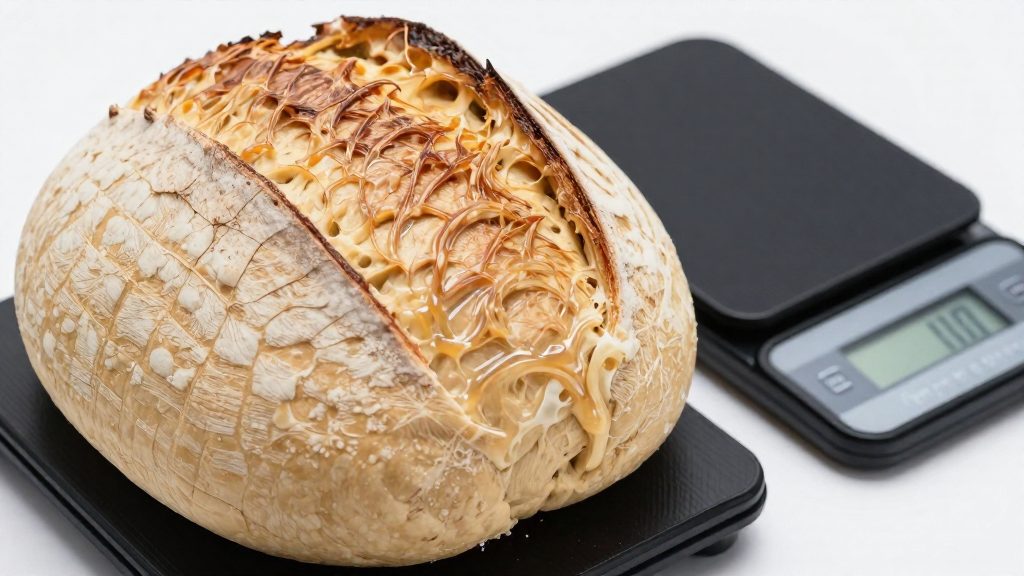
Hydration is the water weight divided by the flour weight, expressed as a percentage. For example, 550 g of water mixed with 1,000 g of flour gives 55% hydration. On the Halo Core, 55% is the lowest hydration Ooni lists, so very low-water doughs sit at the edge of its range. Weigh both ingredients on a scale rather than estimating by volume, because a small error in water changes the percentage quickly.
Home spiral mixers to consider
The two Ooni models most relevant to home spiral mixing are the Ooni Halo Pro and the Ooni Halo Core. Both follow the same spiral principle, but they are aimed at different home setups. The Halo Pro is the larger machine, with a 7 L (7.3 qt) stainless bowl and digital speed controls. Ooni positions the Halo Core as the home-scale option. The comparison below covers bowl, speed range and intended batch use, based on Ooni’s published information (Ooni, 2026).
Bowl
- Halo Pro: 7 L (7.3 qt) stainless steel bowl. Ooni describes a stainless steel breaker bar that works the dough against the rotating hook.
- Halo Core: The official sources consulted do not specify the Halo Core’s bowl volume, so a direct bowl-size comparison with the Halo Pro is not possible from those sources.
Speed range
The Halo Pro’s digital controls run from 60 to 345 RPM (Ooni, 2026). The official sources consulted do not give a speed range for the Halo Core. A controllable speed range matters mainly for managing dough temperature and gluten development, not only for mixing speed.
Intended batch use
The Halo Pro is the choice for larger home sessions, such as making dough for several pizzas at once or for bread bakes that need a bigger bowl. The Halo Core is designed for smaller home sessions, where a compact machine fits a more limited dough quantity. Ooni’s specific batch and hydration figures for each model appear in the batch section of this article.
What size spiral mixer do you need?
Choose the bowl by the bake, not by the machine. A single machine can cover a small pizza night or a bread bake, but the batch you plan determines whether the bowl fits.
Calculating total dough weight per session
Use this method: total dough weight = number of items × dough weight per item. For pizza, multiply the number of balls by the weight of one ball from your recipe. For bread, multiply the number of loaves by the dough weight each loaf needs before shaping. If you bake pizza and bread in the same session, add the two totals. Weigh the flour, water, salt, and levain or yeast together, because the mixer works the full batch at once.
Matching pizza ball count to dough load
Ooni’s figures give a working reference: 500 g of dough makes two 12-inch pizza balls, which implies roughly 250 g per ball. Use this only as a check against your own recipe. If your balls are heavier, the same count needs more dough, and the total rises. Count the balls you intend to make before mixing, so the bowl is sized to a number rather than a guess.
Loaf batches and stiff dough
For loaves, weigh the total dough and check it against the model’s batch range. Ooni’s example is 2.5 kg, which makes three large sourdough loaves on the Halo Core.
Choosing a bowl with headroom
Pick a bowl that holds your target batch with space left above it. The official sources consulted do not specify a headroom percentage, so judge by the behaviour of the dough. In a spiral mixer, the bowl turns with the hook and the dough is worked against the breaker bar. A batch that fills the bowl to the rim leaves less room for that movement.
Care, space and weight
Check the footprint and weight before buying a spiral mixer, because both decide where it can stay and how easily you can move it. According to Ooni (2026), the Halo Core weighs 10.6 kg (23 lb), about 30% lighter than the Halo Pro, and has a footprint 25% smaller than the Halo Pro. These comparisons are relative to the Halo Pro. The official sources consulted do not give the Halo Pro’s absolute weight or the Halo Core’s exact dimensions, so measure your countertop or shelf before ordering.
Space and weight in practice:
- At 10.6 kg (23 lb), the mixer is heavy enough that you should plan a permanent spot for it on a level, stable surface rather than moving it often. Choose a level, stable surface where it can stay in place.
- The smaller footprint leaves more room on a standard worktop for scales, bowls and a proofing container.
- Leave clearance above the bowl so you can lift the hook and bowl out without hitting cabinets.
Routine cleaning of the breaker bar:
The breaker bar is removable and made of stainless steel, so you can take it out of the bowl for washing rather than cleaning it in place. After each session:
- Switch off the mixer and unplug it before touching the bowl or bar.
- Lift the breaker bar out of the bowl.
- Wash it by hand with warm water and a mild detergent, paying attention to the joints where dough collects.
- Rinse and dry it thoroughly before refitting.
Clean the bowl and hook at the same time. Scrape off dough residue while it is still soft, since dried dough is harder to remove.
Frequently asked questions
Can a spiral mixer handle stiffer dough than a stand mixer?
According to Ooni (2026), a standard planetary stand mixer can struggle with stiff dough, while the spiral design is meant to work it with less strain. The spiral mixer is therefore often the better fit for dense, low-hydration bread dough.
How much dough can a home spiral mixer take in one batch?
The Ooni Halo Core mixes from about 500 g, enough for two 12-inch pizza balls, up to 2.5 kg, enough for three large sourdough loaves. The larger Ooni Halo Pro has a 7 L (7.3 qt) stainless bowl that holds up to 11 lb (5 kg) of dough, about twenty 12-inch pizzas per batch (Ooni, 2026).
Is a spiral mixer difficult to move around a small kitchen?
Weight and footprint vary by model. According to Ooni (2026), the Halo Core weighs 10.6 kg (23 lb), about 30% lighter than the Halo Pro, and has a 25% smaller footprint, which makes it the more compact option of the two.