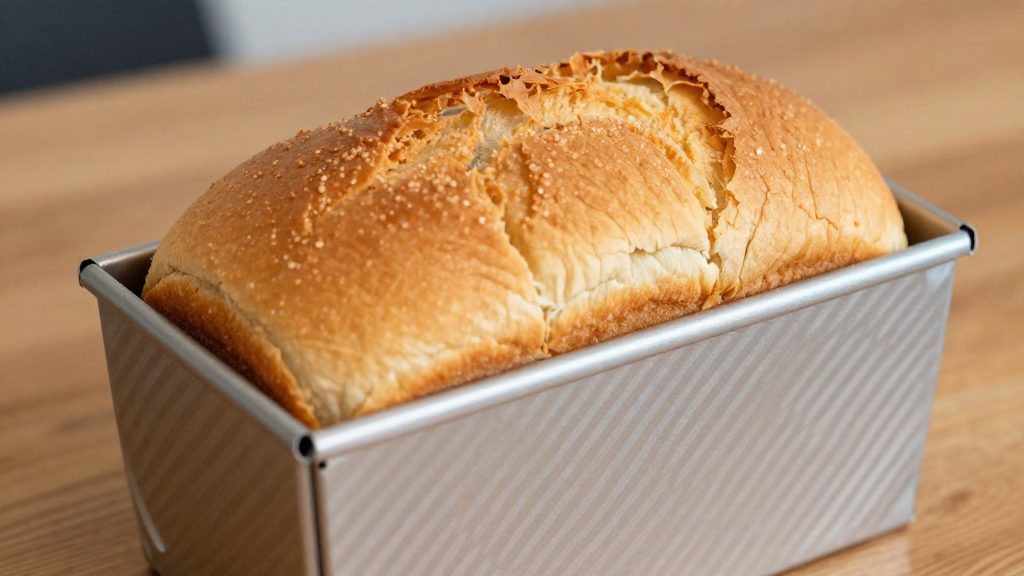
What pan size works best?
The 9×5-inch loaf pan is the standard size for a sandwich loaf. Red Star Yeast’s one-loaf sandwich bread is written for a greased 9×5-inch pan (Red Star Yeast, 2026), and PBS Food uses a 9×5×3-inch pan, which adds the depth that the Red Star recipe leaves out (PBS Food, 2026).
The three recipes in the sources use different pans and different flour amounts:
| Pan size | Recipe source | Bread flour |
|---|---|---|
| 9×5-inch | Red Star Yeast (2026) | 3 cups |
| 9×5×3-inch | PBS Food (2026) | 3½ cups |
| 5×10-inch | Cooking Gorgeous (2026) | 500 g (half white, half whole wheat) |
The PBS recipe uses about half a cup more flour than the Red Star recipe, and its pan is the only one listed with a depth. The sources do not connect these two differences, so treat the flour amount and the pan as a matched pair.
Matching dough to the pan
Dough quantity has to fit the pan’s footprint, which is its length multiplied by its width. A 9×5-inch pan has a footprint of 45 square inches. A 5×10-inch pan has a footprint of 50 square inches, so it covers more area, though the source does not give its depth. The Cooking Gorgeous recipe gives flour by weight and the Red Star recipe gives it by volume, and the sources do not supply a conversion between them, so the two cannot be compared directly.
When you switch pans, keep the recipe’s dough amount tied to the pan it was written for. Scaling a 9×5-inch recipe into a 5×10-inch pan without adjusting it changes how much dough sits in each part of the pan, so the loaf may bake up lower or taller than the recipe intends.
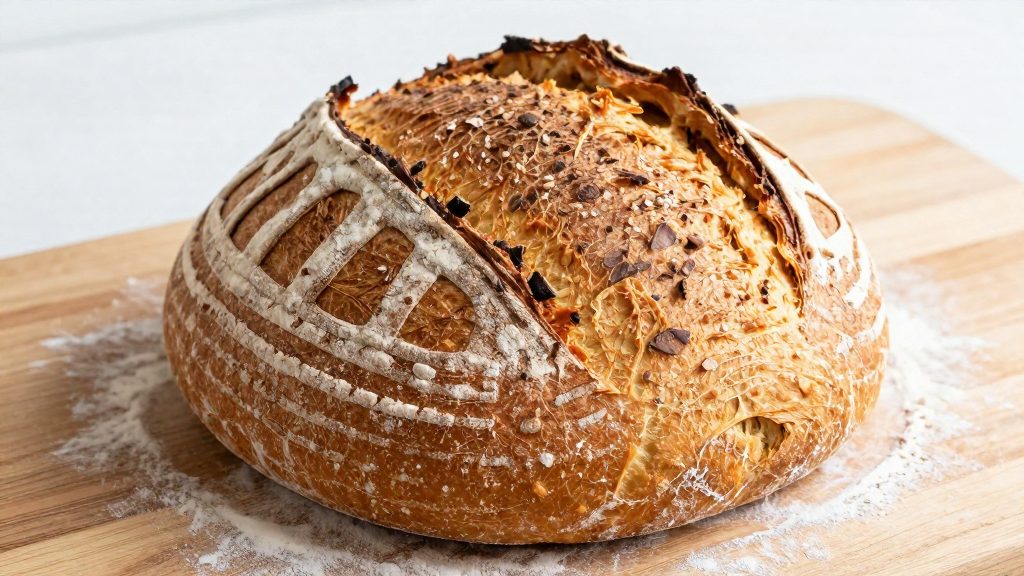
Ingredients for a basic sandwich loaf
The one-loaf sandwich recipe from Red Star Yeast (2026) is built on 3 cups of bread flour and 1 cup of warm water, with a small amount of warm milk, yeast, sugar, butter and salt. Each ingredient has a specific job in the dough, so the amounts matter as much as the choice of ingredients.
| Ingredient | Amount (Red Star Yeast, 2026) | Role in the dough |
|---|---|---|
| Bread flour | 3 cups | Forms the gluten network that traps gas and gives the loaf its structure |
| Warm water | 1 cup | Hydrates the flour and activates the yeast |
| Warm milk | ¼ cup | Softens the crumb and adds a little richness |
| Yeast | 2¼ tsp | Ferments the sugars and produces the gas that raises the dough |
| Sugar | 2 tbsp | Feeds the yeast and contributes to browning in the crust |
| Butter | 4 tbsp | Tenderizes the crumb and keeps the slices soft for longer |
| Salt | 1½ tsp | Strengthens the gluten and moderates yeast activity |
Why bread flour
Bread flour has a higher protein content than all-purpose flour, which allows more gluten to develop. That gluten is what holds the gas from the yeast, so a sandwich loaf made with bread flour generally keeps a firmer, more even structure.
Whole wheat substitution
Cooking Gorgeous (2026) splits its 500 g of bread flour, half white and half whole wheat, and uses 300 ml of water in its one-rise loaf. These are metric measures, so weigh them on a kitchen scale rather than converting to cups. Replacing half of the white flour with whole wheat adds bran and germ, which give the loaf a denser, nuttier crumb. The half-and-half swap is easiest to get right when the flour is weighed.
How do you know when the dough has risen enough?
Rising is judged by how the dough looks and feels, not only by the clock. In this recipe there are two checkpoints. The first rise happens in the bowl, and according to Red Star Yeast (2026) it takes 1–2 hours until the dough doubles. The shaped rise happens in the pan, and it takes about 1 hour until the loaf sits about 1 inch above the pan rim. Both times are guides. Warm kitchens speed fermentation and cool ones slow it, so start checking near the beginning of each window.
| Checkpoint | Timing (Red Star Yeast, 2026) | Observable sign |
|---|---|---|
| First rise, in the bowl | 1–2 hours | Dough has doubled in size and looks airy |
| Shaped rise, in the pan | About 1 hour | Loaf sits about 1 inch above the pan rim |
First rise: doubling in the bowl
Cover the bowl and leave it in a warm spot. Doubling is easiest to judge if you mark the starting level on the outside of the bowl with a strip of tape or use a clear container. When the dough reaches roughly twice its original height, it is ready to be deflated and shaped. Bubbles may be visible at the surface, and the dough should feel light rather than dense.
Shaped rise: reaching the pan rim
After shaping, place the dough seam-side down in the greased pan and cover it loosely. The target is a rise of about 1 inch above the rim. Bake once the dough sits about 1 inch above the rim, as Red Star Yeast specifies. The loaf will still expand a little in the oven, so a loaf that has barely reached the rim is likely underproofed.
The finger-dent test
To confirm the dough is ready, lightly flour one finger and press it gently about 1/2 inch into the dough, then withdraw it. Read the result:
- Springs back quickly and fully: the dough needs more time.
- Springs back slowly and partly: the dough is ready.
- Stays dented and the surface collapses: the dough has overproofed, and its structure may have weakened.
Baking time and temperature
The Red Star Yeast and PBS Food formulas both bake at 350°F, but they differ in bake time and in whether the oven is steamed. (Cooking Gorgeous uses a two-stage bake: 15 minutes at 400°F, then 15 minutes at 360°F.) Red Star Yeast gives a bake window of 30 to 34 minutes for its one-loaf sandwich bread, while PBS Food allows about 40 to 50 minutes and adds steam from boiling water. Choosing a method means choosing how long to bake and how early to start checking.
| Detail | Red Star Yeast (2026) | PBS Food (2026) |
|---|---|---|
| Oven temperature | 350°F | 350°F |
| Bake window | 30–34 minutes | About 40–50 minutes |
| Steam step | None in the published method | Empty pan on the bottom rack, 2 cups of boiling water added as the loaf goes in |
| Pan used | Greased 9×5-inch pan | 9×5×3-inch pan |
Red Star Yeast: a shorter bake at 350°F
Red Star’s method bakes the shaped loaf at 350°F for 30 to 34 minutes. Red Star gives a window of 30 to 34 minutes with no steam step. Start checking at the beginning of the range, and confirm doneness by color and a hollow sound.
PBS Food: steam from an empty pan
PBS Food’s method has a longer bake, about 40 to 50 minutes at 350°F, and includes a steam step. Place an empty steam pan on the bottom rack, and as the loaf goes into the oven, add 2 cups of boiling water to the pan. The water creates a humid oven during the early bake. PBS gives about 40 to 50 minutes, and the loaf is done when an instant-read thermometer reads 195°F in the center.
Tenting the top
If the top browns too fast, Red Star’s method recommends tenting the loaf loosely with foil. Tent only when the top is colouring too quickly, and keep the foil loose.
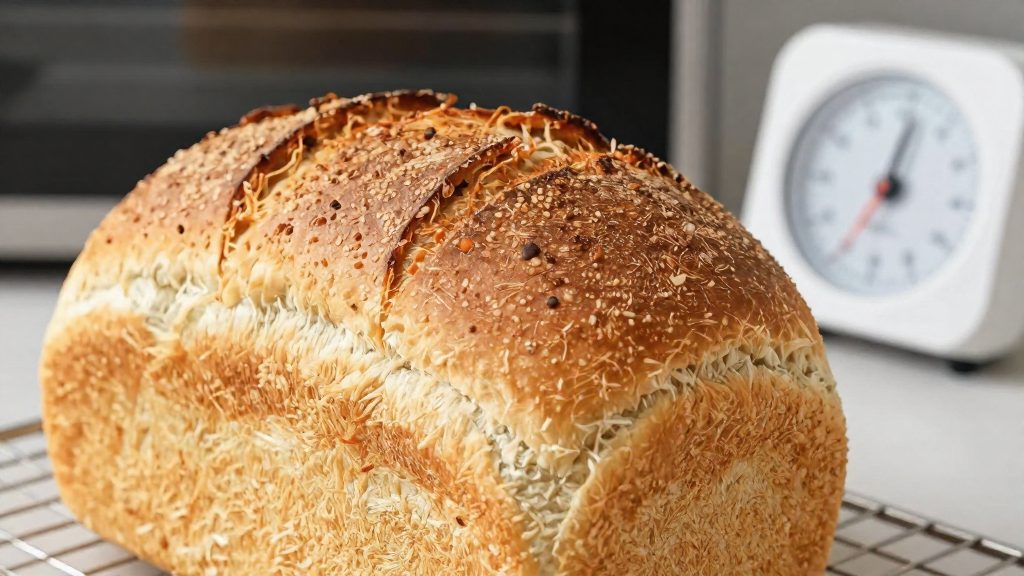
How do you know when the loaf is done?
Three checks confirm that a sandwich loaf is ready: the internal temperature, the sound it makes when tapped, and the color of the crust. Published recipes use different doneness checks: Red Star Yeast relies on golden color and a hollow sound, while PBS Food and Cooking Gorgeous give internal temperatures. A thermometer is the most reliable check, because a golden top can still hide an underbaked center.
Internal temperature targets
Two published recipes give a target for the center of the loaf. The two sources give slightly different figures.
| Source | Target center temperature | Loaf details |
|---|---|---|
| Cooking Gorgeous (2026) | About 190°F | One-rise loaf with 500 g bread flour (half white, half whole wheat) in a 5×10-inch pan |
| PBS Food (2026) | 195°F, read with an instant-read thermometer | Loaf with 3½ cups bread flour in a 9×5×3-inch pan |
Hollow sound when tapped
Red Star Yeast (2026) describes a finished loaf as hollow-sounding when tapped. Red Star Yeast (2026) describes a finished loaf as sounding hollow when tapped. Turn the loaf out of the pan and tap the bottom; a dull sound suggests it may need more time, so confirm with a thermometer. This test takes practice to read reliably, so use it alongside the thermometer while you are learning how your oven and dough behave.
Golden crust color
Red Star Yeast (2026) also uses golden color as a sign of doneness. The crust should look evenly golden across the top and sides. Because color depends on the flour, the sugar and milk in the dough, and your oven, treat it as a supporting signal rather than the only test.
Cooling and slicing tips
Cooling decides how clean the slices will be. PBS Food gives the basic order: take the loaf out of the pan, cool it on a wire rack until it reaches room temperature, and only then cut it. Cooking Gorgeous also says to cool the loaf fully. Lifting it out of the pan lets air reach the bottom and sides, so the loaf cools evenly instead of staying warm and soft underneath.
Removing the loaf from the pan
Turn the loaf out onto the rack as soon as it is out of the oven and the pan can be handled safely. Tip the pan over, support the loaf with your hand or a towel, and set it crust-side up on the rack. Leave space around it so air circulates on every side.
Cooling to room temperature
Keep the loaf on the rack until it is fully cool throughout. Cutting into a loaf that is still warm can make slices squash or drag under the knife. Judge by touch: the centre should feel cool, not warm, when you press the side of the loaf.
Chilling for cleaner slices
Once the loaf is completely cool, a short chill in the freezer can help. Cooking Gorgeous (2026) recommends chilling the fully cooled loaf in the freezer for about 1 hour for cleaner slicing. The order matters: chill only after the loaf has cooled fully, so that the freezer step firms the crumb rather than trapping residual heat.
How the two sources differ
| Stage | PBS Food (2026) | Cooking Gorgeous (2026) |
|---|---|---|
| Pan | Cool out of the pan | Not specified |
| Rack | Wire rack | Not specified |
| Before slicing | Room temperature | Full cooling, then about 1 hour in the freezer |
Use the freezer step when you want the most even slices, especially with a soft sandwich crumb. Otherwise, a fully cooled loaf on a rack is enough.
Common mistakes and fixes
Many sandwich loaf problems trace back to the rise. The three problems below each have an identifiable cause and a corrective step.
| Symptom | Likely cause | Corrective step |
|---|---|---|
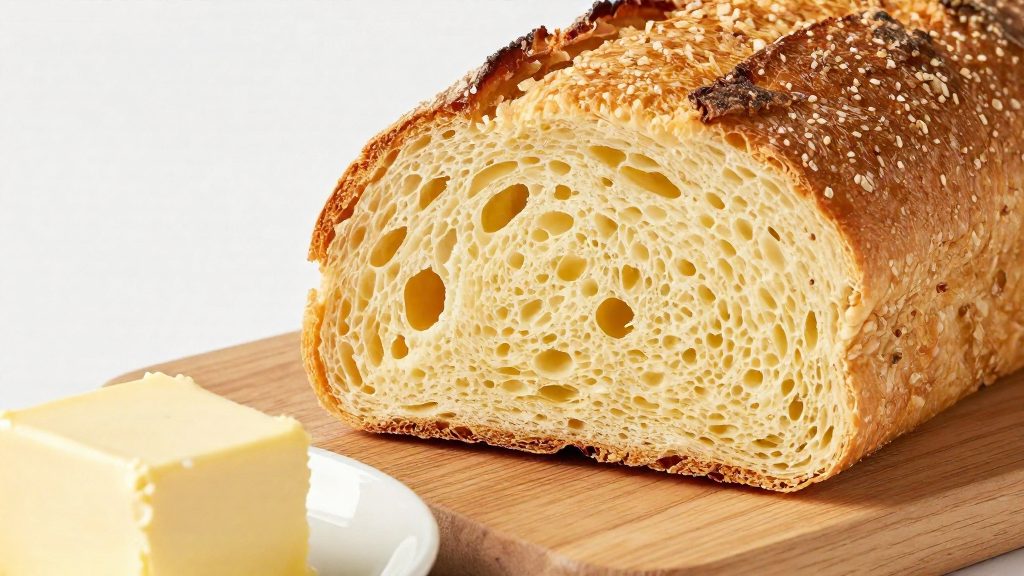
| Dense, tight crumb with few holes | Underproofed dough: the yeast has not produced enough gas before baking | Allow the shaped dough to rise longer before baking |
| Sunken loaf with a collapsed top and large, irregular holes | Overproofed dough: the gluten network has stretched too far and can no longer trap gas | Shorten the rise next time and bake sooner |
Dense crumb from underproofed dough
An underproofed sandwich loaf looks compact after baking and has a tight, gummy texture. The yeast did not have enough time to fill the dough with gas, so the crumb never opened up. The fix is to give the shaped dough more time in the pan before it goes into the oven. If the crumb was dense after one bake, the next loaf usually benefits from a longer rise.
Sunken loaf from overproofed dough
An overproofed loaf often rises quickly, then collapses or sinks in the centre during baking. The gluten has been stretched past the point where it can hold its shape, and the gas escapes. To correct this, reduce the rise time on the next attempt and move the loaf to the oven earlier. A dough that has already sagged in the pan is hard to rescue, so reshape it into a fresh loaf and let it rise for a shorter period.
Top browning too fast: tent with foil
A dark, hard crust while the centre is still underbaked points to too much direct heat on the surface. Red Star’s method is to tent the loaf loosely with foil when the top browns too fast. Remove the foil near the end of baking if you want the crust to brown more.
Frequently asked questions
How do I know when the loaf is done?
Red Star Yeast’s recipe bakes at 350°F for 30–34 minutes, until the crust is golden and the loaf sounds hollow when tapped (Red Star Yeast, 2026). PBS Food takes the more precise route: bake 40–50 minutes until an instant-read thermometer reads 195°F in the center (PBS Food, 2026).
How high should the dough rise before it goes in the oven?
After shaping, Red Star Yeast lets the dough rise for about 1 hour, until it sits about 1 inch above the rim of the pan (Red Star Yeast, 2026). This shaped rise is what gives the finished loaf its height, so judge it by the rim rather than by the clock alone.
Can I slice the loaf while it is still warm?
Wait. PBS Food advises cooling the loaf out of the pan on a wire rack until it reaches room temperature before slicing (PBS Food, 2026). Cooking Gorgeous goes further, recommending a full cool followed by about 1 hour in the freezer for cleaner slices (Cooking Gorgeous, 2026).