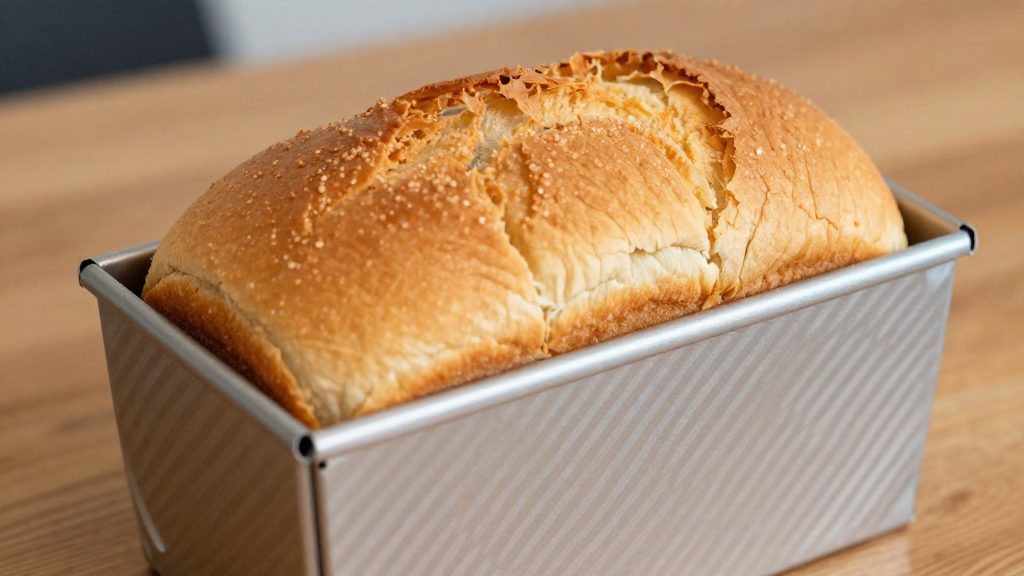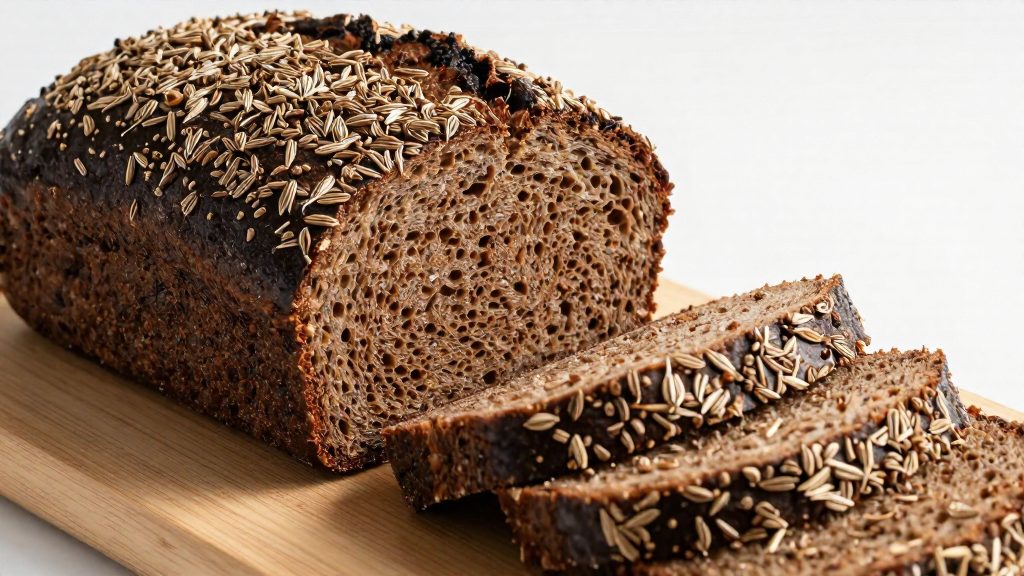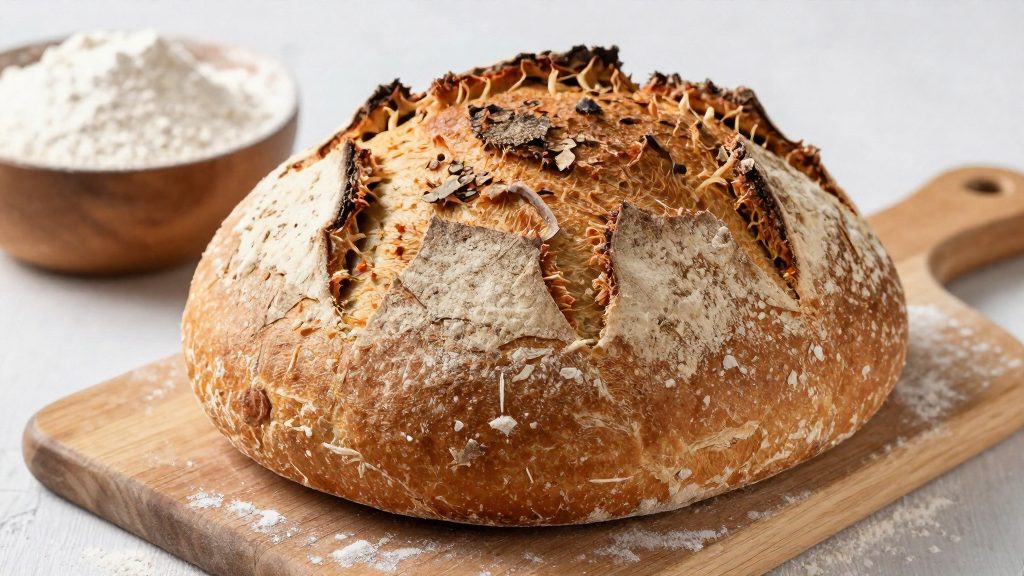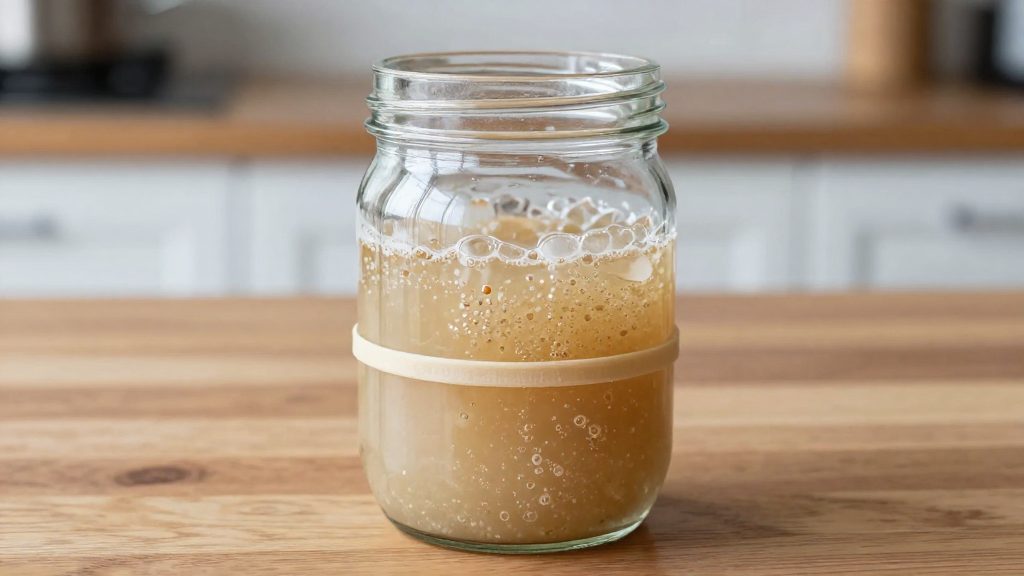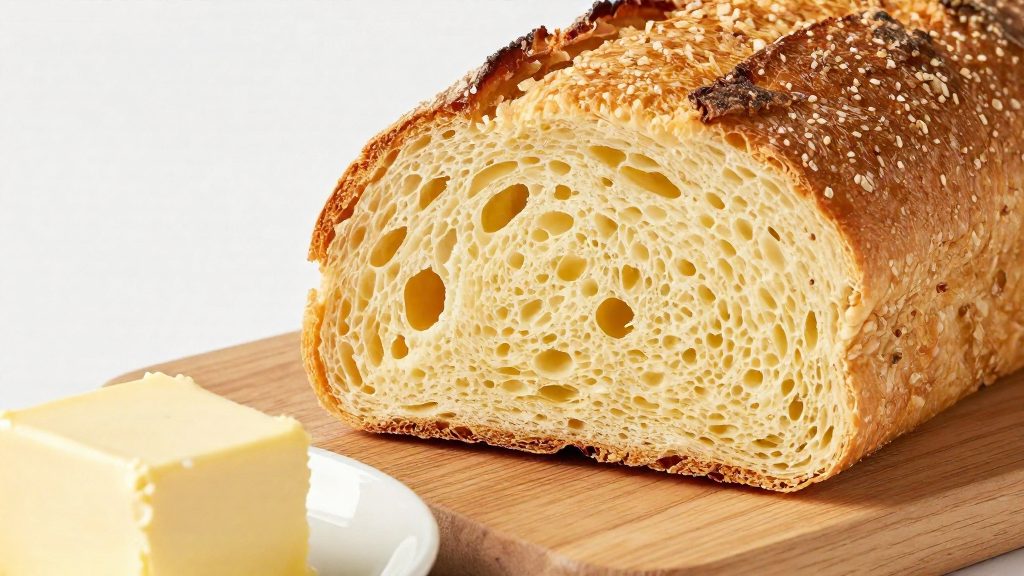
A brioche loaf is rich because its dough is enriched: butter and eggs change how the dough develops and how the crumb sets. A plain loaf made from flour, water, salt and yeast, called a lean dough, lacks these ingredients and therefore bakes up chewier and less golden.
What makes a brioche loaf with butter so rich?
Fat coating the flour strands
Butter is mostly fat. As the dough is mixed, the fat spreads over the flour particles and sits between the gluten strands that form when water meets flour. Those strands link together less tightly, so the crumb is softer and less elastic. Girl Versus Dough (year not specified) notes that all-purpose flour gives a lighter, more tender crumb than bread flour, which fits this idea: bread flour is milled for higher protein and builds more gluten. The sources consulted do not explain the mechanism in more detail.
Egg proteins and yolk fat
Egg whites contain proteins that coagulate during baking and help hold the crumb together, so the loaf keeps its shape despite the high fat content. Egg yolks add fat and emulsifiers, which help the butter and water stay mixed and give the dough a smoother texture. Yolks also contribute pigments that deepen the colour of both crumb and crust. The effect of eggs is structural and visual, while the effect of butter is mainly textural.
Enriched dough compared with lean dough
| Element | Lean dough | Enriched brioche dough |
|---|---|---|
| Fat | None or very little | Butter |
| Eggs | None | Proteins add structure; yolks add fat and colour |
| Crumb texture | Chewier, more open | Softer, finer, more even |
| Crust colour | Paler | Deeper golden tone |
The sources consulted do not give measured values for how much each ingredient changes the texture, so this comparison stays qualitative.
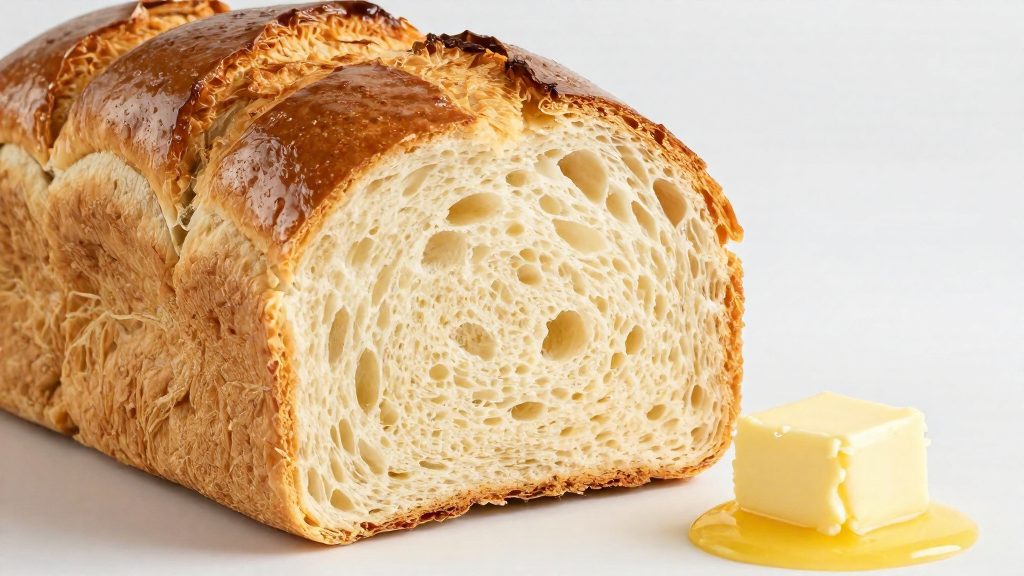
Flour and eggs in two brioche loaf recipes
A brioche loaf uses a short ingredient list, but the amounts and types change the crumb and the richness. Two home recipes show the range. The PBS Food (Martha Stewart) version makes a large, rich loaf. The Girl Versus Dough version is scaled for one 9×5-inch loaf that yields 12 slices. Comparing them shows how flour and eggs shape the result.
| Ingredient | PBS Food (Martha Stewart) | Girl Versus Dough (9×5-inch loaf) |
|---|---|---|
| All-purpose flour | 1 lb 2 oz | About 2 cups plus 2 tablespoons |
| Large eggs | 6 | 3 |
Flour: all-purpose versus bread flour
Both recipes use all-purpose flour. The Girl Versus Dough author states that all-purpose flour gives a lighter, more tender crumb than bread flour. The sources consulted do not give a bread flour quantity or a direct substitution ratio, so the swap is not quantified here.
Eggs: 3 versus 6
The lighter loaf uses 3 eggs, while the Martha Stewart loaf uses 6 large eggs. The larger recipe uses twice the eggs alongside roughly twice the flour; the sources do not explain how the egg count changes the dough.
Yeast
The lighter recipe uses 2¼ tsp of active dry yeast, which is one packet of standard granulated yeast. The Martha Stewart version discussed here does not list a yeast quantity, so the two recipes cannot be compared on this ingredient.
How much butter should go in brioche?
Brioche recipes differ mainly in how much butter they use relative to flour. Martha Stewart’s brioche loaves use 1½ cups (3 sticks) of slightly softened unsalted butter with 1 lb 2 oz of all-purpose flour and 6 large eggs, according to PBS Food (Martha Stewart). The lighter home recipe from Girl Versus Dough makes one 9×5-inch loaf with ½ cup (1 stick) of softened, cubed unsalted butter, about 2 cups plus 2 tablespoons of all-purpose flour and 3 eggs.
The first recipe uses three times the butter by volume. Converting to weight makes the gap easier to see. Assuming a US stick weighs 4 oz (113 g), the Martha Stewart loaf uses about 12 oz (340 g) of butter against 18 oz of flour, a butter-to-flour ratio of about 67%. The lighter loaf uses about 4 oz of butter. Its flour is given by volume, so its weight is not stated in the source. Because its flour is given only by volume, the butter-to-flour ratio of the lighter loaf cannot be calculated from the source and is not stated here.
| Martha Stewart (PBS Food) | Lighter home loaf (Girl Versus Dough) | |
|---|---|---|
| Butter (volume) | 1½ cups (3 sticks) | ½ cup (1 stick) |
| Butter (weight, estimated) | about 12 oz (340 g) | about 4 oz (113 g) |
| Flour | 1 lb 2 oz all-purpose | about 2 cups plus 2 tablespoons all-purpose |
| Butter-to-flour ratio (by weight) | about 67% | not stated (flour given by volume) |
| Eggs | 6 large | 3 |
What the ratio changes in the loaf
A higher butter-to-flour ratio generally gives a richer, softer, more tender crumb. The trade-off is that the dough is softer and harder to handle. The lighter recipe has less fat to work against, so its dough is easier to shape but tastes less rich. The official sources consulted do not give a measured texture comparison between the two loaves, so these differences are general baking principles rather than tested results.
Choosing a ratio
Pick the ratio by the loaf you want. A rich, dessert-style brioche suits the higher ratio, while a sandwich loaf that is easy to slice suits the lower one.
How do you add butter to brioche dough?
Softened butter goes into brioche dough only after the gluten has developed, not at the start of mixing. Both sources used here, PBS Food (Martha Stewart) and Girl Versus Dough, add the butter once the dough is already formed. Adding it earlier can coat the flour and interfere with the gluten network that holds the dough together. The method has three parts: develop the gluten, confirm it with a windowpane test, then incorporate the butter and mix until the dough is smooth and elastic.
When the butter goes in
Mix the dough until it holds together, then knead it until the gluten starts to form. PBS Food (Martha Stewart) describes adding the butter and sugar gradually after the dough is mixed. Girl Versus Dough specifies cubed, softened butter that goes in after gluten development. Adding the cubes a few at a time lets each addition blend into the dough before the next one goes in.
Checking gluten with the windowpane test
The windowpane test is the check Girl Versus Dough uses to confirm gluten is ready. Pinch off a small piece of dough and stretch it gently between your fingers. If the gluten is developed, the piece stretches into a thin, nearly translucent membrane without tearing. If it tears quickly, keep kneading and test again.
| Step | Action | Readiness check |
|---|---|---|
| Base mix | Combine ingredients until the dough holds together | Dough holds together |
| Gluten development | Knead until gluten forms | Windowpane test passes (Girl Versus Dough) |
| Butter addition | Add softened, cubed butter gradually | Each addition is absorbed before the next (PBS Food) |
| Final mix | Mix until the dough is smooth and elastic | Smooth, shiny and elastic (PBS Food) |
The final mix
After the butter is incorporated, PBS Food (Martha Stewart) states that the final mix runs 6–10 minutes, until the dough is smooth, shiny and elastic. Those three visual and tactile signs are the endpoint. Stop when the dough is smooth, shiny and elastic, within the 6–10 minute range.
Proofing: same-day or overnight?
Brioche loaf dough can be proofed within one day or split across two. The PBS Food (Martha Stewart) recipe is an overnight method: the dough rises about 2 hours, then chills at least 8 hours or overnight, is shaped and rises again for 1½–2 hours. Girl Versus Dough lists the overnight refrigerator proof as optional, so a same-day route is possible with that recipe, but the sources do not give same-day rise times. In the overnight method, the dough rises for about 2 hours, then goes into the refrigerator for a cold chill of at least 8 hours, or overnight, according to PBS Food (Martha Stewart). After the chill, the dough is shaped and gets its second rise of 1½–2 hours.
The two routes differ mainly in timing. The same-day method fits into a single baking session. The overnight method moves the bulk of the waiting into the refrigerator, so the dough can be shaped and baked the next day. Girl Versus Dough describes an optional overnight refrigerator proof for its lighter loaf, so the cold step is not limited to the richer dough.
| Step | Same-day | Overnight cold proof |
|---|---|---|
| First rise | About 2 hours, at room temperature | About 2 hours, at room temperature |
| Chill | None | At least 8 hours, or overnight, refrigerated |
| Shaping | After the first rise | After the chill |
| Second rise | 1½–2 hours | 1½–2 hours |
| Planning | One session | Two days |
Flavor is where the methods differ most. Cold slows yeast activity, so the dough ferments more gradually. Home bakers commonly describe the overnight version as having a more developed, slightly tangy flavor, though the consulted sources do not give a measured comparison.
How do you know when brioche is baked?
Brioche is done when its internal temperature reaches the number the recipe gives, not when the crust reaches a particular colour. The two recipes in these sources reach that point differently. PBS Food (Martha Stewart) bakes its enriched dough at 425°F for about 15 minutes, then lowers the oven to 375°F for 20–25 more minutes, until an instant-read thermometer reads 205°F. Girl Versus Dough uses a single 350°F bake of 35–40 minutes and stops when the loaf’s internal temperature reaches 185°F. Each recipe therefore gives a specific endpoint, and a thermometer is the most direct way to check it.
Oven settings and targets
| Recipe | Oven setting | Bake time | Internal target |
|---|---|---|---|
| PBS Food (Martha Stewart) | 425°F, then 375°F | About 15 min, then 20–25 min | 205°F |
| PBS Food, convection | 400°F, then 350°F | Same stages as conventional | 205°F |
| Girl Versus Dough | 350°F, single bake | 35–40 min | 185°F |
The 20°F gap between the two targets is the only difference in endpoint between these recipes. The official sources consulted do not explain why the Martha Stewart loaf is taken to the higher temperature.
Checking the core
Insert the instant-read thermometer into the centre of the loaf to read the interior rather than the surface. Check near the end of the time range given in the recipe. If the reading is below the target, return the loaf to the oven and check again after a few minutes. Relying only on colour can produce a loaf that looks done on the outside but has not reached the target inside.
Cooling in the pan
Girl Versus Dough recommends cooling the loaf five minutes in the pan, then moving it to a wire rack. The author states that staying in the pan too long makes the bottom and sides soggy. A short rest is enough to let the loaf firm enough to lift out, and the rack lets air circulate around all sides once it is out of the tin.
Storing and freezing brioche
A homemade brioche loaf keeps for up to 5 days at room temperature or up to 2 months in the freezer, according to Girl Versus Dough. These timeframes apply to the enriched dough described in this article, which contains butter and eggs. The source gives only these two durations and does not specify wrapping or container; the storage tips below are general practice.
| Storage method | Maximum duration (per Girl Versus Dough) |
|---|---|
| Room temperature | Up to 5 days |
| Freezer | Up to 2 months |
Keeping the loaf at room temperature
For short-term storage, keep the loaf in an airtight container or wrapped tightly in plastic wrap or a bread bag. Sealing the loaf limits contact with air, which otherwise dries out the crumb. Store it away from direct sunlight and heat sources, such as the oven or a radiator.
Slicing before freezing
Girl Versus Dough suggests slicing the loaf before it goes into the freezer. Cutting the whole loaf into portions first means you can remove one slice at a time, and the rest stays frozen. This avoids thawing and refreezing a full loaf each time you want some.
To freeze sliced brioche:
- Cut the loaf into even slices with a serrated knife.
- Stack the slices, placing a sheet of parchment or plastic wrap between each one so they do not stick together.
- Wrap the stack, or place it in a freezer bag, and press out as much air as possible.
- Label the bag with the date, so you can track the two-month window.
Frequently asked questions
Why does the butter go in after the gluten has formed?
In the Girl Versus Dough recipe, the softened, cubed butter is added only once the windowpane test shows the gluten is developed. PBS Food (Martha Stewart) adds the butter and sugar gradually after the dough is mixed, then runs a final 6–10 minute mix until the dough is smooth, shiny and elastic.
How do I know when the loaf is done?
Girl Versus Dough bakes its loaf at 350°F for 35–40 minutes and checks for an internal temperature of 185°F. PBS Food (Martha Stewart) bakes a richer dough at 425°F, then at 375°F, until an instant-read thermometer reads 205°F, so check the recipe you are following before you pull the loaf.
How long does brioche loaf keep, and should I freeze it whole?
According to the Girl Versus Dough author, the loaf keeps at room temperature for up to 5 days and frozen for up to 2 months. The same author suggests slicing the loaf before freezing, so you can thaw only the portion you need.