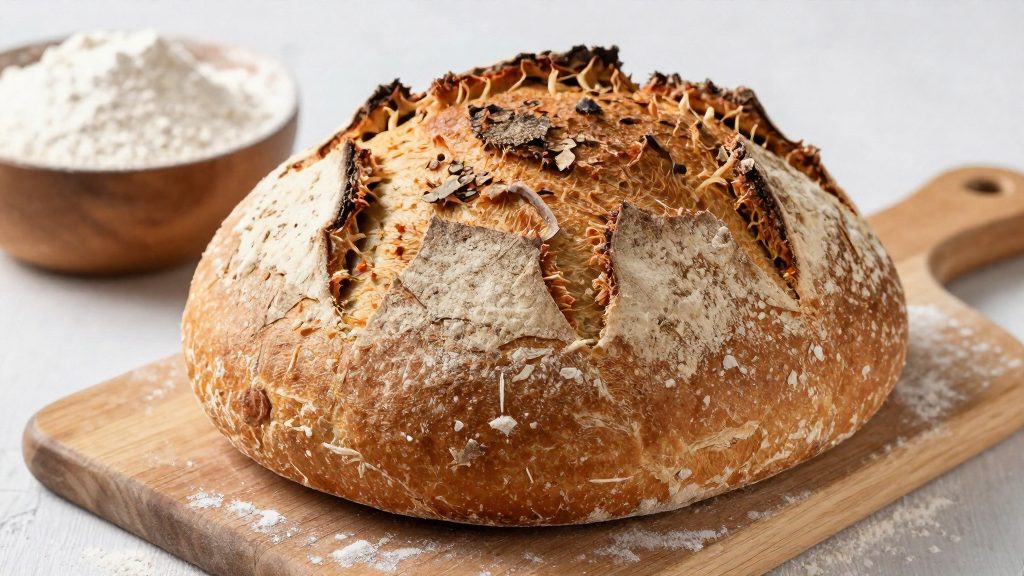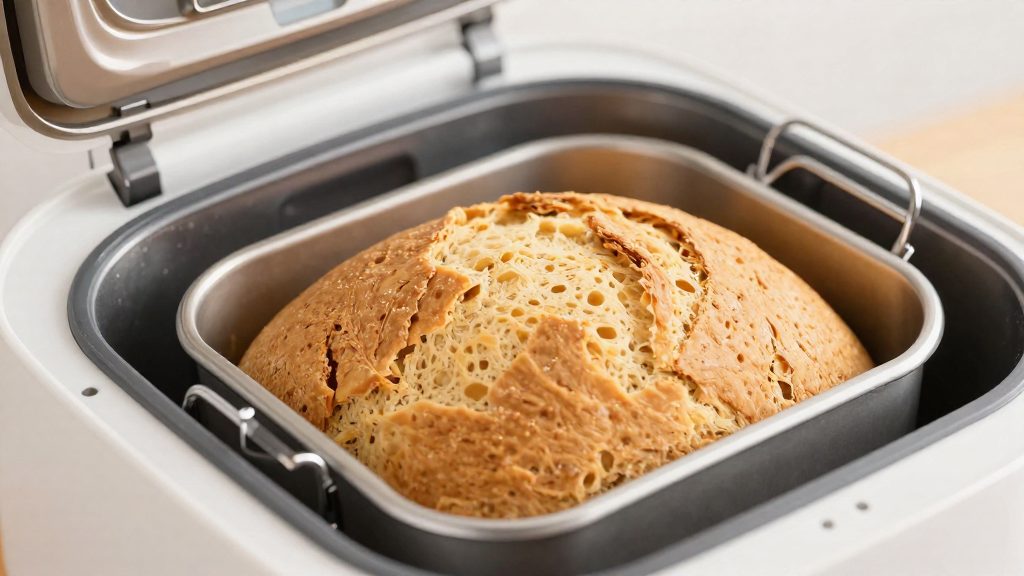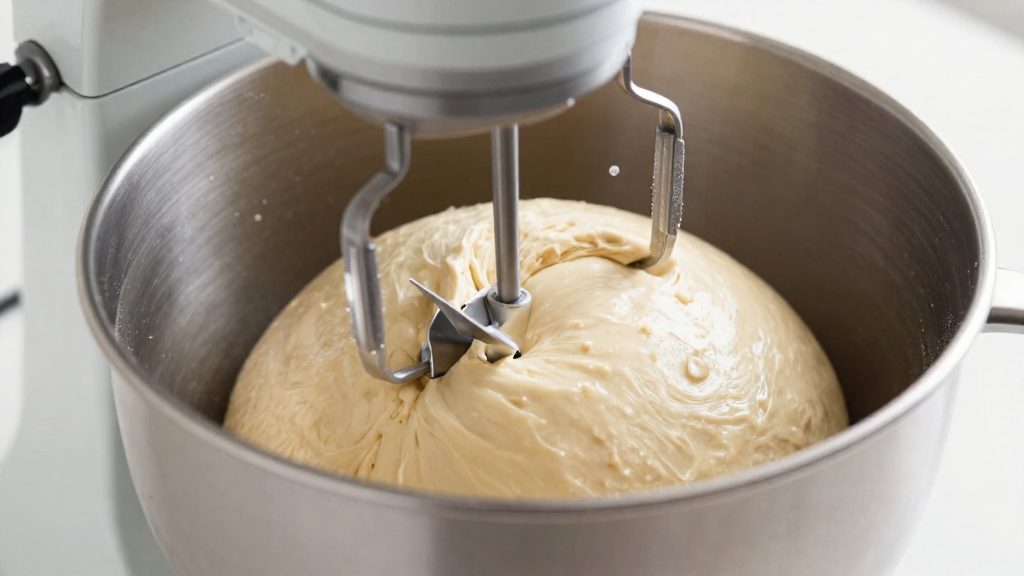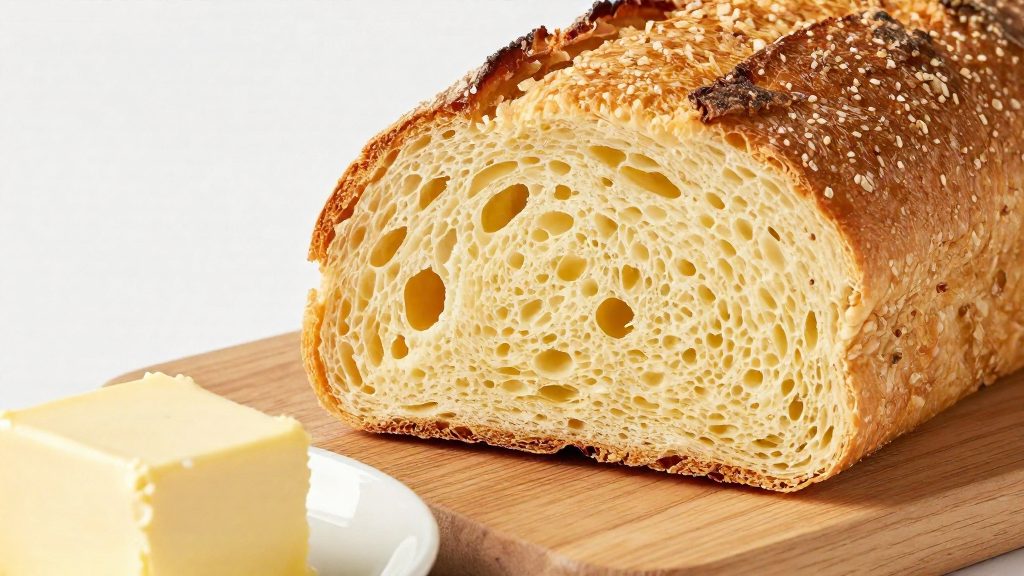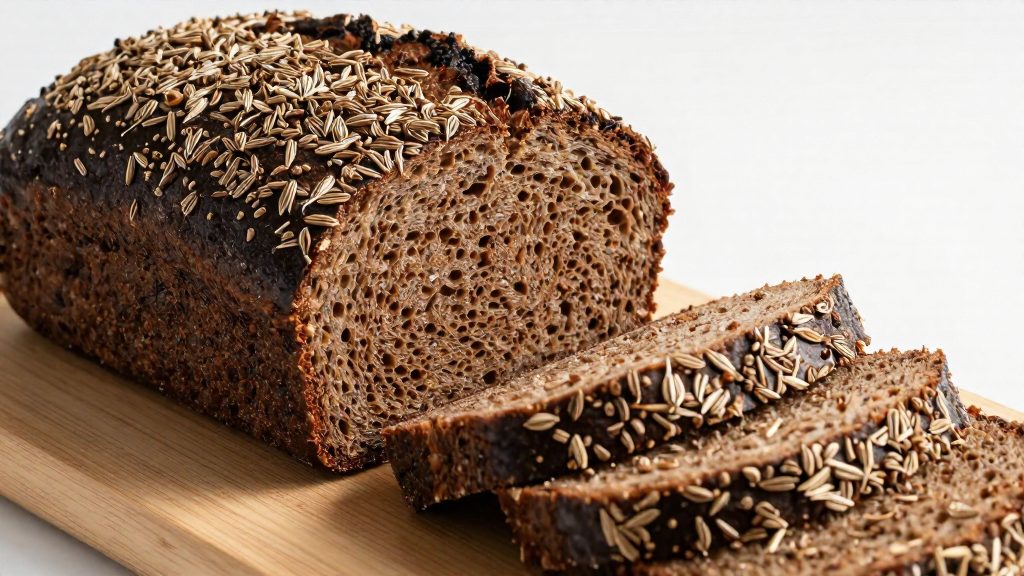
Caraway rye bread stands apart because two things work together: the caraway’s aromatic oils, which give the loaf its signature flavor, and rye flour, which shapes the crumb differently from wheat. A deli-style caraway rye is a slow-fermented, dark, Dutch-oven loaf, while a pan-style version rises faster and bakes in a more uniform shape. The sections below explain each factor.
What makes caraway rye bread distinctive?
Flavor from caraway and rye
Caraway seeds carry the bread’s characteristic aroma. Both the deli-style and pan-style recipes add them to the dough, and the deli-style version also scatters seeds over the crust. Because the seeds are visible on top, the flavor is noticed in the first bite. Bob’s Red Mill (2026) uses dark rye flour in its deli-style version, and the darker flour adds its own earthy, slightly tangy character that pairs well with the seed’s aroma.
Rye also contributes flavor through fermentation. The deli-style recipe from Bob’s Red Mill (2026) uses only 3/8 tsp of instant yeast and lets the dough rise for 18 hours at room temperature. A long, slow rise gives the yeast and naturally present bacteria more time to develop acidity and complexity, which is why this loaf tastes deeper than a quick-rise bread.
How rye changes the crumb
Rye flour behaves differently from wheat flour. Both recipes lean on bread flour for structure: in the deli-style and single-loaf versions, bread flour makes up the larger share of the flour blend, with rye adding flavor and color. Handle the dough gently and expect it to feel softer and stickier than a pure wheat dough.
Deli-style versus pan-style character
The two styles produce different loaves, as the comparison below shows.
| Feature | Deli-style (Bob’s Red Mill, 2026) | Pan-style (Taste of Home, 2026) |
|---|---|---|
| Yeast | 3/8 tsp instant yeast | 2 packages active dry yeast |
| Rise at room temperature | 18 hours | About 1 hour, then about 30 minutes after shaping |
| Baked shape | Round, Dutch-oven loaf with a crisp crust | Shaped loaf baked for sandwich slicing |
| Typical crumb | Denser, chewier | Softer, finer, more uniform |
The deli-style loaf develops a firm crust during the uncovered final phase of baking, and its long fermentation builds the rich, tangy taste associated with delicatessen rye. The pan-style loaf, with its faster rise, produces a softer, more even crumb suited to slicing for sandwiches.
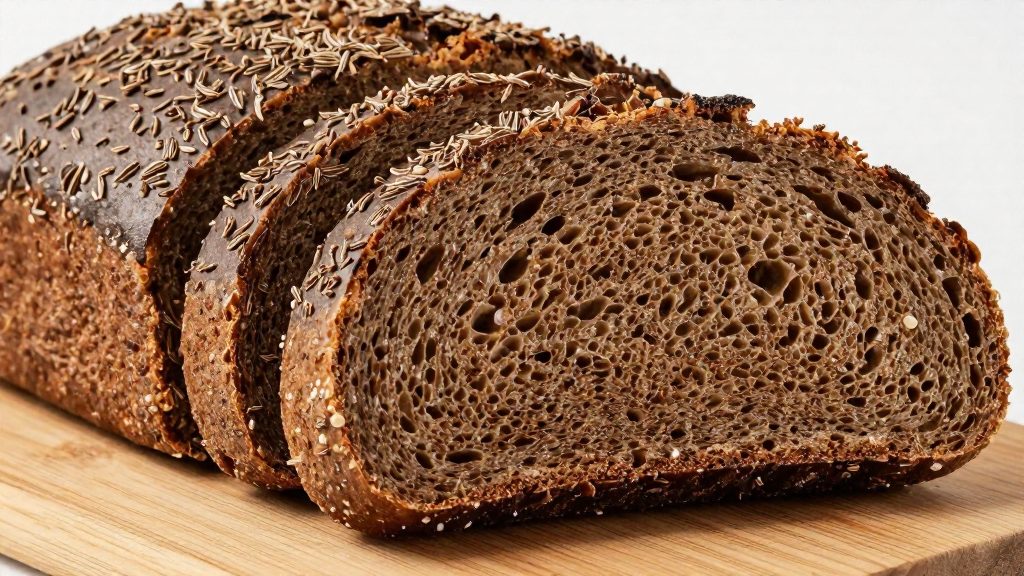
Ingredients for rye bread with caraway seeds
The flours and yeast set the flavor, crumb and rise of a rye loaf. For a single loaf, Once Upon a Chef (2026) uses 1⅓ cups rye flour and 2⅔ cups bread flour, with 2½ tsp instant yeast. The other recipes consulted use different proportions, which show how each choice changes the bread.
Rye flour: dark or light
Dark rye is coarser and keeps more of the bran, which generally gives a stronger, earthier flavor and a denser crumb. Light rye has more of the bran removed and generally makes a milder loaf. Bob’s Red Mill (2026) specifies dark rye for its deli-style version, at 1¼ cups. Taste of Home (2026) uses 2½ cups of rye flour for two loaves but does not specify the grade.
Wheat flour: bread flour or all-purpose
Rye contains little gluten, so the wheat flour provides most of the structure. Bread flour has a higher protein content, which supports that structure. Bob’s Red Mill (2026) uses 2¾ cups of bread flour, and Once Upon a Chef (2026) uses 2⅔ cups. Taste of Home (2026) uses all-purpose flour instead, in a range of 2¾ to 3¼ cups, which lets the baker adjust the dough’s firmness.
| Recipe (source) | Rye flour | Wheat flour | Yeast |
|---|---|---|---|
| Deli-style (Bob’s Red Mill, 2026) | 1¼ cups dark rye | 2¾ cups bread flour | 3/8 tsp instant yeast |
| Two loaves (Taste of Home, 2026) | 2½ cups rye | 2¾–3¼ cups all-purpose | 2 packages active dry yeast |
| Single loaf (Once Upon a Chef, 2026) | 1⅓ cups rye | 2⅔ cups bread flour | 2½ tsp instant yeast |
Yeast: instant or active dry
Instant yeast is measured in teaspoons: 2½ tsp in the single-loaf recipe and 3/8 tsp in the deli-style one. Active dry yeast appears in packages, with two packages in the two-loaf version. The recipes consulted do not give a conversion between the two types, so a swap by measure is not supported by these sources.
Salt is not listed in the single-loaf figures above. For the two-loaf version, Taste of Home (2026) uses 2 tsp.
How much caraway should you use?
The three recipes compared here use 1 to 2 tablespoons of caraway for 4 to 5¾ cups of flour. Bob’s Red Mill’s deli-style rye uses the most, with 2 Tbsp in the dough (Bob’s Red Mill, 2026). Once Upon a Chef’s single loaf and Taste of Home’s pan-style two-loaf recipe both use 1 Tbsp (Once Upon a Chef, 2026; Taste of Home, 2026). The right amount depends on the loaf format and on how much flour the recipe contains.
Dough seeds versus topping seeds
Bob’s Red Mill splits its seeds between the dough seeds and the topping seeds. The dough receives 2 Tbsp (6 tsp), and the top receives 1 tsp, so the topping holds about one-seventh of the total seed weight in volume terms. The other two recipes list caraway only as an ingredient for the dough.
Caraway per cup of flour
Comparing the dough amounts against total flour shows how the ratio changes:
| Recipe (publisher, year) | Format | Caraway in dough | Total flour | Tbsp caraway per cup of flour |
|---|---|---|---|---|
| Bob’s Red Mill (2026) | Deli-style loaf | 2 Tbsp | 4 cups (1¼ dark rye, 2¾ bread flour) | 0.5 |
| Once Upon a Chef (2026) | Single loaf | 1 Tbsp | 4 cups (1⅓ rye, 2⅔ bread flour) | 0.25 |
| Taste of Home (2026) | Pan-style, 2 loaves | 1 Tbsp | 5¼–5¾ cups (2½ rye, 2¾–3¼ all-purpose) | about 0.17–0.19 |
The ratios are calculated from the listed quantities. They are not figures published by the sources.
Scaling from one loaf to two
The Taste of Home recipe makes two loaves with the same 1 Tbsp of caraway as the single-loaf Once Upon a Chef recipe, while using 1¼ to 1¾ cups more flour. Doubling the loaves does not mean doubling the seeds. If the seeds are split evenly between two loaves, each gets ½ Tbsp (1½ tsp).
If you want to scale a recipe yourself, you can apply Bob’s Red Mill’s ratio of 0.5 Tbsp per cup. For 5½ cups of flour, that gives about 2¾ Tbsp. This is a starting point from arithmetic, not a published amount, and the Taste of Home recipe uses far less. Adjust from there based on how strong the caraway flavor should be.
Step-by-step rye bread method
Rye bread at home runs through four stages: mixing, bulk fermentation, shaping and a short final proof. The bulk fermentation time has the largest effect on flavor. A rise of about one hour, as in the pan-style recipe from Taste of Home (2026), gives a different loaf than the 18-hour room-temperature rise in Bob’s Red Mill (2026) deli-style caraway rye.
Mixing and kneading the rye dough
Combine the flours in one bowl first so the rye is evenly distributed. Bob’s Red Mill (2026) uses 1¼ cups dark rye flour with 2¾ cups bread flour. Once Upon a Chef (2026) uses a single-loaf ratio of 1⅓ cups rye flour to 2⅔ cups bread flour.
Add the seeds at this stage. Bob’s Red Mill uses 2 Tbsp caraway in the dough and sets aside 1 tsp for the top. The single-loaf Once Upon a Chef version uses 1 Tbsp caraway in the dough. Stir in the yeast with the dry ingredients, then add the water and mix until no dry flour is visible.
The consulted sources do not specify a kneading time, so judge by texture: the dough should look smooth and hold together without crumbling.
Bulk fermentation: the one-hour and 18-hour options
Bulk fermentation is the rise of the whole dough before shaping. The two timing options differ mainly in yeast quantity and length of rise:
| Timing option | Source | Yeast | Bulk rise | Final proof after shaping |
|---|---|---|---|---|
| Quick | Taste of Home (2026), 2-loaf recipe | 2 packages active dry yeast | About 1 hour | About 30 minutes |
| Overnight | Bob’s Red Mill (2026), deli-style caraway rye | 3/8 tsp instant yeast | 18 hours at room temperature | Not specified in the consulted sources |
The overnight option uses very little yeast, so the long rise carries most of the flavor development. Cover the dough during the rise so its surface does not dry out.
Shaping and surface tension
After the bulk rise, turn the dough onto a lightly floured surface and shape it into a loaf. Once Upon a Chef (2026) advises building surface tension while shaping. Pull the outer skin taut as you roll the dough up, then pinch the seam closed and tuck it underneath. A taut surface helps the loaf hold its shape and rise upward instead of spreading.
Final proof
Place the shaped loaf in its pan or on a tray and let it proof. Taste of Home (2026) allows about 30 minutes for this stage. Sprinkle the reserved caraway over the top of the loaf, as Bob’s Red Mill (2026) does with its 1 tsp topping; the consulted sources do not specify exactly when.
How do you bake rye bread in a Dutch oven or oven?
Rye bread bakes in two main ways: inside a preheated Dutch oven, or directly in a home oven, either as a free-standing loaf with steam or in a loaf pan. The Dutch oven method traps the moisture the dough releases, which keeps the crust soft for the first part of the bake. Bob’s Red Mill (2026) bakes its deli-style caraway rye in a preheated 4–5 qt Dutch oven at 450°F, covered for 30 minutes and then uncovered for 16 minutes. A single-loaf oven method from Once Upon a Chef (2026) starts at 425°F with steam, then drops to 375°F.
Dutch oven method
Preheat the Dutch oven, with its lid, at 450°F before the dough goes in. Bake the loaf covered for 30 minutes, then remove the lid and bake it uncovered for 16 minutes more. The lid holds steam around the loaf during the first phase, and the open final phase lets the crust dry and brown.
Open-oven method with steam
Once Upon a Chef (2026) bakes a single loaf at 425°F for 25 minutes with steam, then reduces the heat to 375°F for 10–15 minutes. Use whatever steam method your oven supports. The higher starting heat sets the crust early, and the lower second phase finishes the interior without over-browning the surface.
Pan-style loaves
Taste of Home (2026) bakes its yeasted pan-style rye at 375°F for 25–30 minutes, with no covered phase and no steam step. This approach suits sandwich-shaped loaves that rely on the pan’s walls for shape.
| Method | Temperature and timing | Covering |
|---|---|---|
| Dutch oven (Bob’s Red Mill, 2026) | 450°F: 30 min covered, 16 min uncovered | Lid on, then off |
| Single loaf with steam (Once Upon a Chef, 2026) | 425°F for 25 min, then 375°F for 10–15 min | Steam, no lid |
| Pan-style (Taste of Home, 2026) | 375°F for 25–30 min | Pan only |
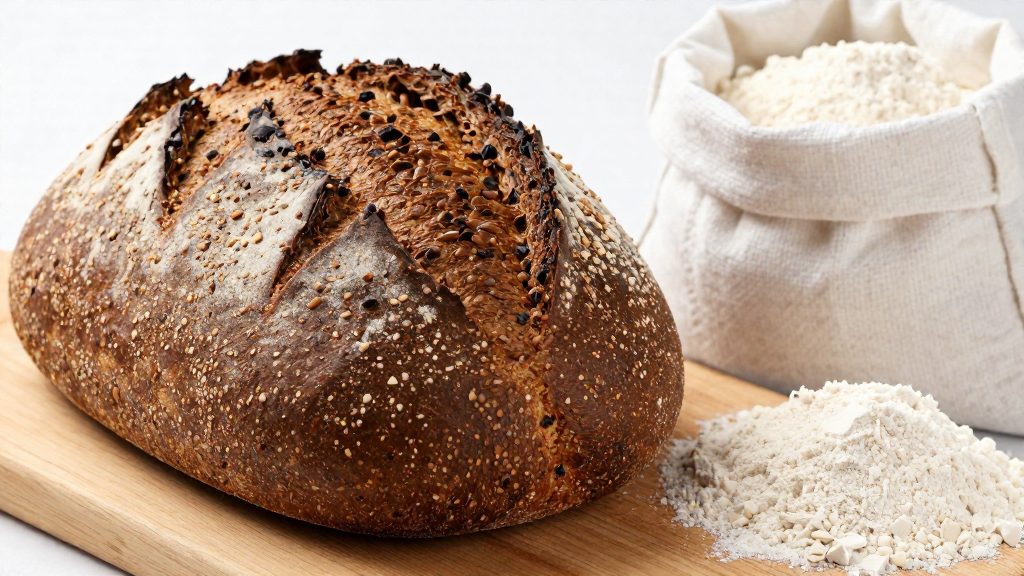
Can you make caraway rye with sourdough?
Yes. A caraway rye can be leavened with a sourdough starter instead of commercial yeast, but the recipe needs adjusting. The starter becomes the only leavening agent, so the dough needs more time to develop. The published recipes below all use packaged yeast, so their rise times are a reference point rather than a direct template for a starter-based loaf.
| Source | Reported rise schedule | Leavening used |
|---|---|---|
| Bob’s Red Mill (2026) | 18 hours at room temperature | Instant yeast |
| Taste of Home (2026) | About 1 hour, then about 30 minutes after shaping | Active dry yeast |
Replacing commercial yeast with starter
Yeast works quickly and predictably. A starter is a colony of wild yeasts and bacteria whose activity depends on its health and temperature. Use it at its peak, when it has roughly doubled in volume and is full of bubbles, and avoid using it when it has already started to collapse. Mix the starter into the dough with the water first so it disperses evenly, since rye flour carries a lot of the flavour and can clump if added dry.
Feeding the starter for rye
Rye flour is more nutrient-rich for microbes than white flour, so a starter fed on rye tends to become active faster and more acidic. Many bakers keep a separate rye starter or feed their main starter with a portion of rye flour before baking, which helps the culture stay vigorous and keeps the caraway flavour rounded rather than sharp.
Dough consistency
Rye has little gluten-forming protein, so rye-heavy dough is stickier and slacker than a wheat dough. Many bakers add bread flour gradually and judge the dough by feel, stopping when it holds its shape without tearing. Caraway seeds are best folded in after the dough has begun to form, so they distribute without damaging the developing structure.
Fermentation and proofing timing
Because a starter is slower than yeast, expect a longer bulk fermentation and a longer proof after shaping. Rely on visual cues, such as a dough that has grown noticeably, shows bubbles at the surface, and springs back slowly when pressed, rather than on the clock alone. Room temperature strongly affects the pace, so a warm kitchen can shorten the timing considerably.
How do you know rye bread is done?
A loaf of caraway rye is done when its internal temperature reaches 200–205°F (about 93–96°C). Bob’s Red Mill (2026) and Once Upon a Chef (2026) both give this target for their caraway rye loaves. Crust color and sound can tell you when to start checking, but neither confirms doneness on its own, so a temperature reading is the most reliable test.
Taking the internal temperature
Use an instant-read thermometer and insert the probe into the center of the thickest part of the loaf, from the bottom or the side, without touching the baking vessel. Read the number, then check a second spot if the first reading is close to the target. Outer layers run hotter than the middle, so a reading taken near the crust can show a finished loaf while the center is still underbaked.
| Recipe | Source | Doneness target |
|---|---|---|
| Deli-style caraway rye, baked in a preheated Dutch oven | Bob’s Red Mill (2026) | 200–205°F |
| Single-loaf rye with caraway, baked with steam | Once Upon a Chef (2026) | 200–205°F |
The pan-style caraway rye from Taste of Home (2026) does not give an internal temperature, so for that loaf the color and sound checks below are the main guides.
Crust color
A deep, even brown crust suggests the surface has browned well, but color varies with the recipe and the oven, so treat it as a first clue rather than proof. Caraway seeds sprinkled on top can darken before the crust beneath them, so judge the exposed bread between the seeds. If the crust is dark but the thermometer is below target, keep baking and check again.
Hollow-sound tapping
Once the loaf is out of the oven, tap the bottom with your fingertips. A hollow, drum-like sound suggests the structure has set. A dull thud suggests the interior is still dense and may need more time. Tapping is quick and useful for a second opinion, but it is a judgment call, which is why it works best alongside the thermometer reading.
Storing and slicing rye bread
Rye bread needs to cool fully before it is cut, and it keeps for days when stored correctly. According to Once Upon a Chef (2026), a finished loaf stores up to 3 days at room temperature, or up to 3 months frozen once it has been sliced.
Cool completely before slicing. Rye crumb is dense and firms up as it cools. Cutting into a loaf that is still warm releases steam and leaves the interior gummy. Once Upon a Chef (2026) advises cooling the loaf completely before slicing to avoid a gummy crumb. Place it on a wire rack and wait until the center, not only the crust, feels cool.
Room-temperature storage. Once cooled, keep the loaf at room temperature for up to 3 days. Store it in a bread box, a paper bag or a clean cloth, which lets the crust stay firm while limiting drying. Once the 3-day window has passed, the bread should be frozen or used.
Freezing sliced loaves. Slice the cooled bread before freezing, so you can remove individual portions without thawing the whole loaf. Wrap the slices tightly in an airtight bag or container. Frozen slices keep for up to 3 months, and you can toast or thaw them one at a time as needed.
| Storage method | Maximum duration | Condition |
|---|---|---|
| Room temperature (whole loaf) | Up to 3 days | Fully cooled first |
| Frozen (sliced) | Up to 3 months | Sliced before freezing |