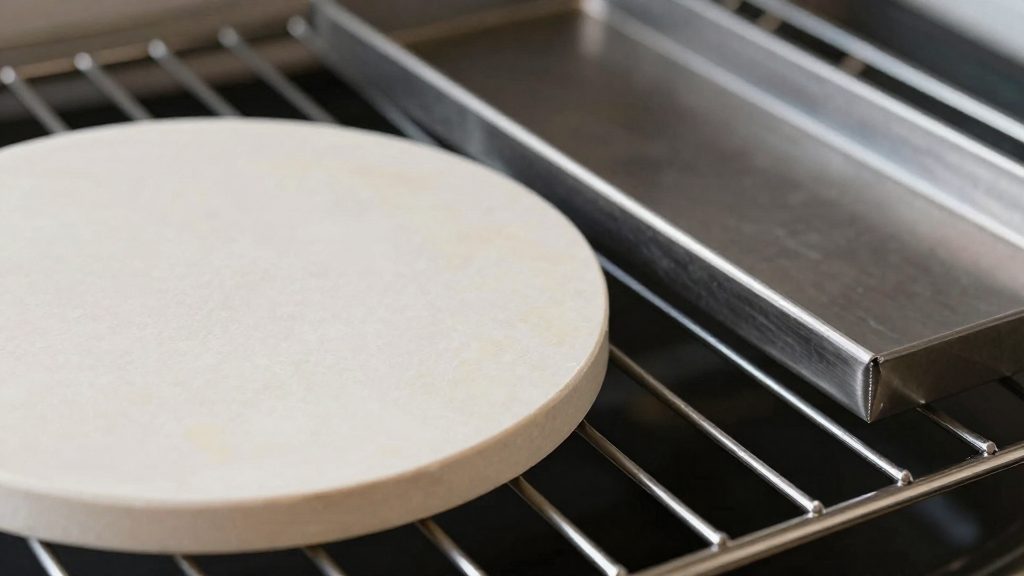
For a home oven, a baking steel is the faster surface, and a pizza stone is the other workable choice. Both materials suit home ovens. The choice depends mainly on whether you value speed and durability more than what you already own.
Pizza stone vs baking steel: the short answer
Steel bakes faster
A baking steel responds to heat sooner than a stone. The practical difference is that a steel moves heat into the pizza faster. With either surface, leave at least 5 minutes between pizzas so it can reabsorb heat.
Cordierite stone versus solid metal steel
Most products sold as pizza stones are cordierite, a ceramic. A baking steel is a metal slab with sanded edges.
| Attribute | Pizza stone (cordierite) | Baking steel |
|---|---|---|
| Material | Ceramic | Metal slab with sanded edges |
| Durability | Can crack or deteriorate over time | Described as nearly indestructible |
| Cleaning | Scraped and rinsed without soap | Wiped with warm water and dried right away |
| Upkeep | Discolors over time | Needs seasoning to prevent rust |
Which buyer should pick which material
Choose a baking steel if you want the fastest heat response, if you want a surface that is unlikely to break, and if you are willing to dry it promptly and season it to prevent rust. King Arthur Baking (2026) recommends a steel if you can choose.
Choose a pizza stone if you already own an intact one and are happy to keep it. A stone will still work in a home oven, but its slower heat response and tendency to discolor are the trade-offs. Compare current prices for both before you buy.
How do stones and steels differ in heat transfer?
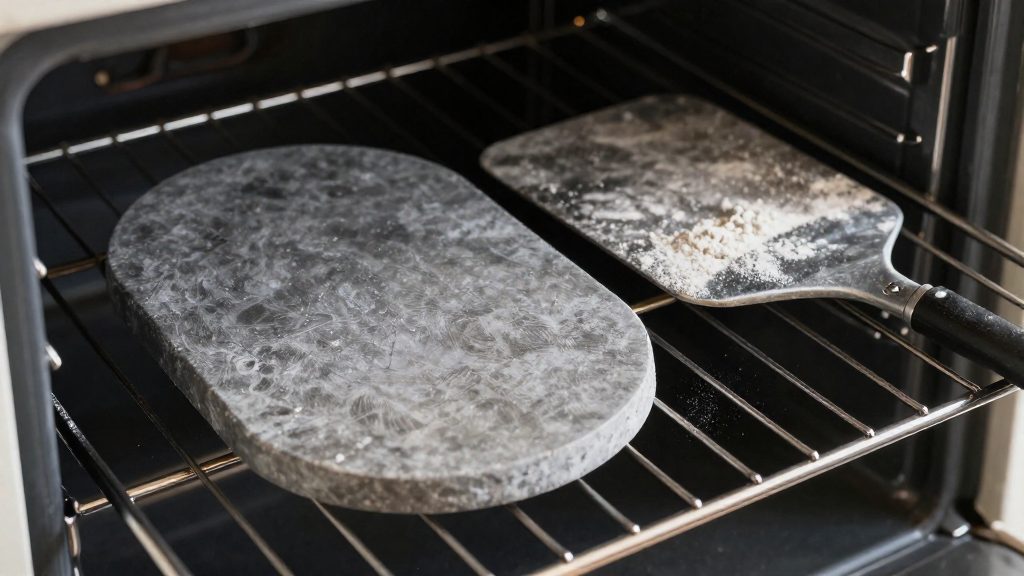
A steel conducts heat better than a stone, so it heats faster and passes heat to the pizza more quickly. A stone holds heat and releases it more slowly. These two behaviours come from the materials themselves.
Made In Cookware (2026) describes the difference as one of speed: steel absorbs and releases heat quickly, while stone holds heat and releases it more slowly. King Arthur Baking (July 2026) states that steel’s higher conductivity means heat moves into the pizza faster than it does from a stone.
Conductivity versus heat storage
Two separate properties are involved. Conductivity describes how quickly heat travels through a material. Heat storage describes how much heat the material keeps and how it lets go of it. Steel scores higher on conductivity, so it delivers energy to the base of the pizza at a quicker rate. Cordierite behaves more like a reservoir: it gives up its stored heat gradually.
| Property | Steel | Cordierite stone |
|---|---|---|
| Heat conduction | Faster | Slower |
| Heat release | Absorbs and releases quickly | Holds heat and releases it slowly |
Why the material matters
Metal and ceramic handle heat differently. Heat moves through a metal such as steel readily, which is why a steel responds quickly when the oven heats up or when a cold pizza is placed on it. Cordierite, being a ceramic, stores heat within its mass and passes it on more gradually. Because of this, two bases set at the same oven temperature can transfer heat at different rates, depending on whether the base is steel or stone.
Which is better for crispy crust in a home oven?
For a crispier base in a home oven, a baking steel generally outperforms a pizza stone, because it moves heat into the dough faster. According to King Arthur Baking (July 2026), this produces faster cooking, better browning and crispier crusts. The difference shows most on the underside of the pizza, where the dough meets the hot surface.
| Property | Baking steel | Pizza stone |
|---|---|---|
| Typical crust result | Faster cooking, better browning, crispier crust (King Arthur Baking) | Transfers heat to the dough more slowly than steel |
Recovery between consecutive pizzas
Each pizza draws energy out of the cooking surface, so the surface has to regain that heat before the next pizza goes in. King Arthur Baking (July 2026) advises leaving at least 5 minutes between pizzas so the steel or stone can reabsorb heat. If you skip this gap, later pizzas come out paler and less crisp than the first. Batch baking is where this matters most, because the surface is steadily losing heat across the session.
Is a baking steel worth choosing? Frequency of use and handling
Compare current purchase prices and slab weights before deciding. The two materials behave differently, and that difference is the basis for deciding whether the extra spend pays off in a home oven.
Faster results are the main argument for steel. Whether that difference justifies the extra cost depends on how often you bake. If you make pizza weekly, the faster transfer is repeated every session. If you bake occasionally, the faster transfer matters less often, so weigh it against the stone you may already own.
Handling weight deserves a practical test before buying. A steel slab is a single heavy piece that you lift in and out of a hot oven, so check the listed weight of the model and make sure you can move it safely with oven gloves and a peel.
How long should you preheat a stone or steel?
King Arthur Baking (2026) advises preheating the oven with the stone or steel inside for at least one hour before baking. The target is a surface temperature of at least 500°F, checked with an infrared thermometer. The oven’s air setting alone does not show whether the slab itself is ready, so the surface reading is what confirms it.
Preheating time
Put the stone or steel in the oven before you switch the oven on. This lets the slab heat gradually with the oven instead of being added to a cavity that is already hot. Keep it inside for the full hour, so the surface has time to reach the target.
Surface temperature and checking
| Check | Target | How to do it |
|---|---|---|
| Preheat duration | At least one hour | Slab stays in the oven the whole time |
| Surface temperature | At least 500°F (about 260°C) | Read the slab surface, not the air |
| Measuring tool | Infrared thermometer | Aim at the centre, then near the edges |
Point the infrared thermometer at the slab and take a reading. Check the centre and the edges, since a single spot can miss uneven heating. If the reading is below 500°F, keep the oven running and check again after a few more minutes.
Can a pizza stone crack?
Yes. Stones can crack or deteriorate over time, and this is the main durability trade-off between a stone and a steel. According to King Arthur Baking (2026-07-17), stones can crack or deteriorate over time. How long a stone lasts depends on how often it is used and how it is handled.
How a stone fails over time
Per King Arthur Baking (2026), a stone can crack or deteriorate over time, so inspect it regularly. A small crack can grow with later use, and a cracked stone may split during a bake. The other failure mode is gradual deterioration: the stone’s surface wears down and its performance declines, so it can get worse without any obvious break.
Why steel is more durable
King Arthur Baking (2026-07-17) describes steels as nearly indestructible. Because the material is metal rather than ceramic, the cracking that affects stones is not the main concern with a steel.
Choosing steel when you have the option
King Arthur Baking (2026-07-17) recommends a steel if you can choose between the two. If you already own a stone, handle it carefully and replace it if it cracks.
| Feature | Cordierite stone | Steel slab |
|---|---|---|
| Durability over time | Can crack or deteriorate | Described as nearly indestructible |
| Source recommendation | Not the first choice when a steel is possible | Recommended if you can choose |
Care and cleaning for each
Daily care for a pizza stone and a baking steel differs because the two materials react to water differently. According to Made In Cookware (2026), a steel is wiped with warm water and dried right away, while a stone is scraped and rinsed without soap. The table below compares the two routines.
| Routine point | Pizza stone | Baking steel |
|---|---|---|
| Cleaning method | Scraped, then rinsed | Wiped |
| Cleaning agent | Water only, no soap | Warm water |
| Drying | Not stated | Dried immediately after wiping |
| Surface over time | Discolors over time | Needs seasoning to prevent rust |
The main difference is moisture. Because a steel can rust, the surface must be dry before you put it away. Dry it immediately after wiping, since leftover water is what starts rust on bare metal.
Seasoning is the protective layer on a steel. It is what prevents rust, so it belongs to routine care rather than a one-time job.
A stone is cleaned differently. Scrape off stuck flour, cheese, or dough first, then rinse. Skipping soap matters because the stone is porous, so it is rinsed rather than washed with detergent. Expect the stone to discolor with use; Made In Cookware (2026) describes this as a normal change over time, not a cleaning failure.
What size and shape should you buy?
King Arthur Baking (2026) recommends choosing the largest rectangular unit that fits your oven. Measure the oven’s interior before you shop, then pick the biggest rectangle that still fits with room to spare for the door and for air to move around it. A larger cooking surface gives you more room for dough, toppings, and error, so size matters as much as material.
Why rectangles beat round shapes
According to King Arthur Baking (2026), rectangles are more versatile than round shapes. A rectangular unit uses the straight walls of a standard oven more fully, so less of the interior goes unused. Round units can still work, but King Arthur Baking (2026) considers rectangles more versatile.
Why a bigger surface makes sliding easier
King Arthur Baking (2026) also notes that a bigger surface makes it easier to slide pizzas on. Sliding a pizza from a peel onto a hot surface is the step where dough most often sticks or folds. A surface clearly larger than the pizza gives you a margin for error, while a surface that barely matches the pizza leaves little room to correct a misaligned slide.
Buying checklist
| Check | Why it matters |
|---|---|
| Interior width and depth of the oven | Sets the largest rectangle you can fit (King Arthur Baking, 2026) |
| Shape: rectangle | More versatile than a round shape (King Arthur Baking, 2026) |
| Surface size compared with the peel blade | A bigger surface makes it easier to slide pizzas on (King Arthur Baking, 2026) |
Measure your own oven and peel rather than relying on general sizes.
Frequently asked questions
Which should a beginner buy first, a pizza stone or a baking steel?
King Arthur Baking (2026) recommends a steel if you have the choice, mainly for its durability. If you already own an intact pizza stone, it will still work in a home oven, so you don’t need to replace it before you start making pizza.
Will a baking steel make my crust crispier than a pizza stone?
According to King Arthur Baking (2026), steel has better thermal conductivity than stone, so it transfers heat to the dough faster. That faster transfer is what the publisher links to quicker cooking, better browning and crispier crusts.
How do I look after each one so it lasts?
A steel is wiped with warm water and dried right away, and it needs seasoning to prevent rust. A stone is scraped and rinsed without soap, and it discolors over time. Stones can also crack or deteriorate, while King Arthur Baking (2026) describes steel as nearly indestructible.