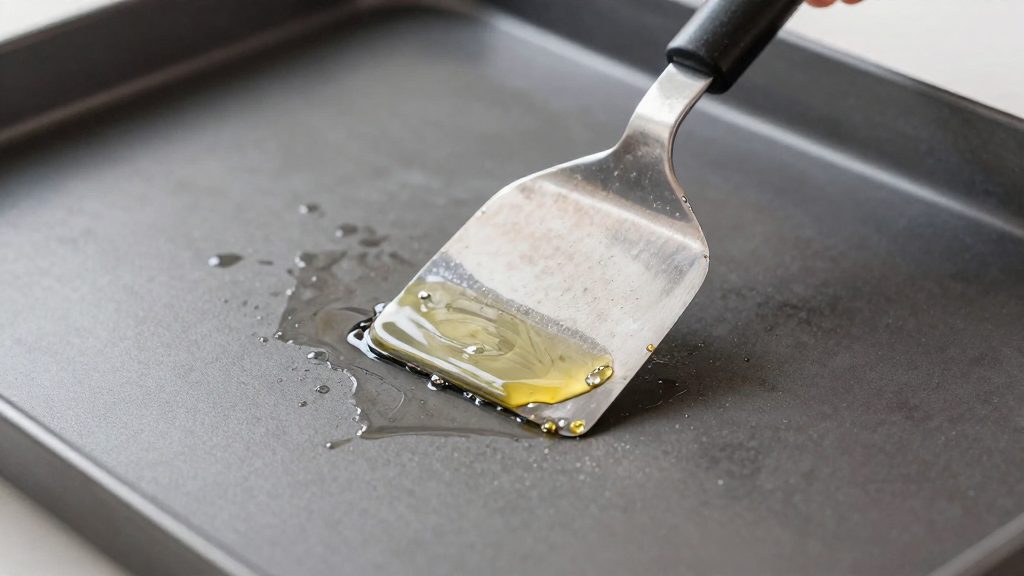
No, a baking steel does not need a full wash after every bake. The manufacturer, Baking Steel, advises scraping residue off while the steel is warm, wiping it with a dry paper towel or cloth, and drying completely to prevent rust. King Arthur Baking (2024-07-03) says routine care is usually just brushing off crumbs. A full wash is only needed when residue will not lift with a scraper.
Do you need to clean a baking steel after every use?
Scrape-only versus full wash after routine baking
A scrape-only routine covers most bakes. Loose crumbs, flour, and small drips come off with a scraper and a dry cloth. Once the surface is wiped, dry it fully.
A full wash is a separate step for residue that stays after scraping. King Arthur Baking (2024-07-03) recommends letting the steel cool completely, scraping off stuck-on residue, then washing and drying it fully. Baking Steel (manufacturer) describes a deeper method for rust or heavy buildup: scrub with a pumice cleaning brick, wash with hot soapy water and a stiff brush, then rinse.
| Situation | Action | Source |
|---|---|---|
| Loose crumbs or flour after a bake | Scrape while warm, wipe with a dry paper towel or cloth | Baking Steel (manufacturer) |
| Stuck-on residue that does not lift with a scraper | Cool completely, scrape, wash, rinse, dry fully | King Arthur Baking (2024-07-03) |
| Heavy buildup or rust with a deep clean | Pumice brick, hot soapy water, stiff brush, dry at 200°F for 10–15 minutes | Baking Steel (manufacturer) |
Telling residue from browning
Darkening is not the same as dirt. The King Arthur Baking (2024-07-03) guidance states that darkening or patina is normal and needs no removal unless the surface is sticky or rough. This distinction determines whether a steel needs cleaning at all.
Cleaning frequency for everyday versus heavy use
The decision depends on the surface rather than the calendar.
- Everyday use: Scrape and wipe after each bake. Most sessions need nothing more.
- Heavy use: Expect more residue, such as cheese, sugar, or dough that has baked onto the surface. Check by touch after each session. If the surface feels sticky or rough, use the full wash method from the table above before the next bake.

What you need to clean a baking steel
Cleaning a baking steel takes only a few inexpensive tools, most of which are already in a home kitchen. According to the manufacturer, Baking Steel, routine cleaning relies on a scraper and a dry cloth or paper towel, while hot soapy water and a stiff brush are used when needed. A pumice cleaning brick is reserved for deep cleaning and rust, not everyday use.
Pumice cleaning brick
A pumice cleaning brick is a block of abrasive volcanic stone. Baking Steel recommends it for deep cleaning and for rust, where it removes residue that water and a brush cannot shift. When buying one:
- Choose a brick sold as a cleaning brick for baking steels or stones, rather than a general-purpose abrasive.
- Check that the brick is solid and not crumbling, since loose grit can scratch the surface.
- Keep a separate brick for the steel so it is not mixed with tools used on other cookware.
Other tools
- Plastic scraper: Removes stuck-on residue. Plastic is used instead of metal so the scraper does not gouge the surface.
- Stiff brush: Works with hot soapy water when the steel needs washing.
- Lint-free cloths or dry paper towels: Wipe the steel and dry it completely after washing.
- Heat-resistant gloves: Steel holds heat for a long time after the oven is turned off, so gloves protect your hands when you move or scrape a warm steel.
Gather these tools before you begin, so the steel can be handled and dried without interruption.
How to clean a baking steel step by step
Routine cleaning of a baking steel is two stages: scrape and wipe, then dry. Washing is an optional step between them, used only when residue will not lift with a scraper. According to Baking Steel (manufacturer, undated), you start while the steel is still warm, not hot. Residue lifts more easily at that temperature, and you avoid handling a steel that is still too hot to touch comfortably. Routine cleaning is quick, but the drying stage matters most, because moisture left on the metal is what leads to rust.
| Stage | Action | Key detail |
|---|---|---|
| 1. Scrape and wipe | Scrape off residue, then wipe with a dry paper towel or cloth | Steel still warm, not hot |
| 2. Wash and rinse | Wash with hot water and a stiff brush, then rinse | Hot water plus a stiff brush |
| 3. Dry | Dry completely; after a wash or deep clean, place the steel in a 200°F oven | 10–15 minutes |
Step 1: Scrape and wipe while warm
Scrape stuck-on residue off the surface with a flat tool while the steel is still warm. Then wipe the surface with a dry paper towel or cloth to pick up loose crumbs and dust. Doing this first removes most of the debris, so the wash step has less to clean.
Step 2: Wash with hot water and a stiff brush
If residue remains after scraping, let the steel cool completely, then wash it with hot soapy water and a stiff brush. The brush loosens material the scraper cannot lift. Rinse the steel thoroughly afterward so no residue is left on the surface.
Step 3: Dry completely in a 200°F oven
Dry the steel completely before storing it. After a routine scrape and wipe, Baking Steel (manufacturer) says to dry the steel completely, and you can return it to a warm oven for a few minutes. After a wash or deep clean, it recommends a 200°F oven for 10–15 minutes. Full drying is the step that prevents rust, so do not skip it or shorten it, even if the surface looks dry to the touch.
Can you use soap on a baking steel?
Yes. According to Baking Steel (manufacturer, undated), hot soapy water is safe for a baking steel when cleaning is needed. Soap is a fallback, though, not a routine step. Soapy water comes in when that is not enough. King Arthur Baking (2024-07-03) takes a similar position, advising light soap and water once the steel has cooled completely, followed by a rinse and full drying.
Where soap is the wrong choice
The soap warning does not apply to steel. King Arthur Baking (2024-07-03) states that its warning against soap applies to unglazed ceramic stones, not to steel. Treat the two surfaces as separate cases.
| Surface | Soap guidance | Source |
|---|---|---|
| Baking steel | Hot soapy water is safe when needed | Baking Steel (manufacturer, undated) |
| Baking steel | Light soap and water is acceptable after the steel has fully cooled | King Arthur Baking (2024-07-03) |
| Unglazed ceramic stone | The soap warning applies | King Arthur Baking (2024-07-03) |
Soap residue and the seasoning
The seasoning is the oil layer on the steel, and it is what helps food release.
King Arthur Baking (2024-07-03) gives the practical test for judging the surface after washing. A sticky film is the residue to act on. If it remains after washing, the steel has not been cleaned adequately, and the sources do not suggest leaving it in place.
How to remove rust from a baking steel
Surface rust on a baking steel is usually removed by abrasion, not by replacing the steel. Before you start, judge how far the corrosion goes, because that determines which tool to use and how much work the steel needs afterwards.
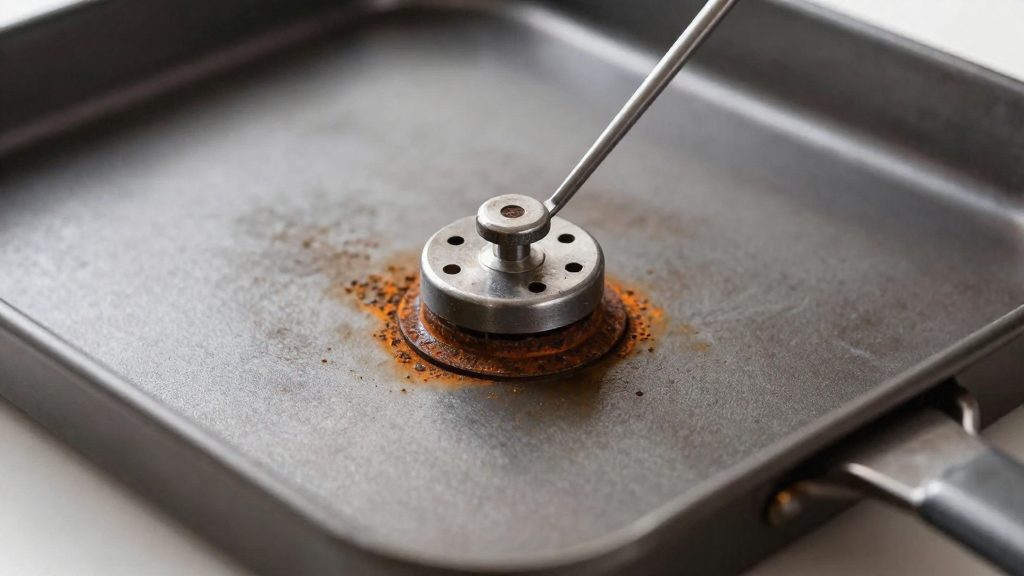
Scrubbing with a pumice brick
Work on the steel when it is cool and dry. Rub the pumice cleaning brick over the rusted area with firm, short strokes. Brush the loose dust away periodically so you can see whether the orange-brown discoloration is lifting. Stop when the rust is gone. Then wash the steel with hot soapy water and a stiff brush, rinse it, dry it completely in a 200°F oven for 10–15 minutes, and re-season it.
Use steady pressure rather than force. The aim is to remove the oxidised layer, not to grind down the surface around it. Work in small areas and check each one before moving on.
For isolated spots that resist the brick, King Arthur Baking (2024-07-03) suggests fine sandpaper or steel wool as an alternative.
Telling light spots from widespread corrosion
The severity of the rust decides the approach. The table below sets out the two situations.
| Condition | What it looks like | Suggested approach |
|---|---|---|
| Light surface spots | Small, separate orange-brown patches that lift after a few passes with the pumice brick | Scrub each spot locally, then use fine sandpaper or steel wool on any stubborn areas |
| Widespread corrosion | Rust across a large part of the surface, with roughened or flaking metal | Scrub the whole affected area with the pumice brick, then assess the result before deciding anything further |
If rust remains after thorough scrubbing across most of the surface, the steel’s condition should be reviewed carefully before it is used for baking.
How to re-season a baking steel
Re-seasoning restores the thin, slightly darker layer that helps a baking steel release food. Baking Steel, the manufacturer, describes an oil-based method that uses very little oil: a film is applied, most of it is wiped off, and the steel is baked. The steel is not coated thickly, so the result is a film rather than a pool of oil on the surface.
Choosing the oil
Baking Steel names three oils for this step: flaxseed, grapeseed, and canola. The manufacturer specifies high-smoke-point oils, which matter because the steel is heated to 400°F for an hour. King Arthur Baking (2024) describes the same step more generally as a thin film of vegetable oil, so for the manufacturer’s method, use one of its three named oils. For the manufacturer’s named options, use one of the three oils above.
When to re-season
Re-season when the steel looks dull and gray or when food starts to stick to it. For most users, Baking Steel says this is about once or twice a year. Use the sticking as the trigger rather than a fixed calendar: if food still releases cleanly, the steel does not need the treatment yet.
Applying a thin coat
Apply a very thin layer of oil to both the top and the bottom of the steel. Then wipe off nearly all of it with a dry cloth or paper towel. What remains should be barely visible on the surface. Leaving a heavy coat is the main thing this method is meant to avoid.
Baking and cooling
Place the steel in the oven and bake for 1 hour. The two sources give slightly different temperatures:
| Source | Oil | Temperature | Time |
|---|---|---|---|
| Baking Steel (manufacturer) | Flaxseed, grapeseed, or canola | 400°F | 1 hour |
| King Arthur Baking (2024) | Vegetable oil | 375–400°F | 1 hour |
Once the hour is over, turn the oven off and leave the steel inside to cool. Both sources give this instruction, so the steel should not be removed while hot. Once it has cooled, it is ready for use again.
Mistakes that ruin a baking steel
Most damage to a baking steel comes from three habits: shocking the hot metal with cold water, cleaning it with harsh chemicals, and dragging blades across it. Each one harms either the metal or the thin layer of oil that builds up on the surface during seasoning and gives it its non-stick behaviour. The table below lists each mistake, the reason it causes harm, and a safer approach.
| Mistake | Why it causes harm | Safer approach |
|---|---|---|
| Adding cold water to a hot steel | A sudden temperature drop puts stress into the metal, which can lead to cracking or warping | Let the steel cool completely before any water touches it |
| Using oven cleaner or other harsh chemicals | Caustic products strip the seasoning layer and can leave residue that affects later bakes | Remove loose debris by hand or with a dry cloth, and re-season if the surface dulls |
| Dragging knives or sharp tools across the surface | Blade edges scratch and gouge the metal and wear away seasoning | Keep blades and metal tools off the surface |
Thermal shock
A baking steel is a thick slab that heats slowly in the oven, so its surface and core do not always share the same temperature. Cold water hitting a hot surface creates a sudden contrast that the metal has to absorb. The simplest rule is to avoid the contrast altogether.
Harsh chemicals
Oven cleaners are designed to break down baked-on grease, and that same action can damage the oil layer on a steel. Once the seasoning is stripped, food is more likely to stick, and the surface may need to be rebuilt from scratch.
Knives and sharp tools
A knife edge can leave visible marks on the steel and remove seasoning in the same stroke. Repeated scratching gives food more places to catch and makes the surface harder to keep even.
How to store and maintain your steel
Between bakes, a baking steel needs little more than a dry resting place and a quick visual check. Moisture is the main thing to avoid, because rust is what turns a stored steel into a maintenance job.
Choosing a storage spot
Store the steel in a dry area, away from humidity. A cupboard or shelf in a room that stays dry suits this better than a spot next to a sink or dishwasher.
Where you keep the steel depends on how often you bake:
| Storage option | Advantage | Watch for |
|---|---|---|
| Left on an oven rack | Ready for the next bake | Cooking steam and oven humidity reach the surface |
| Cabinet or dry shelf | Kept out of the cooking area | Needs to be dry before it is put away |
Leaving the steel on a rack saves a trip, but the oven is a space where steam from cooking collects. A cabinet or shelf keeps the steel out of that moisture, which lowers the risk of rust forming between sessions.
Routine visual checks
Make a routine visual check each time you put the steel away or before the next bake. Look at the whole surface, top and bottom, for three things:
| What you see | What it means | What to do |
|---|---|---|
| Even, darkened surface | Normal patina from use | Leave it alone |
| Loose crumbs or dust | Everyday residue | Brush it off |
| Sticky film or built-up residue | Residue needs removing | Scrape it off, then wipe it dry |
Check the surface for changes in texture and for any spot that looks different from the rest. A spot that looks like rust is not part of routine care and needs its own treatment, so do not mix it into the everyday cleaning routine.
Keeping the steel dry, storing it away from humid air, and checking its surface between uses is the simplest way to keep it in good condition over time.
Frequently asked questions
Do I need to wash my baking steel after every bake?
No. Scrape the steel while it is still warm, wipe it with a dry paper towel or cloth, and dry it completely. A washing step is optional and only needed when residue will not lift with a scraper, and the steel must cool fully before any water touches it.
Can I use dish soap on my baking steel?
Yes. King Arthur Baking (2024-07-03) allows light soap and water for a wash after the steel has cooled, followed by a full rinse and drying. Its soap warning applies to unglazed ceramic stones, not to steel.
What should I do if my baking steel has rust?
Scrub the rusted spots with fine sandpaper or steel wool, or use the pumice cleaning brick Baking Steel recommends with hot soapy water and a stiff brush. Then dry the steel completely and re-season it with a very thin layer of flaxseed, grapeseed or canola oil, baked at 400°F for 1 hour.