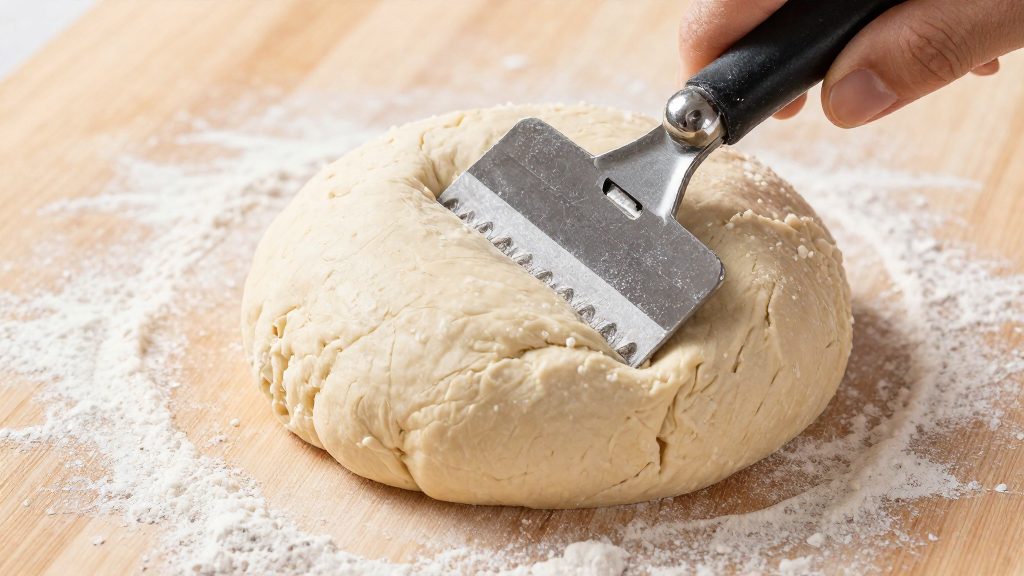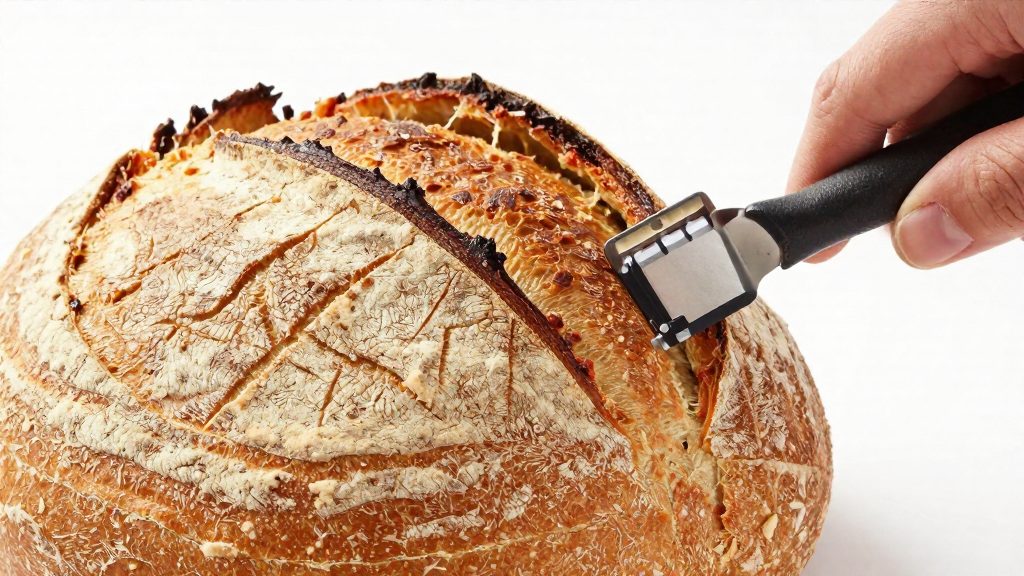
Choose a bread lame by three criteria: how easily and safely the blade changes, how comfortable the holder is, and how well it performs on simple ears and intricate patterns. America’s Test Kitchen (2025) rated the Baker of Seville Artisan Bread Lame as its top pick, and it scored well on these criteria. The three criteria below explain why it, the Wire Monkey UFO, and the Breadtopia lame each earned a place in the comparison.
Which bread lame should you buy?
The criteria that separate lames
America’s Test Kitchen (2025) judged lames on the following points:
- Blade changes: The blade should be easy to swap without risk to your fingers.
- Holder design: The holder should expose both cutting edges, so left-handed and right-handed bakers can both use it. A grippy handle was also part of the evaluation.
- Comfort and performance: Testers scored each lame on comfort and on results. They scored results on simple ears and on intricate patterns.
Blade compatibility
Any double-edged safety razor blade, or a blade sold specifically for lames, fits these holders. Testers found no significant differences between brands, so the blade brand is not a deciding factor in ATK’s findings.
The tested models compared
ATK scored the lames by scoring 10 loaves of pain au levain and 8 baguettes. The table summarises the three models the review highlighted.
| Model | Blade orientation | Notable points (ATK, 2025) |
|---|---|---|
| Baker of Seville Artisan Bread Lame | Switches between curved and straight | Screw system for swapping blades; one-piece handle; case and 3 blades; about $23 at Amazon; main drawback is weight |
| Wire Monkey UFO | Straight only | Chosen for intricate scoring |
| Breadtopia lame | Curved only | Well-pronounced ears; case and 5 blades; about $13 at Amazon |
If you want one holder that covers both ear-making and decorative scoring, the Baker of Seville is the model that offers both blade orientations. If you mainly want ears, the curved-only Breadtopia is the lower-cost option. If your priority is intricate decorative work, the straight-only Wire Monkey UFO fits that use.
Curved or straight blade: does it matter?
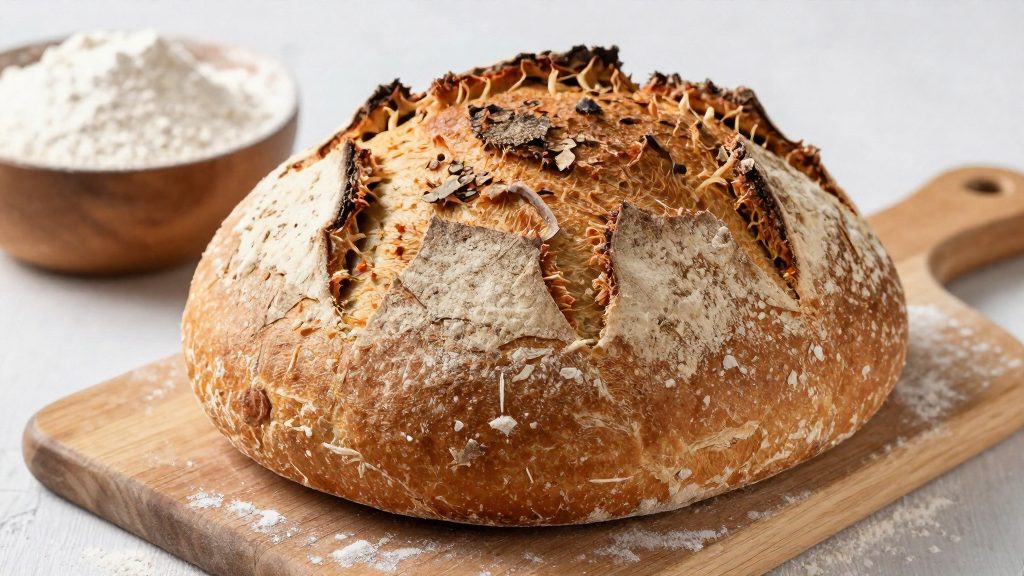
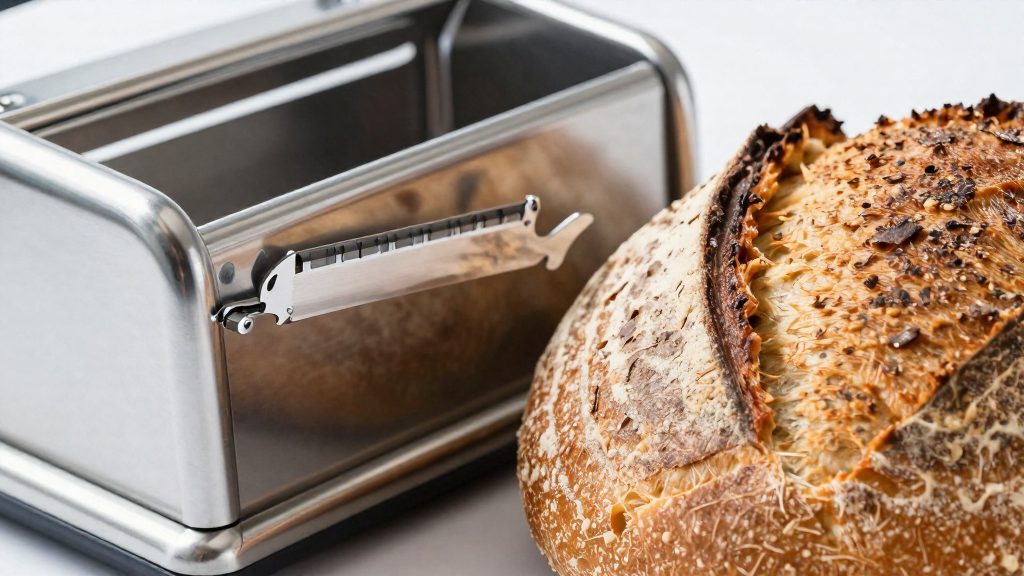
Curved blades and straight blades both open a loaf, but they do not perform equally on every goal. According to America’s Test Kitchen (2025), curved blades make slightly more pronounced ears, the raised flap that forms along a cut during the bake. ATK found that this difference is mostly aesthetic, so the blade shape matters less for a simple country loaf than it does for a loaf with a detailed design. Straight blades give more control for decorative scoring.
The practical split comes down to what you want the cut to do. If the goal is a taller, more visible ear on a plain boule or batard, a curved lame is the more direct choice. If the goal is a pattern made of several lines, such as parallel strokes, a wheat motif or a lettered design, a straight lame gives you more control over where each line goes.
ATK’s testing reflects this split. The team scored 10 loaves of pain au levain and 8 baguettes, then rated each lame on simple ears and intricate patterns, along with ease of use and comfort. The lames were not judged on shape alone, so the results describe the overall tool, not the blade geometry in isolation.
| Goal | Better-suited shape | Basis |
|---|---|---|
| Taller, more visible ear | Curved | Slightly more pronounced ears (ATK, 2025) |
| Intricate or decorative patterns | Straight | More control for decorative scoring (ATK, 2025) |
For intricate designs, ATK named the Wire Monkey UFO as its pick. It is straight-only. Check how often you will change blades before buying.
Best all-around lame
America’s Test Kitchen (2025) names the Baker of Seville Artisan Bread Lame as its top-rated lame. Its main feature is versatility. Some lames in ATK’s testing fix you to one blade shape: the Breadtopia is curved-only, and the Wire Monkey UFO is straight-only. The Baker of Seville avoids this limit. A screw system lets you switch between a curved blade and a straight blade in the same holder, so one tool can handle both the rounded cuts that help form ears and the straight lines used for decorative scoring. A baker who works with several bread styles can therefore manage with one lame instead of two.
| Feature | Baker of Seville Artisan Bread Lame |
|---|---|
| Approximate price | About $23 at Amazon |
| Blade options | Curved or straight, switched with the screw system |
| Handle | One-piece |
| Included | Case and 3 blades |
| Main drawback | Weight |
The trade-off is the build. ATK identifies weight as the main drawback of this model. A heavier holder can feel tiring during long scoring sessions, so it suits bakers who value a versatile, stable tool over a light one.
Best lame for intricate scoring
For detailed decorative work, America’s Test Kitchen (2025) names the Wire Monkey UFO as its pick for intricate scoring. Testers scored 10 loaves of pain au levain and 8 baguettes with each lame, rating ease of use, performance on simple ears and intricate patterns, and comfort. The Wire Monkey UFO was singled out for the intricate-pattern category, which is the main reason to choose it for decorative bread.
Why a straight-only blade suits detailed patterns
The Wire Monkey UFO accepts only straight blades. Control matters when you cut small, repeated shapes such as leaves, wheat stalks, or lettering into the surface of a loaf, because each stroke depends on keeping the blade’s angle and depth consistent.
Curved blades still open a loaf more dramatically, so a straight-only holder is a better fit when the goal is the pattern itself rather than a bold ear. The Wire Monkey UFO is therefore suited to bakers who score for appearance first.
The trade-off: a harder blade change
The blade on the Wire Monkey UFO is harder to attach and remove than on the other holders in the test. This affects workflow more than results. If you change blades often, expect that step to take noticeably more time, and plan your session around it.
Best budget lame
The Breadtopia lame is the lower-cost option of the two priced models in America’s Test Kitchen’s (ATK, 2025) review, and it produces well-pronounced ears on a loaf. ATK lists it at about $13 on Amazon, roughly $10 less than the Baker of Seville Artisan Bread Lame at about $23.
| Feature | Breadtopia lame (ATK, 2025) |
|---|---|
| Approximate price | About $13 at Amazon |
| Blade orientation | Curved only |
| Result on bread | Well-pronounced ears |
| Included | A case and 5 blades |
For a basic ear on a country loaf or pain au levain, a curved-only tool is a reasonable buy.
Replacement cost matters on a budget. The five included blades give you a spare set for regular use.
How do you change and store lame blades safely?
Caring for a lame blade mostly means keeping it dry and handling used blades carefully. According to America’s Test Kitchen (2025), blades should never be washed with water or soap, because they can rust.
Why blades should not be washed
Rust is the reason for avoiding washing. Water and soap can leave a blade rusting, so the blade should stay dry at all times. Keep the blade dry from the start.
Disposing of used blades
Used blades should be taped inside cardboard before they go in the bin. Wrapping the blade this way keeps the exposed edges covered when you handle or empty the waste. ATK also lists a blade disposal container as an acceptable alternative.
Storing blades safely
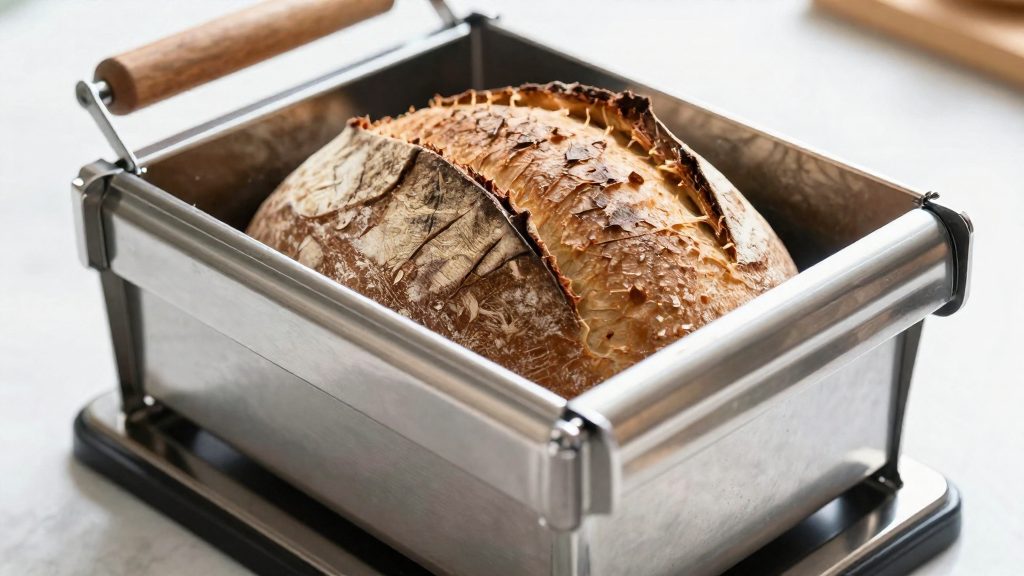
Store blades in the case or cover that came with the lame, away from loose objects. Storage is one of ATK’s selection criteria, which favours a case or blade cover. Two examples from its tests show this: the Baker of Seville Artisan Bread Lame includes a case and 3 blades, and the Breadtopia lame includes a case and 5 blades (America’s Test Kitchen, 2025). Keeping spare blades in a case also keeps them together and protected when they are not on the holder.
What can you use instead of a lame?
If you don’t have a lame, a few kitchen knives can make similar shallow cuts, but each one changes the result. A lame holds a thin blade in a holder, which helps you keep the cut steady. Household knives don’t have that holder, so the angle and depth depend more on your hand. The notes below describe general technique, not measured outcomes.
Sharp paring knife held at a shallow angle
A small, very sharp paring knife is the closest stand-in for a straight-blade lame. Hold it at a shallow angle, so the blade sits almost flat against the dough, and make one confident pass. A dull blade drags and tears the surface, so sharpness matters more here than with a lame. Because you hold the knife freehand, the depth often changes from one end of the cut to the other.
Serrated bread knife for shallow slashes
A serrated bread knife can score with a light sawing motion, but its serrated teeth tend to catch on the surface. Use only the tip, keep the strokes very shallow, and move slowly. It works best for broad, simple slashes rather than fine decorative patterns. Its length also makes it harder to keep every cut parallel across the loaf.
How results compare with a lame
| Tool | Angle control | Typical result |
|---|---|---|
| Lame, straight blade | Steady, set by the holder | Fine, controlled lines for decorative scoring |
| Lame, curved blade | Steady, set by the holder | Slightly more pronounced ears |
| Paring knife | Depends on your hand | Clean lines if very sharp, depth varies |
| Serrated bread knife | Depends on your hand | Broad, rough-edged slashes |
A lame’s main advantage is repeatability: once the blade is set, each cut follows the same path.
When should you replace the blade?
Rotate or replace a lame blade as soon as a corner starts to drag through the dough. According to America’s Test Kitchen (2025), the rule is simple: rotate or replace the blade when a corner drags. A dragging edge tends to tear the surface instead of opening a clean cut. ATK’s guidance is simply to rotate or replace the blade when a corner drags.
Rotate to a fresh edge first
Try the other cutting edge before discarding a blade. A double-edged razor blade has two sharp sides, and ATK’s selection criteria favoured holders that expose both cutting edges, so you can turn the blade to bring its unused side into position. Make the change with the holder’s blade-change mechanism rather than with your fingers on the edge. Then make a test cut in a scrap of dough to confirm the new edge glides without catching.
Replace a blade that drags again
If the blade still drags after rotation, replace it. The second edge is now worn too, so turning the blade again will not restore a clean cut.
| Situation | Action |
|---|---|
| A corner drags during scoring | Rotate the blade to expose the other edge |
| The blade drags again after rotating | Replace the blade |
Frequently asked questions
Which lame should a beginner buy if the main goal is well-pronounced ears?
The Breadtopia lame is the option ATK (2025) highlighted for ears, and it uses a curved blade that lifts the scored edge into a more pronounced ear. ATK lists it at about $13 at Amazon, with a case and 5 blades included.
Do I need a specific brand of blade for my lame?
No. Any double-edged safety razor blade or a blade sold specifically for lames fits these holders. According to America’s Test Kitchen (2025), testers found no significant performance differences between blade brands.
Which lame suits intricate, decorative scoring, and what is the trade-off?
The Wire Monkey UFO was ATK’s (2025) pick for intricate scoring. It uses a straight blade, which gives more control over fine lines, but its blade is harder to attach and remove than the other models tested, so blade changes take more effort.