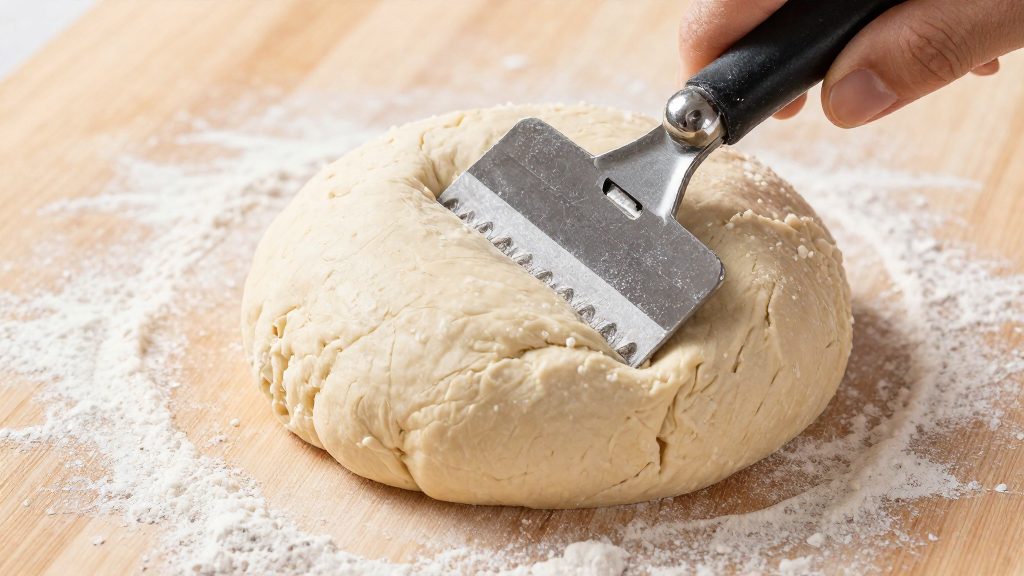
A bench scraper divides a batch of dough into pieces of similar size by moving the whole portion in one controlled pass, instead of pulling at it with your fingers. It is most useful when you are shaping several loaves or a tray of rolls and want each piece to match.
Why use a bench scraper to divide dough?
Even portion weights
Pieces of similar size bake and rise more evenly, which matters when several loaves or rolls go into the oven together.
Less tearing and less gas loss
Pulling dough apart with your hands stretches and tears the surface. That tearing can let some of the gas built up during fermentation escape, and it disturbs the structure you have been developing. A scraper makes a clean cut with less pulling, so each piece keeps more of its internal structure.
Faster batch division
Once the first cut is set, the same movement can be repeated across the batch, which reduces handling. The scraper’s job is to make the division repeatable, not to replace careful shaping.
Bench knife or plastic dough scraper?
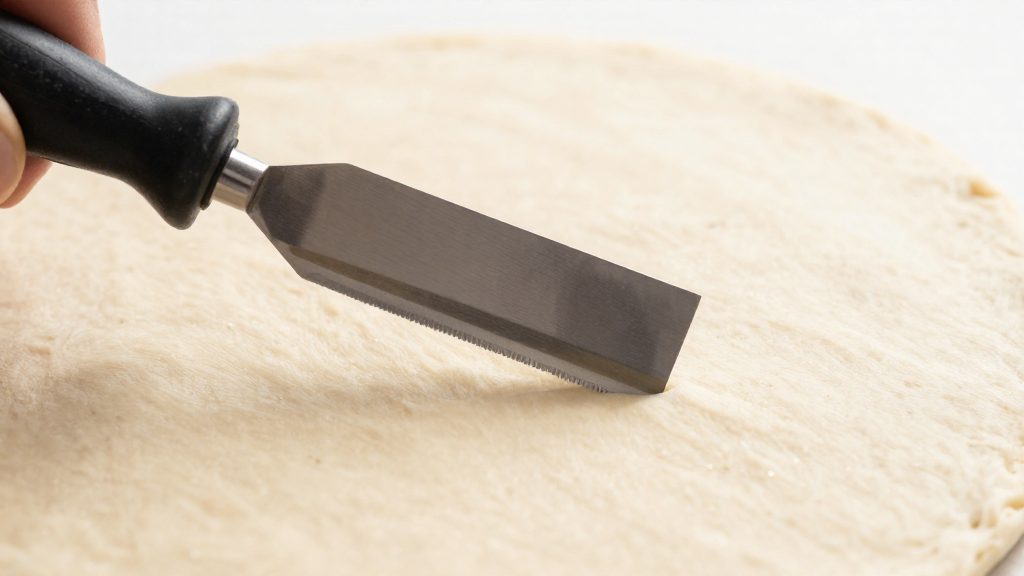
For dividing yeast dough, the bench knife is the recommended tool. King Arthur Baking Company (2026) states that nothing beats the baker’s bench knife for dividing yeast dough into loaves or rolls. The two tools differ mainly in blade material and in how safely they work on certain bakeware.
Thin metal blade versus rigid plastic blade
- Bench knife: a thin metal blade, which gives a narrow, precise edge for cutting through a mass of dough.
- Plastic dough scraper: a rigid plastic blade, which is a different material with a different edge.
Because the blade materials differ, the two tools are not interchangeable in every situation. The bench knife is the tool King Arthur Baking Company (2026) recommends for dividing, while the plastic scraper is a non-metal alternative that can also divide dough.
Pan safety
The plastic scraper won’t mark nonstick pans, according to King Arthur Baking Company (2021-08-24). This makes it the safer choice when a tool may come into contact with a nonstick surface. Check the pan’s surface before using the bench knife on it.
Which tool for yeast dough
The plastic heavy-duty dough scraper can also divide dough, as King Arthur Baking Company (2021-08-24) notes, so it is a workable option.
How to cut dough cleanly
Clean cuts depend on one motion, a straight downward press of the blade, followed by a weight check on each piece. The steps below are practical technique; King Arthur Baking Company (2026) recommends the bench knife for dividing, and the plastic scraper can also divide dough.
Press straight down, don’t saw
Hold the blade perpendicular to the work surface, with the edge aimed at the line you want to cut. Press down in one firm, vertical motion until the blade reaches the bench. A back-and-forth sawing motion drags the dough across the surface, which can tear it and distort the shape of the pieces. Keep the blade flat against the bench, then slide it under each piece to lift it away.
Divide the slab into equal portions
Plan the cuts before the blade touches the dough. Decide how many pieces you need, then divide the slab in a grid pattern: cut it in half, then cut each half in half again. Working in halves keeps the portions symmetrical, which is harder to achieve by estimating each cut by eye.
| Step | Action | Purpose |
|---|---|---|
| 1 | Weigh the whole slab | Sets the total dough to share out |
| 2 | Choose the number of pieces | Sets the target weight |
| 3 | Cut halves, then quarters | Keeps portions symmetrical |
Check each piece on a kitchen scale
Divide the total weight by the number of pieces to get your target weight. Place an empty bowl or tray on the scale and press the tare button so only the dough registers. Weigh each piece in turn. If a piece is heavier than the target, pull a small amount from its edge and add it to a lighter piece, then weigh both again. Repeat until the pieces are close to the target weight.
Does a bench scraper work for sticky dough?
Yes, but the result depends on the tool and the technique. High-hydration dough is wet enough to cling to both the blade and the bench, so tool choice matters most here.
Why wet dough sticks to the blade
Wet dough tends to form a film on any surface it touches. As you drag the blade through it, that film grips the edge and pulls the dough out of shape instead of separating it. The problem grows if the dough sits for a few minutes, because it spreads and settles against the bench. Pressing harder usually makes it worse, since the dough compresses and smears rather than parting.
Metal versus plastic blade with wet dough
For sticky dough, the practical difference is how the edge meets the dough:
- Thin metal edge: A thin metal edge is generally expected to meet the dough with less contact area.
- Rigid plastic edge: Works for dividing dough, according to King Arthur Baking Company (2021-08-24); the sources do not compare how it handles wet dough, so test it and adjust with light flouring.
If the dough starts to drag, lift the blade and reposition it instead of forcing it through.
Lightly dusting the blade to limit sticking
Dust the blade with a thin layer of flour before each cut, and redust whenever the edge starts to grab. Tap off any loose flour against the bench so that only a film remains. Keep the layer light: excess flour on the cut face changes the dough’s hydration at that point and can leave dry streaks in the crumb.
Other jobs a scraper does
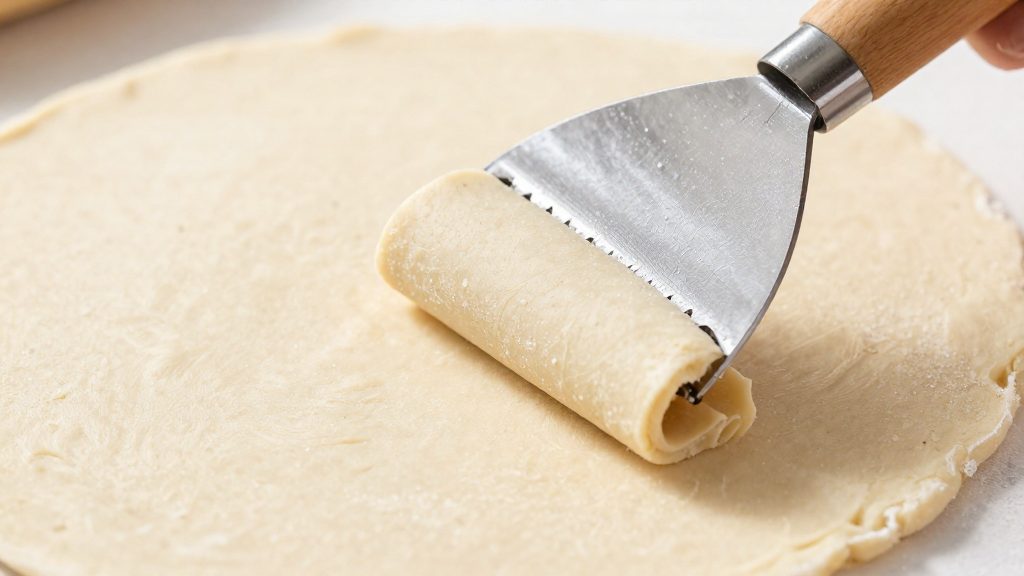
Beyond dividing, a bench scraper handles three routine tasks in bread and pizza making: clearing flour from the work surface, moving fragile dough, and cutting pizza and flatbread dough. According to King Arthur Baking Company (2021-08-24), the heavy-duty plastic dough scraper performs all three, so it is useful well beyond the dividing step.
| Task | What the scraper does | Typical moment |
|---|---|---|
| Clearing flour and residue | Gathers loose flour and dough scraps off the work surface | Between shaping steps |
| Transferring fragile dough | Lifts soft dough without tearing it | Moving shaped dough to a peel or tray |
| Cutting bread dough and pizza | Cuts through dough sheets and shaped pieces | Portioning pizza or flatbread |
Clearing flour and residue from the counter
Dusting flour on the bench during shaping leaves a film of loose flour and small dough scraps. Hold the scraper almost flat against the surface and push the debris into a pile, working in short, overlapping passes. Lift the pile into your hand or a bin. Clearing the surface between steps keeps loose flour from being pressed into the next piece of dough.
Transferring fragile dough
Soft, shaped dough can stretch or tear when lifted by hand. Slide the scraper’s edge underneath the piece, support its full weight, and move it onto a peel or baking tray. Because the scraper is flat, it supports the piece more evenly than pinching it with your fingers.
Cutting pizza and flatbread dough
The same edge that divides dough can cut pizza and flatbread dough. Use the edge to cut across a sheet of dough, then check that the cut edge is even before the dough goes into the oven.
What to look for before buying?
Three physical features decide how comfortable and useful a bench scraper will be: the handle, the blade size, and how well the tool is built. The checks below are practical tests you can run in a shop rather than numerical targets.
Handle grip and hand comfort
Hold the tool as you would during a real cut and press down through the blade. A handle that fills your palm lets you apply even pressure straight down. Make sure your fingers can close around it without the edge digging into your palm, since a poor grip becomes tiring when you divide a large batch.
Blade dimensions for bench and batch size
Choose a blade wide enough to cross the whole piece of dough in one pass. A short blade usually means more passes, and more passes mean more handling of the dough.
Build durability and joint quality
Inspect where the blade meets the handle. The join should show no gaps and no movement when you gently wiggle the handle. Press the blade flat on a table to check that it stays straight and does not bow. Any play at the joint will tend to grow under repeated pressure, so a tool that feels loose in the shop is unlikely to improve with use.
Care and cleaning
Removing dough residue after each use
Clean the blade as soon as you finish dividing. Scrape off soft dough with the flat edge or a dry spatula, then wipe the blade with a damp cloth to lift the thin film that remains. Dough that dries on the metal is harder to remove later. Check the joint between blade and handle too, because flour and dough paste can collect there.
Drying the metal blade
Dry the blade thoroughly with a clean towel after washing. Moisture left on steel can lead to rust, so do not leave the tool wet on the bench or put it away damp. Air-drying alone is less reliable than wiping, because water can stay in small gaps near the handle.
Storing the blade to protect the edge
Store the bench knife in a dry spot where the edge will not knock against other utensils. Because the blade is thin, a hard knock can bend it or leave a nick that makes dividing less clean. Hanging it or keeping it in its own drawer compartment works well.
The plastic dough scraper is easier to care for in one respect: it can be washed and dried the same way, without the rust concern that applies to steel.
Frequently asked questions
Can I divide yeast dough with a plastic dough scraper instead of a bench knife?
King Arthur Baking Company (2026) names the bench knife as the best choice for dividing yeast dough into loaves or rolls. King Arthur Baking Company (2021-08-24) also notes that a heavy-duty plastic dough scraper can divide dough, so it works as a backup for simpler jobs.
Will a scraper damage my nonstick pans?
Yes, a metal tool can mark nonstick surfaces, but the rigid plastic blade of a dough scraper will not. According to King Arthur Baking Company (2021-08-24), this makes the plastic scraper the safer option when you cut or transfer dough directly in nonstick bakeware.
Can the same tool clean my work surface after dividing?
Yes. King Arthur Baking Company (2021-08-24) states that the heavy-duty plastic scraper can scrape flour off the work surface, so it can handle cleanup between batches as well as cutting.