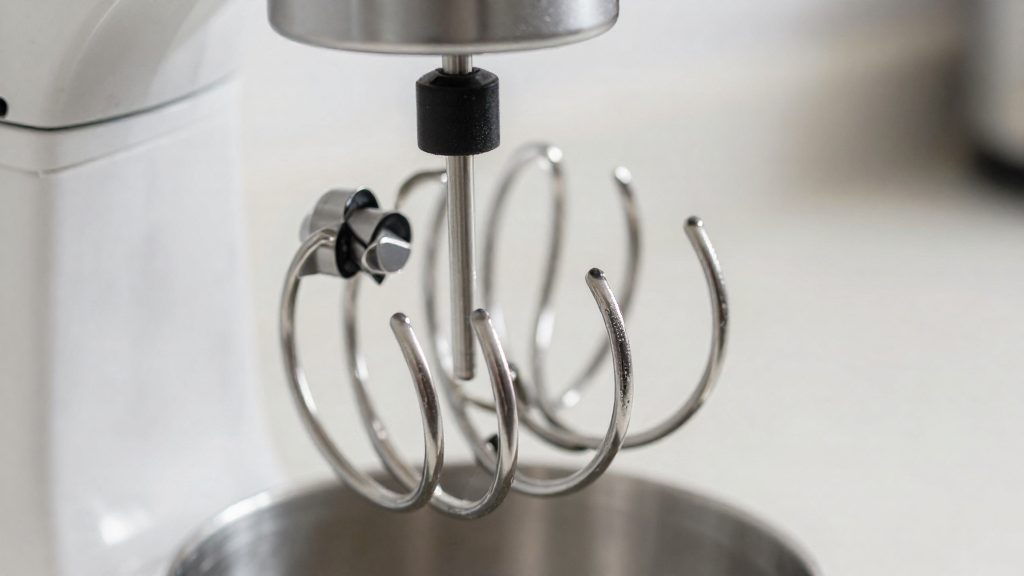
Yes, on some models. On the KitchenAid Mini 3.5 Quart tilt-head stand mixer, the dough hook can go in the dishwasher, but only on the top rack. KitchenAid’s guidance covers the bowl, flat beater, Flex Edge beater, and pouring shield in the same way, while the wire whip is not dishwasher safe. Dishwasher rules differ between models and between parts, so check the manual for your machine before loading anything.
Can you put a dough hook in the dishwasher?
The dishwasher rules come from the manufacturer, and they are specific to each model. For the KitchenAid Mini 3.5 Quart tilt-head, KitchenAid (2026) lists the dough hook as dishwasher safe on the top shelf only. The manufacturer does not give the lower rack as an option, so the top rack is the only position to use.
The rules are set per part, not per mixer. The same machine can have a dishwasher-safe dough hook and a whip that must stay out of the dishwasher. Check each attachment’s status separately:
| Part (KitchenAid Mini 3.5 Quart tilt-head) | Dishwasher status per KitchenAid (2026) |
|---|---|
| Dough hook | Dishwasher safe, top shelf only |
| Bowl | Dishwasher safe, top shelf only |
| Flat beater | Dishwasher safe, top shelf only |
| Flex Edge beater | Dishwasher safe, top shelf only |
| Pouring shield | Dishwasher safe, top shelf only |
| Wire whip | Not dishwasher safe |
Breville USA (2026) follows the same general principle for its own products: the dishwasher is an option only when the parts are dishwasher-safe. A part that is not clearly dishwasher-safe is best washed by hand, as a precaution.
What you need to clean a dough hook
Before any cleaning begins, switch the stand mixer off and unplug it. KitchenAid tells owners to do this before cleaning any attachment (KitchenAid, 2026). Unplugging the machine means it cannot start while your hands are near the hook or the head, so this step comes before you pick up any tool.
Gather the following items before you start:
- Dish soap: Add a small amount to hot water to create a sudsy solution. KitchenAid describes hot, sudsy water for its tilt-head models (KitchenAid, 2026).
- A non-abrasive sponge: Use it to wipe the hook with the soapy solution. Choose a soft sponge rather than a scouring pad, since the hook is a metal attachment that you want to keep in good condition.
- A bowl or sink large enough for the hook: Pick a container where the whole hook fits with room to turn it. This lets you reach every curve without bending or forcing the attachment.
- A dry towel or cloth: Keep it within reach so you can dry the hook once it is clean.
Because the dough hook has few corners, Tasting Table notes that it is the easiest attachment to clean (Tasting Table, 2025-08-18). Even so, the basic setup of unplugged mixer, soapy water, a soft sponge and a container that fits the hook is what makes the job quick and safe.
How to clean a dough hook by hand
Hand washing a dough hook takes only a few minutes.
| Step | Action | Purpose |
|---|---|---|
| 1 | Detach the dough hook from the mixer | Gives access to every surface of the hook |
| 2 | Wash in hot, sudsy water with a cloth or sponge | Lifts dough residue from the whole surface of the hook |
| 3 | Rinse completely under clean running water | Removes soap so none remains on the hook |
Work the cloth or sponge along the full curve of the hook, then move on to rinsing.
Rinse until no suds remain. Soap left on the metal can affect the next batch of dough, so a short extra rinse is worth the few seconds it takes.
If the manufacturer specifies hand washing only, follow the same sequence.
How do you remove dried dough from a hook?
Dried dough is easiest to remove before the hook goes anywhere near the sink. Once the dough has set, rinsing alone may not remove it from the curve and the end that fits onto the mixer, so the aim is to loosen the hardened layer first.
Work through the hook in three stages:
- Clear the loose pieces. Flake off or wipe away anything that comes away easily. Do this over a bin or a sheet of paper so the crumbs don’t end up in the drain.
- Soak to soften. Immerse the hook in warm water until the stuck-on dough begins to swell and lose its grip on the metal. Breville suggests soaking attachments in warm soapy water (Breville USA, 2026), and the same soak works here because it softens the residue. Leave it for a few minutes and check again rather than forcing the dough off straight away.
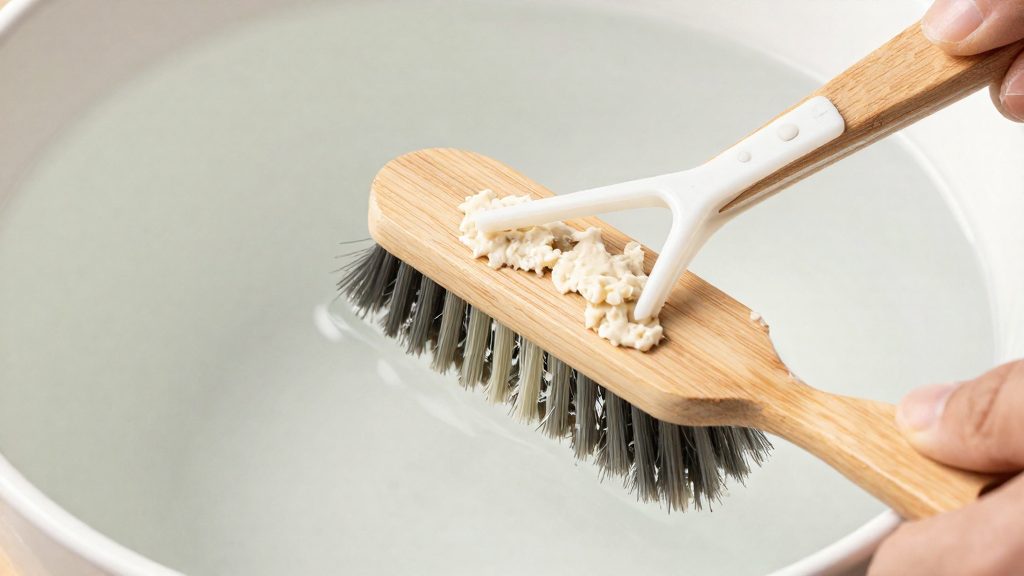
- Scrape with a plastic tool. Use a plastic scraper, a wooden spatula or a soft nylon brush to lift the softened dough out of the loops and along the curve. Avoid metal knives, screwdrivers or steel scrapers, which can scratch the finish. Scratched metal is harder to clean next time because dough settles into the marks.
The hook needs this extra care when it is hand-wash only. NutriMill advises removing dried dough or batter before washing (NutriMill Help Center, 2026).
Cleaning where the hook meets the mixer
The junction between the dough hook and the stand mixer is the part most often missed. Dough and flour can still collect where the hook connects to the mixer. Clearing that spot keeps the attachment seating properly and stops old residue from building up in the connection.
Clearing debris at the attachment point
Once the dough hook is off, look at the drive shaft, the metal post the hook slides onto, and the surrounding area. Use a dry brush or a dry cloth to lift away flour, dough crumbs and other loose debris. Work around the collar of the shaft so material falls away rather than being pushed deeper into the gap. Tasting Table recommends using a brush or cloth to clear debris from where the hook attaches to the mixer.
Wiping the mixer shaft
After clearing the loose material, wipe the shaft with a dry cloth. Move the cloth in one direction, from the base of the shaft toward its tip, so residue is lifted off instead of spread around. Check the shaft by touch as well as by sight: a faint film or tacky patch means some dough is still there, and it should be cleared before the hook is refitted.
Keeping water out of the motor housing
The mixer’s head contains the motor, so moisture must stay away from the shaft and the head. Do not rinse the shaft under a tap, and do not spray or pour liquid near the vents or the join between the head and the body. Keeping this work dry means the cleaning step never requires a wet cloth near the mixer’s electrical parts.
How to dry and store a dough hook
Thorough drying is the step that protects a dough hook from corrosion. Breville USA (2026) advises drying the bowl and attachments thoroughly right after washing, so the drying should start as soon as the hook comes off the rinse, not later when it is needed again.
Drying the hook
- Dry every surface with a clean cloth or towel, including the curve and the end that fits onto the mixer.
- Check the joints and small gaps where water tends to collect, and wipe them until no moisture remains.
- Let the hook air-dry briefly on a rack or dish towel, then finish with a cloth. Do not put it away while it still feels damp.
Storing the hook
Clean, dry storage keeps the hook free of both moisture and dust. Choose a spot away from the sink and any other source of humidity, and keep it covered or in a closed drawer to limit dust. Store the hook only once it is completely dry, because trapped moisture in a closed space works against the drying you just completed.
Lay the hook flat in a dry drawer, and check it for any sign of rust or residue before the next use.
| Step | Purpose |
|---|---|
| Dry all surfaces right after washing | Prevents corrosion (Breville USA, 2026) |
| Confirm no moisture remains in joints | Stops water from collecting in gaps |
| Store in a clean, dry spot | Keeps the hook away from moisture and dust |
Which dough hooks are hand wash only?
The NutriMill Artiste stand mixer’s dough hook is listed as hand wash only, according to the NutriMill Help Center (2026), so the hook should be washed by hand rather than placed in a dishwasher. Dough hooks are not all treated the same way.
NutriMill Artiste: hand wash only
The NutriMill Artiste’s dough hook is the clearest hand-wash-only example.
Comparing the NutriMill Artiste with the KitchenAid Mini
| Model | Dough hook washing label | Source |
|---|---|---|
| NutriMill Artiste stand mixer | Hand wash only | NutriMill Help Center (2026) |
| KitchenAid Mini 3.5 Quart tilt-head | Dishwasher-safe, top shelf only | KitchenAid (2026) |
The two labels show why model checks matter: the same type of attachment can carry opposite instructions depending on the brand.
Checking your model’s manual
Before washing, find the washing label for your specific model, usually in the care or cleaning section of its manual or on the manufacturer’s support pages. A generic rule cannot replace the label on your own machine.
Frequently asked questions
Does my dough hook go in the dishwasher if my mixer is a different brand?
Not necessarily. Dishwasher rules come from each manufacturer, so the owner’s manual for your machine is the reference. The NutriMill Help Center (2026) lists the dough hook of its Artiste stand mixer as hand wash only.
What should I do if dough has dried onto the hook?
Remove the dried dough before you wash the hook, as the NutriMill Help Center (2026) advises. Breville USA (2026) also suggests soaking the attachments in warm soapy water before washing.
Why do I need to dry the hook straight after washing it?
Breville USA (2026) says to dry the bowl and attachments thoroughly right after washing to prevent corrosion. Leaving them wet on the counter works against that step.