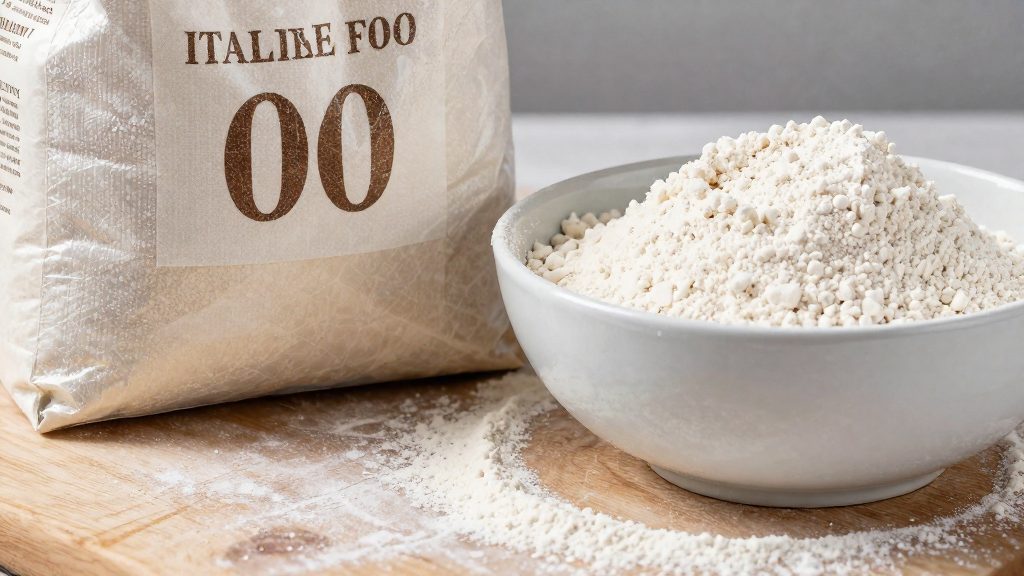
A flour suited to Neapolitan pizza has to do two things at once: build a dough that stretches very thin without tearing, and hydrate evenly during a short mix. The bake itself is brief and very hot, so the flour’s behaviour before the dough reaches the oven matters as much as what happens inside it. The three traits below are what separate a flour that fits this style from one that does not.
What makes flour right for Neapolitan pizza?
Soft, extensible dough that stretches without tearing
A suitable flour produces a dough that relaxes under the hand and opens into a thin disc without snapping back. When a dough resists stretching, it tends to shrink and tear at the rim; when it is too slack, it cannot hold its shape once topped. Extensibility is the property to watch for: the dough should stretch from the centre outward while the edge stays intact.
For home bakers, Hecker’s & Ceresota (2026) recommends its All-Purpose Unbleached flour or its Ceresota Premium High-Gluten flour for Neapolitan-style pizza, which gives two named starting points from a US miller.
Fine milling and consistent particle size for even hydration
Fine, uniform milling matters because particles of a consistent size take up water at a steady rate. Coarse or uneven flour can leave dry pockets and wet patches in the same dough, which show up as tearing or uneven stretching later.
The AVPN recipe for Neapolitan pizza calls for about 1.6–1.8 kg of flour per liter of water (Associazione Verace Pizza Napoletana (AVPN), 2026). That ratio works out to a derived hydration of roughly 56–63%, a moderate level that a fine flour can absorb evenly in a short mix.
Why a short bake favours tender, quick-hydrating flour
Because the bake is brief, the oven cannot finish a flour that hydrates slowly. The dough has to be fully hydrated during mixing and resting, so the flour needs to take up water promptly. A flour that does this gives a crust that sets quickly and keeps a tender, light interior rather than a chewy one.
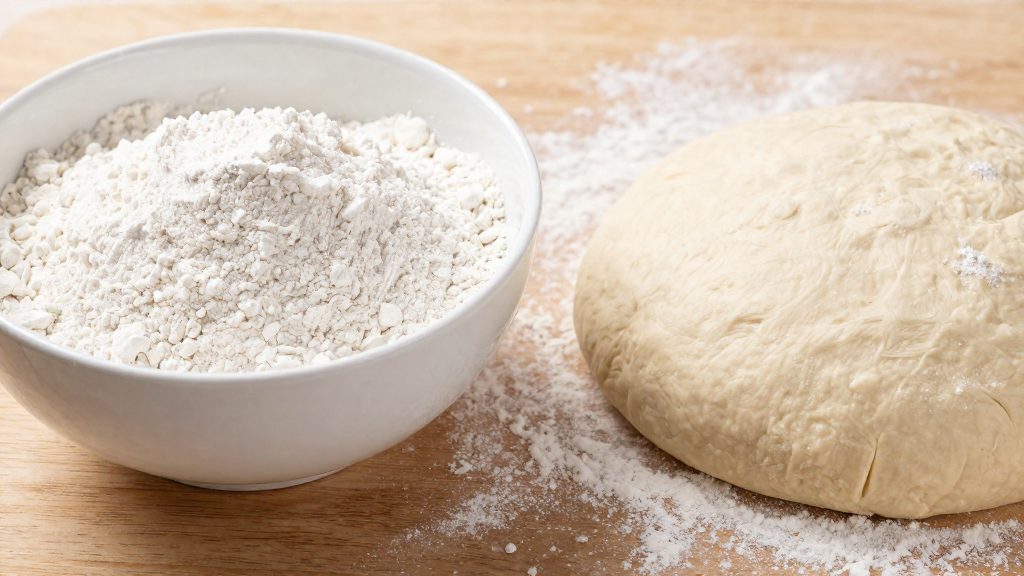
What does 00 actually mean?
The “00” on an Italian flour bag is a grade, not a brand or a quality rating. Italian flour grading is based on ash content, meaning the mineral residue left when the flour is burned. Ash comes mostly from the bran and germ, so the grade reflects how much of the outer grain remains. The lower the number, the more refined the flour and the less bran it contains. Protein is not part of this system, so a grade number alone does not tell you how strong a flour is.
The main difference between 00 and 0 is how refined the flour is: 00 is the more refined grade, with less bran and lower ash content. Type 00 is milled the most finely of the common Italian grades, producing a powder that feels almost like talc. Type 0 is milled less finely and is slightly coarser to the touch. Both grades are refined white flours, which is why both appear in traditional Neapolitan dough.
The Associazione Verace Pizza Napoletana (AVPN, 2026) accepts two flour types for its Neapolitan pizza recipe: type 00 or 0. Any other grade falls outside the AVPN specification. The AVPN does not reserve one grade for a particular step, so both are acceptable choices for the same dough.
Some practical points for home bakers:
- The grade is printed on the bag as “00” or “0”, usually next to the milling type.
- A finer grind absorbs and hydrates differently from a coarser one, so a flour’s grade should be read together with its packaging and the producer’s instructions.
- Grade numbers are not comparable across countries’ systems. A “00” from Italy is not the same classification as an American “all-purpose” label.
Protein and W strength explained
Protein content and dough strength are related, but they are not the same measurement. Protein content is the share of a flour’s weight that can form gluten when mixed with water. Gluten strength describes how well that network stretches, holds the gas produced during fermentation, and keeps its shape. Two flours with the same protein percentage can behave differently in the dough, which is why a percentage on the bag does not settle the question.
The W value is the rating used on Italian flour to describe dough strength. A higher W generally points to a flour that can handle a longer fermentation, while a lower W suits a shorter rise. Bakers use it to match a flour to their timing. It is a rating of how the dough behaves, not a count of how much protein the flour contains.
The W rating becomes misleading when it is applied to flours made from North American hard wheat. According to Hecker’s & Ceresota (2026), the Italian W value is unreliable for that wheat, so a bag from North America carrying a figure does not reliably predict how the dough will perform. The same source states that Italian flours are strong enough for long fermentation, while North American soft wheats are not. The distinction matters because a flour can be labelled for pizza and still be too weak for a slow, multi-hour rise.
To judge a flour practically, start with its origin and stated use rather than a single number:
- Read whether the bag names an intended use, such as pizza or long fermentation.
- Treat a W figure as useful only when it is paired with a clear origin.
- If the flour’s strength is uncertain, bake a small test batch before committing a full dough to a long rest.
Is Italian 00 flour best for a home oven?
Italian 00 flour is the traditional choice for Neapolitan pizza. Whether it suits a home oven depends mostly on heat, not on the flour alone. The AVPN benchmark assumes a wood-fired oven, so a home oven needs adjustments to get comparable results.
The AVPN benchmark
According to AVPN (2026), a wood-fired oven reaches about 430–480 °C (about 800–900 °F) and bakes a pizza in about 60–90 seconds. This intense heat produces the fast rise, leopard-spotted edge, and soft centre associated with the style.
What changes in a home oven
| Factor | AVPN wood-fired benchmark | Typical home oven |
|---|---|---|
| Temperature | About 430–480 °C (about 800–900 °F) | Lower than the benchmark |
| Bake time | About 60–90 seconds | Longer, so the crust dries more |
| Flour | Type 00 or 0 | Type 00 or 0 can still be used |
Because home ovens run cooler, the dough spends more time in the heat and can lose moisture before the crust sets. A pizza steel helps here: it stores heat and transfers it quickly to the base, which partly offsets the lower air temperature. Flour that performs well in a wood-fired oven may therefore need a longer or hotter preheat at home to achieve a similar base.
Availability and freshness of imported 00
Imported 00 flour is sold in many specialist shops and online, but a bag may have travelled a long way before it reaches you. Check the best-before date on the packaging and avoid old stock, since flour that has been stored poorly can taste stale or behave less predictably in the dough.
Italian 00 is a sound choice for a home oven with a steel when the aim is the Neapolitan style. Expect a result that differs from the AVPN benchmark, and treat the bake time and preheat as the variables to adjust.
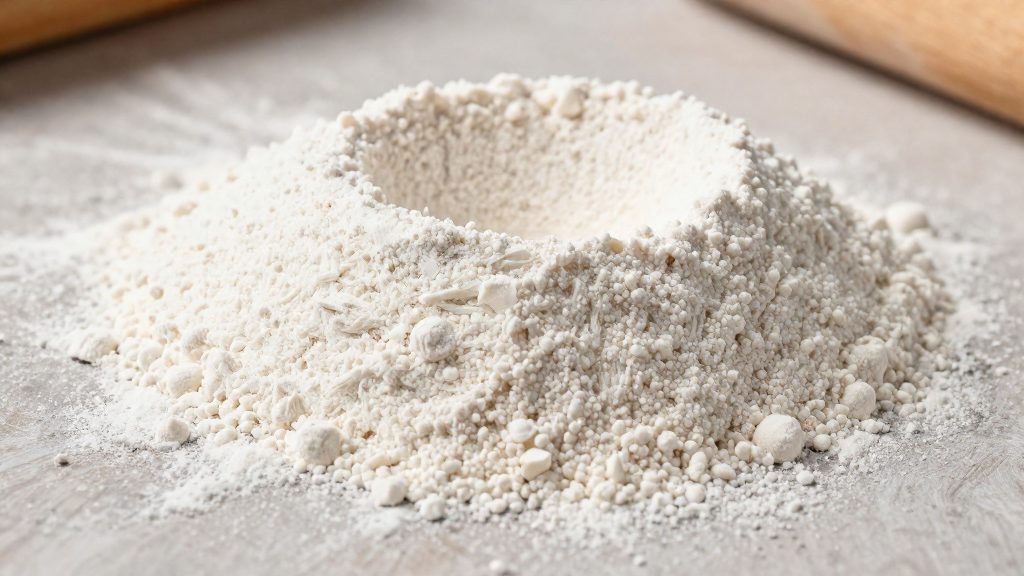
Can bread or all-purpose flour work?
Bread flour and all-purpose flour can make a pizza, but neither behaves like the flour in traditional Neapolitan dough. The choice of flour affects the dough long before the oven.
Higher-protein bread flour
Bread flour has more protein than all-purpose flour, which gives the dough more structure. In a Neapolitan-style pizza, that extra structure usually produces a firmer dough that resists stretching and a crust that is tougher and chewier than the soft, thin base the style aims for. The result is still edible, but the texture moves away from the style.
All-purpose flour
All-purpose flour produces a softer dough with a weaker structure. The dough is easier to handle at first but can tear or sag when stretched thin, and it gives a less springy crust.
| Flour | Dough behaviour | Crust tendency |
|---|---|---|
| Type 00 or 0 (AVPN baseline) | Strong enough for long fermentation (Hecker’s & Ceresota, 2026) | Light, soft base suited to the style |
| Higher-protein bread flour | Firmer, more elastic dough | Tougher, chewier crust |
| All-purpose flour | Softer dough, weaker structure | Less springy, more fragile when stretched |
Bread and all-purpose flours are workable substitutes when no suitable flour is available, but the trade-off is clear: bread flour gives a sturdier, chewier result, while all-purpose flour gives a softer dough that is less reliable when stretched thin.
Top flours to try in the US
Hecker’s & Ceresota (2026), a US flour miller, recommends two of its own flours for Neapolitan-style pizza at home: Hecker’s All-Purpose Unbleached and Ceresota Premium High-Gluten.
| Flour | Role for Neapolitan-style home pizza | Recommended by |
|---|---|---|
| Hecker’s All-Purpose Unbleached | Named by Hecker’s & Ceresota for Neapolitan-style pizza | Hecker’s & Ceresota (2026) |
| Ceresota Premium High-Gluten | Also named by Hecker’s & Ceresota for Neapolitan-style pizza | Hecker’s & Ceresota (2026) |
| Caputo Pizzeria 00 | Imported type 00 benchmark for comparison | Not part of the Hecker’s & Ceresota list |
Hecker’s & Ceresota names both flours for Neapolitan-style pizza. Because all-purpose flour gives a softer dough and high-gluten flour a firmer, chewier one, bake a small test batch with each and compare how the dough stretches and how the crust turns out.
Caputo Pizzeria 00 is not in the Hecker’s & Ceresota recommendation. It works as a reference point: make one batch with it and one with a US flour, then compare how each dough handles and how the baked crust looks and tastes. Keep all other ingredients and steps the same so the flour is the only variable.
Hydration and fermentation tips
The AVPN recipe for Neapolitan pizza calls for about 1.6 to 1.8 kg of flour per liter of water. Since one liter of water weighs about 1 kg, this range gives a derived hydration of roughly 56 to 63 percent. That is a moderate level, not a very wet dough. Hydration is calculated as water weight ÷ flour weight × 100, so a larger amount of flour produces a stiffer dough and a smaller amount produces a softer one.
Converting the ratio to a batch
| Flour per liter of water | Derived hydration |
|---|---|
| 1.6 kg | about 63% |
| 1.7 kg | about 59% |
| 1.8 kg | about 56% |
Weigh both ingredients (grams or ounces) rather than measuring by volume. The hydration percentage is the same in either weight unit, but cups shift it unpredictably.
Adjusting fermentation to flour strength
The flour strength of your flour determines how long the dough can hold its structure during fermentation. With a weaker flour, shorten the rest and check the dough more often instead of relying on a set schedule.
The same source states that the Italian “W” value is unreliable for North American hard wheat, so do not use W alone to judge whether a flour can handle a long fermentation. Assess the dough directly:
- Underfermented: the dough is tight, resists stretching, and springs back quickly.
- Overfermented: the dough feels slack, sticks to the bench, and spreads flat when left out of shape.
Stronger flours tolerate a longer, gentler rest before these signs appear, while weaker flours reach the overfermented stage sooner.
Frequently asked questions
Can I use ordinary supermarket all-purpose flour for Neapolitan pizza?
The AVPN recipe specifies type 00 or 0 flour, so a generic all-purpose flour is a departure from the standard. According to Hecker’s & Ceresota (2026), North American soft wheats are not strong enough for long fermentation, so check the flour’s strength before committing to a full batch.
What does the “00” or “0” on an Italian flour bag actually tell me?
The grade reflects ash content, which measures how refined the flour is, not its protein level or strength. Hecker’s & Ceresota (2026) also notes that the Italian W rating is unreliable for North American hard wheat, so a W value cannot be read as a guarantee of performance.
Which flours does Hecker’s & Ceresota suggest for a first attempt?
Hecker’s & Ceresota (2026) names two options for Neapolitan-style pizza: All-Purpose Unbleached and Ceresota Premium High-Gluten. The source gives no ranking between them and does not designate either as the default choice.