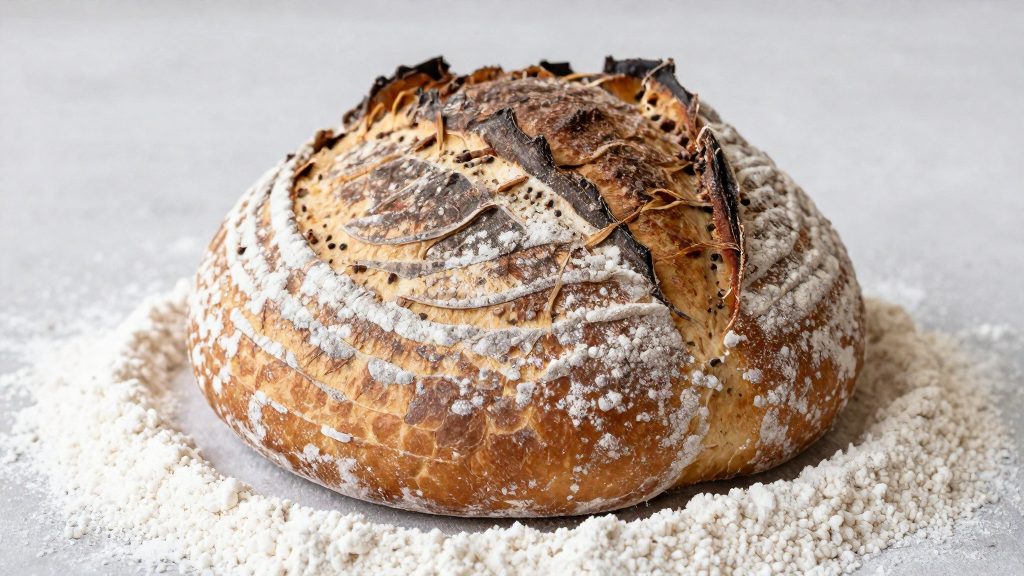
Choosing a banneton comes down to three checks, in this order: the total weight of your dough, the basket shape, and whether the finished basket fits your oven. Capacity matters more than diameter because it determines how much dough a basket can hold without the loaf spreading. According to Pantry Mama (2026), a 9-inch round banneton holds about 850 g of dough and a 9-inch oval holds about 600 g, so baskets of the same width can differ a lot in usable volume.
How do you choose a banneton size for sourdough?
Step 1: Start with the dough weight
Weigh the whole batch right before you shape it. The basket has to hold that full weight, so the weight you record sets the minimum size you can consider. Use this number for every later check.
Step 2: Match the shape to the loaf
Once you know the weight, choose the shape you plan to bake. Each shape has its own capacity, so compare the weight against the capacity for that shape only.
Step 3: Confirm the oven fit
For a simple sourdough recipe, Pantry Mama (2026) recommends a 10-inch round banneton for a boule and a 10-inch oval for a batard. The guide states that the round boule fits a 5-quart Dutch oven at least 11 inches across, and the oval batard fits a 5-quart oval Dutch oven. Check these figures against your own equipment before buying.
Why capacity matters more than diameter
Diameter describes width only, while capacity describes how much dough the basket holds. A basket that is too large lets the dough spread and lose oven spring, which is the rise the loaf gets in the first minutes of baking. Capacity therefore controls the shape and rise of the finished loaf more directly than width does.
Quick checklist before buying a basket
- Confirm the basket’s inner dimensions, not its outer size.
- Pick the shape you will bake before comparing capacities.
- Check the 10-inch oven-fit figures against your Dutch oven’s interior width.
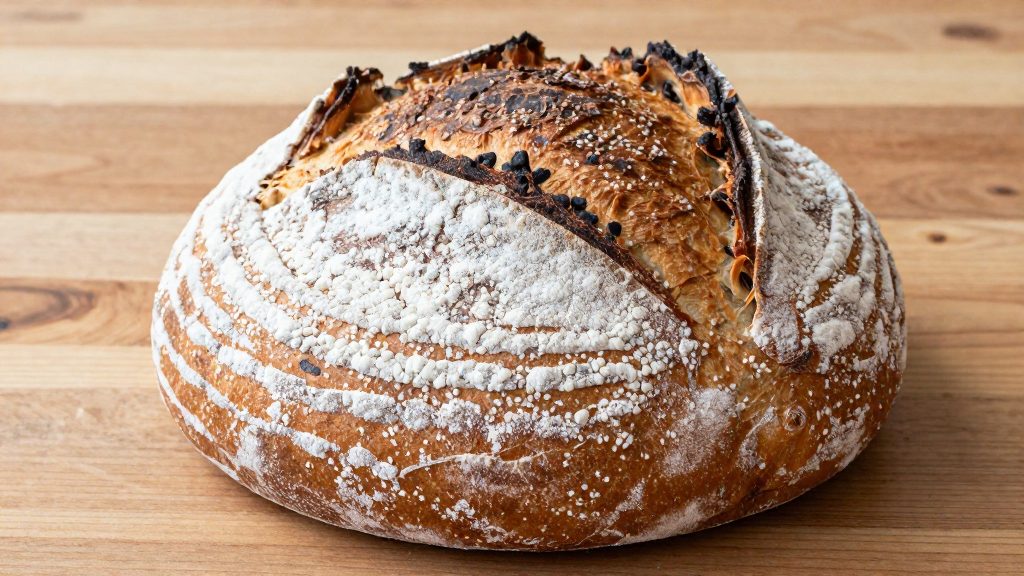
Dough weight comes first
Basket capacity depends on the total weight of the dough, not on the flour alone. According to Pantry Mama (2026), a banneton should be sized by total dough weight, which covers flour, water, starter, salt and any inclusions. A recipe that lists 500 g of flour will produce a heavier dough once the water, starter, salt and add-ins are counted, so the flour figure alone does not tell you what the basket has to hold.
What counts toward the total
Every ingredient in the mix adds weight to the dough:
| Component | Counts toward dough weight? | How to account for it |
|---|---|---|
| Flour | Yes | Weigh the full amount in grams |
| Water | Yes | Include all water added to the mix |
| Starter | Yes | Count the whole starter, not only the flour it contains |
| Salt | Yes | Weigh it like any other ingredient |
| Inclusions (nuts, seeds, etc.) | Yes | Weigh each addition separately and add it to the total |
Inclusions add weight
Nuts and seeds are easy to overlook because they are added at the end. They still add to the total, so a loaf with walnuts or seeds weighs more than the same formula without them. If a recipe calls for inclusions, add their weight to the sum before you compare the dough with a basket’s sizing information.
How to total the dough weight
- Weigh each ingredient in grams as you add it to the bowl, or read the gram column of the recipe.
- Add the totals: flour, water, starter, salt and inclusions.
- Use that sum as the dough weight when you choose a banneton.
- Optionally, weigh the finished dough after mixing and folding in the inclusions. It may read slightly lower than the recipe sum, because some dough clings to the bowl and scraping tools.
Weighing the dough gives you a more dependable basis for matching a basket to your bake than relying on a rough visual impression of the bowl.
Round or oval: which shape suits your loaf?
The basket shape should match the final form of the dough. A round banneton supports a boule, a ball-shaped loaf, while an oval banneton supports a batard, an elongated loaf with tapered ends. During the final proof, the basket’s walls press their contour into the dough’s surface, so the loaf leaves the oven close to the shape it had in the basket. A mismatch forces you to reshape the dough at the last moment, which can break the surface tension you built during shaping.
| Basket shape | Loaf form | Shaping motion before proofing | Typical result |
|---|---|---|---|
| Round | Boule (ball) | Pull the edges toward the center, then turn the dough until the skin is taut | Domed, symmetrical loaf |
| Oval | Batard (torpedo) | Roll the dough into a log and seal the seam along its length | Long loaf that keeps its length |
Round baskets for rounded shaping
Rounded shaping works by rotating the dough on the bench while you tighten its outer skin. The round walls of the basket guide the dough into an even dome, and the loaf’s sides rise at the same rate. The round walls of the basket support the boule’s shape during the final proof.
Oval baskets for elongated shaping
A batard is rolled into a cylinder, with the seam pinched closed along its length. An oval basket holds the long sides parallel and the tapered ends in place, so the loaf keeps its elongated form instead of rounding out. Pre-shaping the dough into a loose log, then rolling it under light pressure, gives the oval basket a dough that fits its walls.
What size banneton fits a 500 g to 1 kg loaf?
A 9-inch oval banneton holds about 600 g of dough, and a 9-inch round banneton holds about 850 g (Pantry Mama, 2026). A 500 g dough is below both listed capacities (about 600 g for the oval, about 850 g for the round), so it fits in either. The oval is the closer match. The round basket leaves much more spare room, and a basket that is too large lets dough spread. The source gives no minimum fill or tolerance, so treat the oval as the better fit. A 1 kg dough is larger than both 9-inch figures, so neither 9-inch basket suits it. The source does not give a capacity for the 10-inch baskets it recommends for a simple recipe, so it does not confirm which size fits 1 kg. Check the manufacturer’s stated capacity before buying.
| Basket | Listed capacity (Pantry Mama, 2026) | Suits 500 g dough | Suits 1 kg dough |
|---|---|---|---|
| 9-inch oval | About 600 g | Yes | No |
| 9-inch round | About 850 g | Yes | No |
| 10-inch | Not stated | Not stated | Not stated |
A dough that is close to the limit may behave differently from one that sits well below it.
Weigh before you shape. Divide the dough once it has finished bulk fermentation and weigh each piece. If the weight is already near the listed capacity, the dough will tend to spread sideways instead of rising upward in the basket.
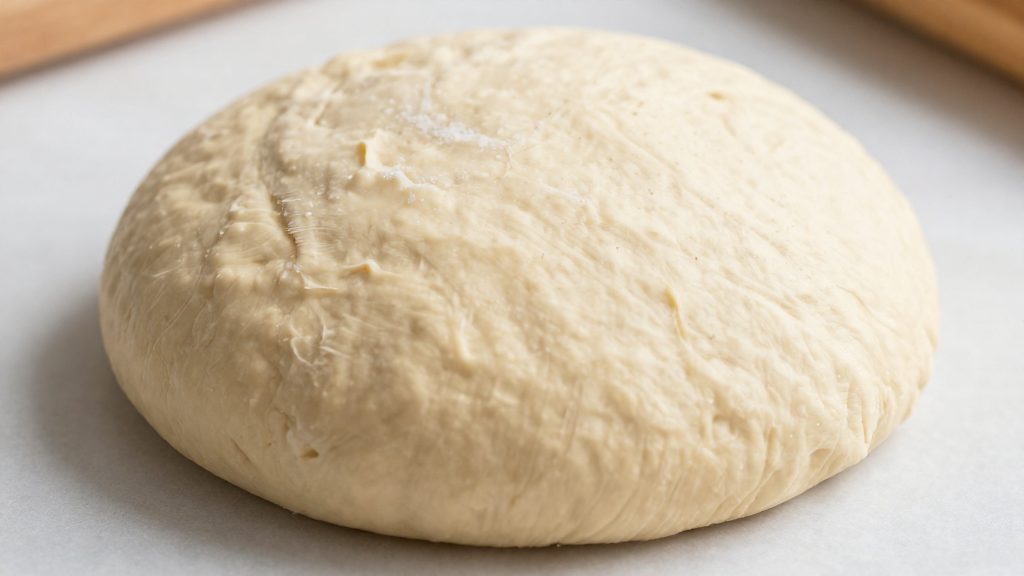
Will your Dutch oven fit the basket?
Before you shape the dough, confirm that the proofed loaf can move from the banneton into the pot without being squeezed or deformed. According to Pantry Mama (2026), a simple sourdough recipe pairs a 10-inch round banneton with a boule and a 10-inch oval banneton with a batard. Those pairings only work if the pot is large enough to take the loaf after it has risen, so check the pot against the basket before you start mixing.
| Loaf shape | Banneton (per Pantry Mama, 2026) | Dutch oven (per Pantry Mama, 2026) |
|---|---|---|
| Boule (round) | 10-inch round | 5-quart, at least 11 inches across |
| Batard (oval) | 10-inch oval | 5-quart oval Dutch oven |
Round loaves need a round pot. The guide states that a 10-inch round basket fits a 5-quart Dutch oven that is at least 11 inches across. The guide gives the pot as a 5-quart Dutch oven at least 11 inches across, so check the pot’s interior width against the basket.
Oval loaves need an oval pot. The guide pairs the 10-inch oval banneton with a 5-quart oval Dutch oven, but it does not give a minimum interior length for that pot. Measure the pot yourself and compare it with the basket’s inner length.
To check a fit:
- Measure the basket’s inner dimensions.
- Measure the pot’s interior diameter (round) or interior length (oval).
- Compare the two. A round pot should be at least 11 inches across for a 10-inch round basket.
Should you size up or down?
When your dough falls between two basket sizes, choose the smaller one. Pantry Mama (2026) gives this rule directly. A basket that is too large lets the dough spread and lose oven spring, so the smaller basket is the safer choice.
| Dough position | Basket to choose | Documented effect |
|---|---|---|
| Between two sizes | Smaller basket | Recommended by Pantry Mama (2026) |
Sizing down has its own limit: the guide does not specify how far dough may exceed a basket’s capacity, so you should not assume an overfill margin.
Common banneton sizing mistakes
Most sizing problems come from misreading the basket itself. Pantry Mama (2026) gives its chart dimensions as inner dimensions, and it describes the capacities as approximate. Three mistakes come up most often.
Measuring the outside instead of the inside. The outer rim of a banneton is wider than the space where the dough sits. If you measure across the outside, you will think the basket holds more than it does. Measure across the inside of the rim, from the inner edge of one side to the inner edge of the other, and compare that figure with the chart.
Treating chart capacities as exact. The figures are approximate. The listed capacities are approximate. The source does not state how far dough can exceed a basket’s capacity before shaping or proofing suffers, so you should not assume a small overfill is harmless. Use the figure as a starting point and check the basket against your own dough weight.
Using one basket for very different loaf weights. A single basket cannot suit both a small and a large batch. A dough much lighter than the basket’s capacity spreads out and loses its shape, while a dough heavier than the capacity is cramped and hard to shape. Since the oval and round shapes differ in capacity, switching shape also changes how much dough fits. If you bake in several sizes, keep a basket for each typical loaf weight rather than stretching one basket across all of them.
Frequently asked questions
Which banneton fits a 500 g sourdough dough?
Both 9-inch baskets can hold 500 g. The oval (about 600 g) is the closer match, while the round (about 850 g) leaves much more spare room, and a basket that is too large lets dough spread. According to Pantry Mama (2026), the guide gives no minimum fill, so the oval is the better fit.
My dough weighs 1 kg. Which basket should I buy?
Neither 9-inch basket is large enough, because both listed capacities fall below 1 kg. The guide does not give a capacity for its 10-inch baskets, so check the manufacturer’s stated capacity before buying for a loaf this size.
Can I overfill a banneton a little?
The listed capacities are approximate, and the guide gives no overfill tolerance (Pantry Mama, 2026). If your dough falls between two sizes, choose the smaller basket.