A sourdough starter that smells like nail polish remover is usually carrying alcohol, a fermentation by-product. According to King Arthur Baking (2021-09-02), a mild smell of this kind is not a reason to throw the starter out. The aroma is a normal sign of fermentation, and the smell alone does not mean the culture has spoiled.
Why does my sourdough starter smell like nail polish?
The sources link the solvent-like odour to hooch, the alcohol-rich liquid that can form on a starter. They do not specify which compounds or microorganisms are responsible.
Alcohol as a fermentation by-product
The clear to light-amber liquid that sometimes sits on top of a starter is alcohol, a by-product of fermentation (King Arthur Baking, 2021-09-02). When that liquid is present, the starter can smell like nail polish remover (The Perfect Loaf, 2024-10-01). The sources link the smell to hooch, but the smell alone does not rule out a contaminant, so also check the starter for colour changes or fuzz.
Why a hungry starter smells stronger
Hooch that forms often suggests the starter needs feeding earlier (The Perfect Loaf, 2024-10-01). In practice, a starter that has gone longer between feedings is more likely to show the solvent smell.
How young and mature starters differ
What is hooch, and how is it linked to the nail polish smell?
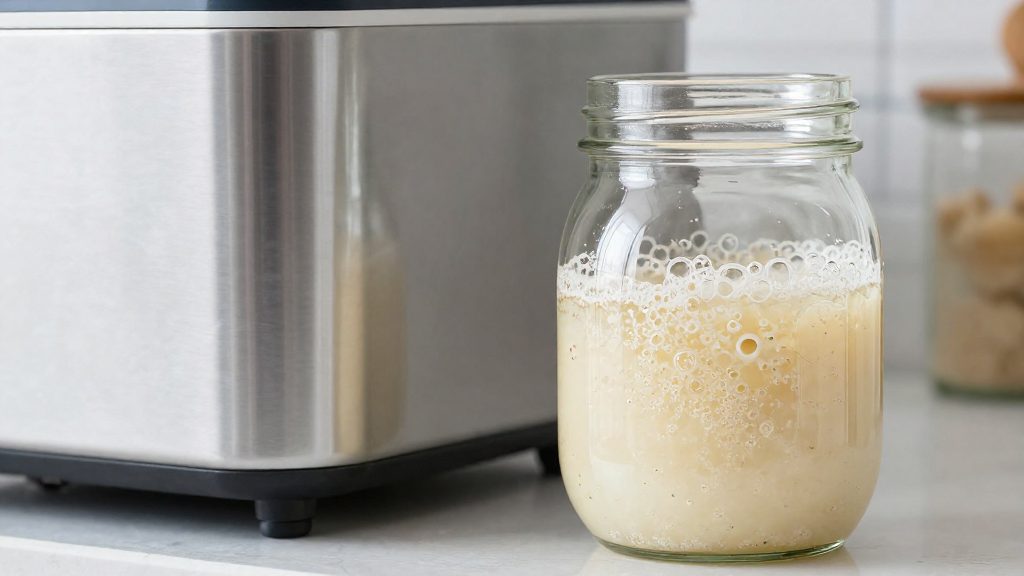
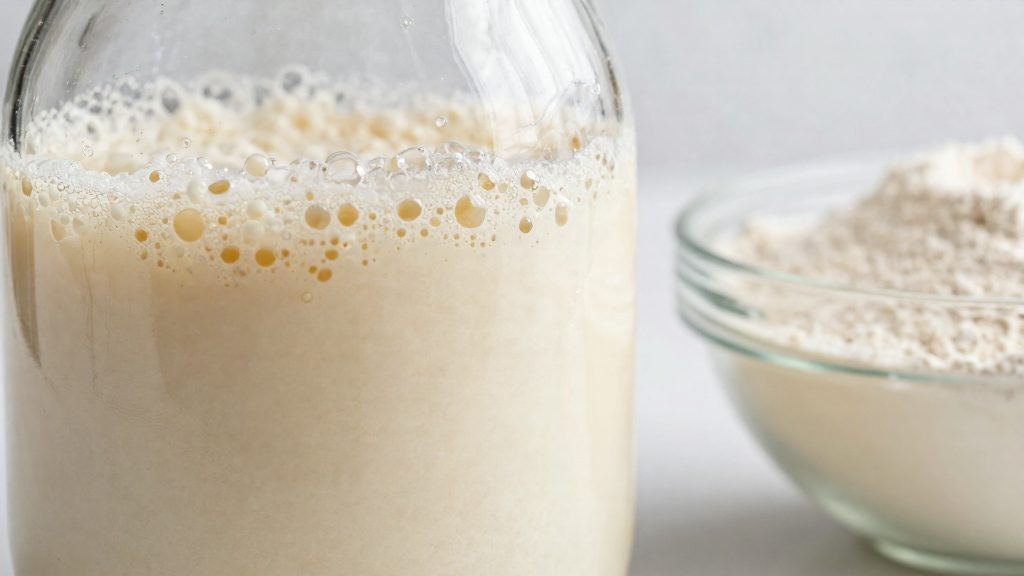
Hooch is the clear liquid that can form on the surface of a sourdough starter. As the microorganisms in the starter break down the sugars in the flour, they produce alcohol, and it can separate out and collect as a distinct layer instead of staying mixed into the culture.
The Perfect Loaf (2024) gives two options for handling the liquid. You can stir in the hooch, mixing it back into the starter, or pour off the liquid before going on. Both options are followed by the same step: discard the portion as usual and feed the starter. King Arthur Baking (2021) lists the same two choices for clear to light-amber hooch.
| Option | What to do | Next step |
|---|---|---|
| Stir in | Mix the liquid back into the starter | Discard and feed as usual |
| Pour off | Remove the liquid layer before mixing | Discard and feed as usual |
Pick one method and handle the liquid the same way each time you see it, so your routine stays consistent.
Is a nail polish smell in my starter dangerous?
According to King Arthur Baking, a mild nail-polish-remover smell in a sourdough starter is not, on its own, a reason to throw the starter out. Still check the starter for colour changes or fuzz. King Arthur Baking (2021-09-02) advises discarding the starter only if it smells truly bad.
The practical question is whether the smell is mild or truly foul. King Arthur Baking frames the cases as follows:
| Smell | What the sources say |
|---|---|
| Mild, sharp, nail-polish-remover-like | Not a reason to discard (King Arthur Baking, 2021-09-02) |
| Truly bad | Discard the starter (King Arthur Baking, 2021-09-02) |
Scent is a useful signal, but it is a judgment, not a diagnosis. Compare the starter’s current odor with its usual smell after feeding. If the smell becomes truly bad rather than a mild solvent note, discard the starter, as King Arthur Baking advises.
How do I fix a hungry starter?
A neglected starter can often be revived with a short, repeated routine. According to King Arthur Baking (2021), the method is to keep 50 g of starter, feed it equal weights of flour and warm water, and rest it at about 75–78°F for 12 hours. You repeat this round until the starter doubles within 12 hours. If it still does not respond after 3–4 days of daily feeding, the source advises starting over.
Step-by-step revival routine
- Keep 50 g. Discard the rest of the starter and place the 50 g in a clean container.
- Feed with equal weights. Add flour and warm water in the same weight, then mix until no dry flour remains.
- Rest at 75–78°F. Leave the starter at about 75–78°F for 12 hours.
- Check the result. Note whether the starter has doubled within those 12 hours.
- Repeat. If it has not doubled, start the next round with 50 g from the current batch.
The rounds are identical each time. Only the result changes, so keep a note of the time and the volume after each rest to compare progress from one round to the next.
Go or no-go rule
| Result after a 12-hour rest | Decision |
|---|---|
| Starter doubles within 12 hours | Revival is working: the protocol’s goal is met |
| Starter does not double within 12 hours | No-go for now: repeat the round |
| No doubling after 3–4 days of daily feeding | No-go: start over with a new starter |

Feeding schedule and temperature tips
A practical feeding rhythm is set by the interval between feedings, not by a fixed clock time. The right interval is the one that matches how quickly your starter uses up its flour, and that rate changes with the room. Check the jar at the point where you would normally feed it. Look at the surface and the walls of the jar, and note whether the starter has risen, flattened, or started to separate.
Room temperature shifts that timing. In a warm kitchen, fermentation runs faster, so the starter peaks and exhausts its food sooner. A schedule that worked in winter may need to be tightened in summer. In a cool kitchen, the same starter takes longer to reach the same point, so the gap between feedings can be stretched. Adjust in small steps and observe the jar after each change instead of switching schedules all at once.
Hooch is your signal to act on the interval. If the liquid appears before the next scheduled feeding, shorten the gap for the next cycle. If the starter is still rising well and shows no liquid when you check it, the current interval is working.
| Observation at feeding time | What it suggests | Adjustment |
|---|---|---|
| Hooch on top before the planned feed | Interval too long for current conditions | Feed earlier next cycle |
| No hooch, starter still active | Interval matches conditions | Keep the same interval |
Keep the feeding weight and flour-to-water ratio unchanged while you test timing. Changing only the interval lets you see its effect clearly.
Signs that mean you should throw the starter out
Some changes in a starter are unambiguous. A clear colour change or fuzz on the surface means the culture has moved beyond normal fermentation, and it should not be used to raise bread. According to King Arthur Baking (2021-09-02), any pink, blue, green or orange colour means you should discard the starter. The Perfect Loaf (2024-10-01) lists pink, orange and green, together with white fuzzy spots, as signs of spoilage or mould.
| Visual sign | Action | Source |
|---|---|---|
| Pink | Discard | King Arthur Baking (2021-09-02); The Perfect Loaf (2024-10-01) |
| Orange | Discard | King Arthur Baking (2021-09-02); The Perfect Loaf (2024-10-01) |
| Green | Discard | King Arthur Baking (2021-09-02); The Perfect Loaf (2024-10-01) |
| Blue | Discard | King Arthur Baking (2021-09-02) |
| White fuzzy spots | Throw away and make a new starter | The Perfect Loaf (2024-10-01) |
Colour changes
Check the starter in daylight, both on the surface and in the layer you see when you stir it. Do not wait to see whether the colour spreads, and do not mix the coloured part into a fresh feeding.
White fuzzy spots
White fuzzy patches are mould growth. Look along the surface and the rim of the jar. The Perfect Loaf (2024-10-01) treats these spots as a reason to throw the starter away, the same outcome as a colour change.
Why a new starter replaces a contaminated one
Discard a contaminated starter and make a new one rather than trying to rescue it. The reason is practical: appearance alone does not show which organisms have grown in the jar, so feeding or stirring cannot be relied on to remove the problem. Starting over gives you a culture you can trust and a clean jar to start it in.
When is the starter ready to bake with?
A sourdough starter is ready to raise bread without added commercial yeast once it doubles within 6 to 8 hours of feeding, according to King Arthur Baking (2021-09-02). This doubling benchmark is a practical test for whether the starter has enough active wild yeast and bacteria to leaven a dough on its own. The test is simple, but it only gives a reliable answer when the timing starts from a fresh feeding and the starting level is measured clearly.
The doubling benchmark
The test compares the starter’s volume at two moments: right after feeding and once fermentation has raised it. King Arthur Baking (2021-09-02) sets the window at 6 to 8 hours. If the starter reaches about twice its starting volume inside that window, it meets the benchmark for baking without added commercial yeast. If it takes longer, it has not yet reached that point.
Doubling is the signal to look for. A starter can show bubbles on its surface and still not have doubled, so visible activity alone does not confirm readiness.
Timing the test from a fresh feeding
The clock starts at the feeding, not at the last time you looked at the jar. Begin each test with a fresh feed so the 6 to 8 hour window reflects how the starter performs after a full meal, not leftovers from an earlier cycle.
A practical routine:
- Feed the starter with flour and water as usual.
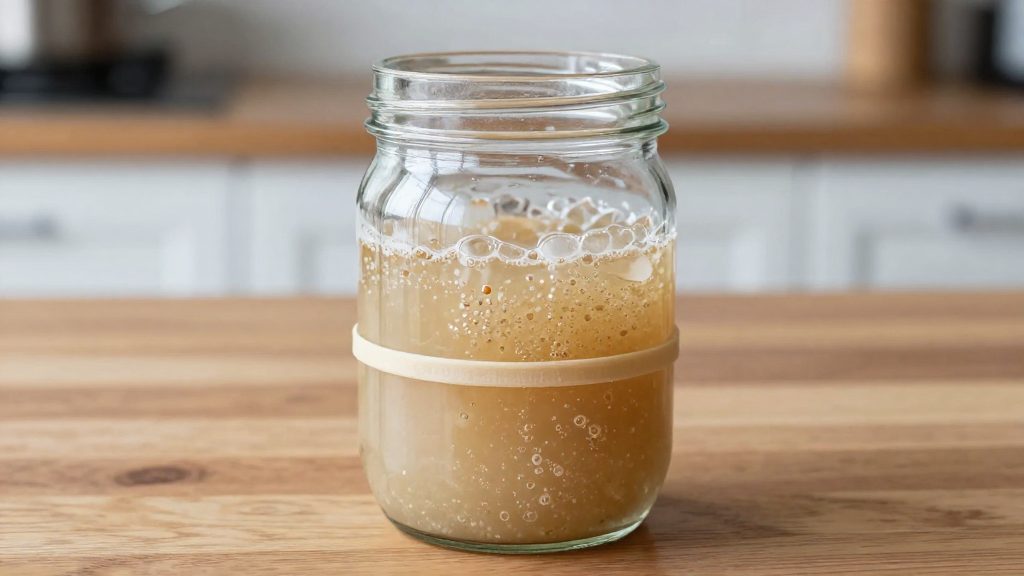
- Immediately mark its level on the outside of a clear container with a rubber band or a strip of tape.
- Note the time of the feeding.
- Check the starter within the 6 to 8 hour window and compare its level with your mark.
A clear, straight-sided container makes the rise easier to read. Keeping your starting mark fixed as the reference is what makes the comparison meaningful.
Using a starter for bread without added yeast
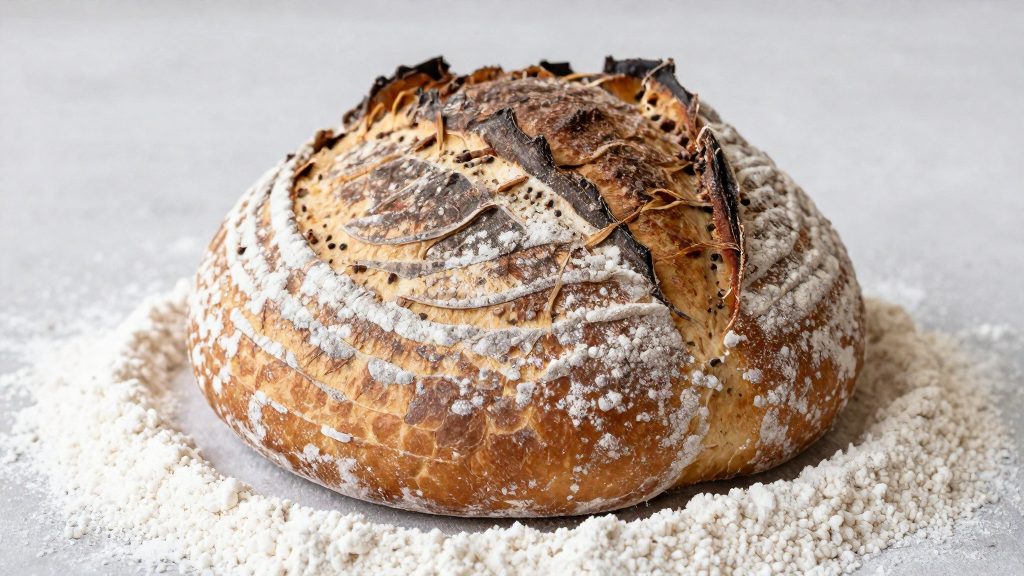
Once the starter doubles within the window, it can serve as the only leavening in a bread dough. The bread then rises on wild yeast and bacteria, with no commercial yeast added. Run the test on the feeding you plan to bake with, rather than relying on a result from a different day, so you know the starter is performing consistently when you need it.
Frequently asked questions
Is a nail-polish smell normal in a sourdough starter?
A mild solvent-like smell is common, and King Arthur Baking (2021-09-02) says it is not a reason to throw the starter out. Discard it only if the smell is truly unpleasant, such as rotten or sour in a way that goes beyond the acetone-like note of ordinary fermentation.
How do I revive a neglected starter that smells strong?
Keep 50 g of starter, feed it equal weights of flour and warm water, and rest it at about 75–78°F for 12 hours. Repeat until it doubles within 12 hours, following King Arthur Baking (2021-09-02). If nothing changes after 3–4 days of daily feeding, start over with a fresh starter.
Which signs mean my starter has spoiled?
Any pink, blue, green or orange colour means the starter should be discarded, according to King Arthur Baking (2021-09-02). White fuzzy spots indicate mould, and in that case The Perfect Loaf (2024-10-01) advises throwing the starter away and making a new one.