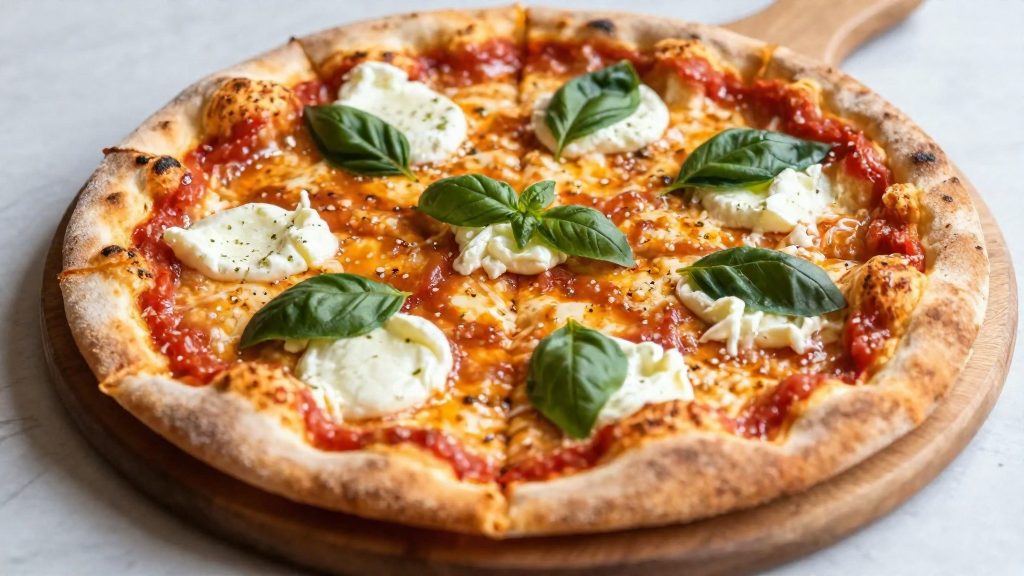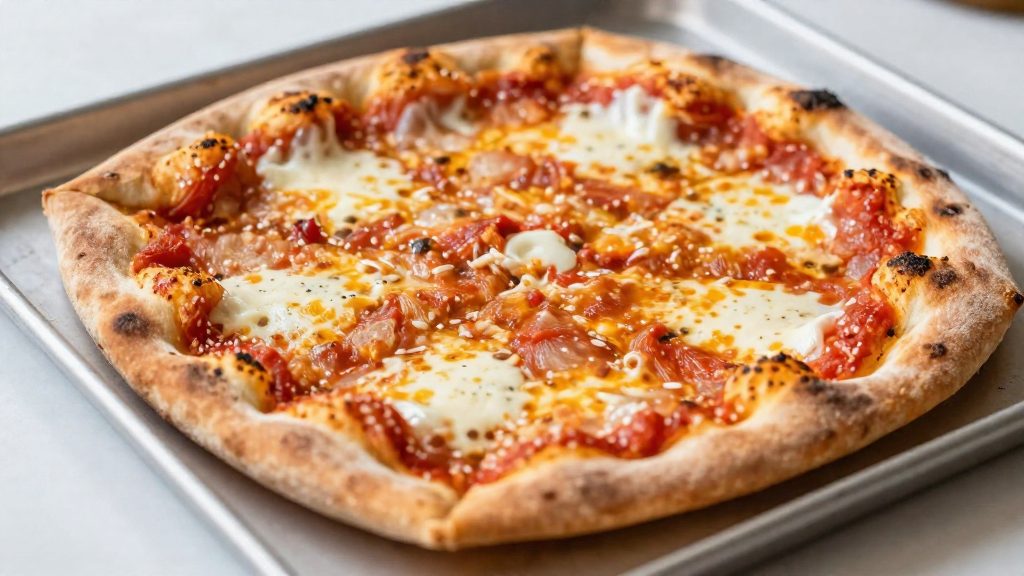
Grandma pizza is a rectangular pizza that originated on Long Island, New York. King Umberto’s in Elmont is often credited with first putting it on a menu, and by the late 2000s and early 2010s pizzerias widely offered it. Its name on menus has varied, with “Sicilian Grandma pizza” being one of the labels used.
What is grandma style Sicilian pizza?
Origin on Long Island
Grandma pizza comes from Long Island, in New York State. Its defining feature is its sheet-pan format: the pizza is baked in a rectangular pan rather than shaped as a round pie. Because the pan sets the outline, the finished pizza has straight edges.
King Umberto’s and Umberto Corteo
The name “Sicilian Grandma pizza” is attributed to Umberto Corteo, who introduced it around 1994.
Spread across pizzerias
After its menu debut, the style moved beyond a single restaurant.
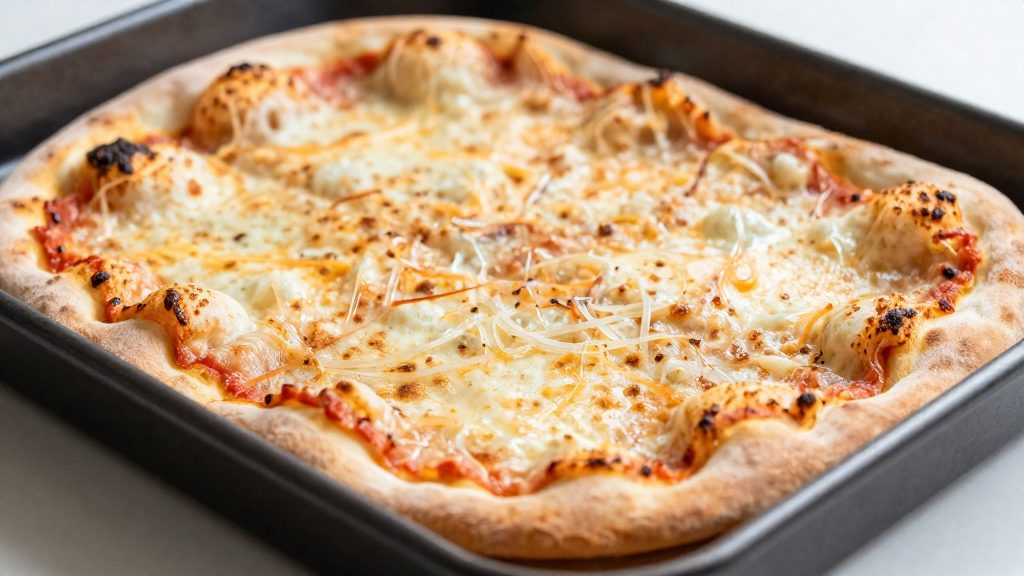
Grandma pizza vs. Sicilian pizza: what’s the difference?
Grandma pizza and Sicilian pizza are both baked in pans and both have a bready base, but they differ in crust thickness, cut and texture. According to Wikipedia (2026), the grandma crust is thinner and crisper than a Sicilian crust. The documented difference is that the grandma crust is thinner and crisper than a Sicilian crust.
Crust thickness
The grandma crust is thinner than the Sicilian one, so the dough spreads across the pan rather than rising into a deep base. A dough that stops short of the corners bakes into a deeper, denser slab, which moves the result closer to a Sicilian base.
Cutting into small squares
Grandma pizza is cut into small squares, which makes each piece easy to pick up and share. The format is a rectangle cut into a grid of uniform pieces, with the same crust reaching every edge.
Texture contrast
The grandma crust is described as thinner and crisper than a Sicilian crust.
Ingredients and flour for the dough
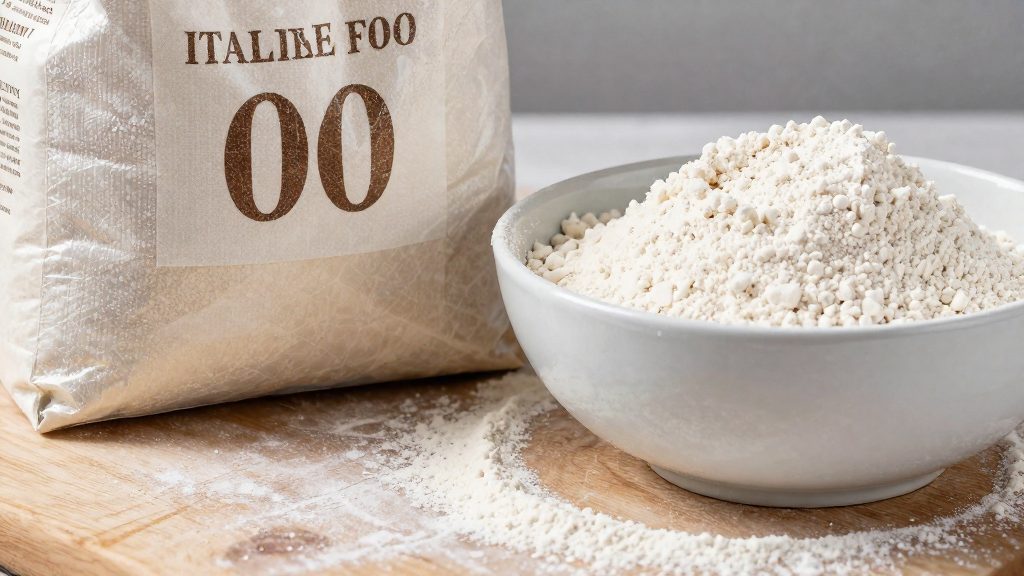
This grandma-style dough follows one professional formula published by PMQ Pizza Magazine. It uses two flours, water, instant yeast, salt and olive oil, with the flour blend making up the base for all other weights. The total flour is 401 g, made of high-gluten flour and bread flour. Because the formula is weighed rather than measured by volume, every ingredient can be recreated exactly.
| Ingredient | Weight | Baker’s percentage (of 401 g flour) |
|---|---|---|
| High-gluten flour | 281 g | about 70.1% |
| Bread flour | 120 g | about 29.9% |
| Water | 282 g | about 70.3% |
| Instant yeast | 1.5 g | about 0.4% |
| Salt | 8 g | about 2.0% |
| Olive oil | 12 g | about 3.0% |
Flour blend
The blend is roughly seven parts high-gluten flour to three parts bread flour by weight. High-gluten flour is the larger share of the total, so it sets the character of the dough. The bread flour is included in the same measured total, so the two flours should be weighed together before mixing.
Hydration and water weight
Hydration is the water weight divided by the flour weight, multiplied by 100. Here, 282 g of water divided by 401 g of flour gives roughly 70 percent. Keeping water at 282 g is what holds the dough at this hydration. If the flour weight changes, the water weight must be recalculated to keep the same percentage.
Yeast, salt and oil
The formula uses 1.5 g of instant yeast, 8 g of salt and 12 g of olive oil. These are small amounts, so a scale that reads to 0.1 g is practical for the yeast. Weighing salt and yeast separately, rather than dropping them in by spoon, helps keep the quantities consistent from batch to batch.
How do you make grandma pizza dough?
Grandma-style dough is a high-hydration dough that is cold-fermented before it is shaped. One professional recipe, published by PMQ Pizza Magazine, uses about 70% hydration. The dough is refrigerated for 48 hours, then stretched in two stages in an oiled pan. The steps below follow that recipe’s timing.
Ingredients and weights
The total dough weight is about 705 g.
Mixing
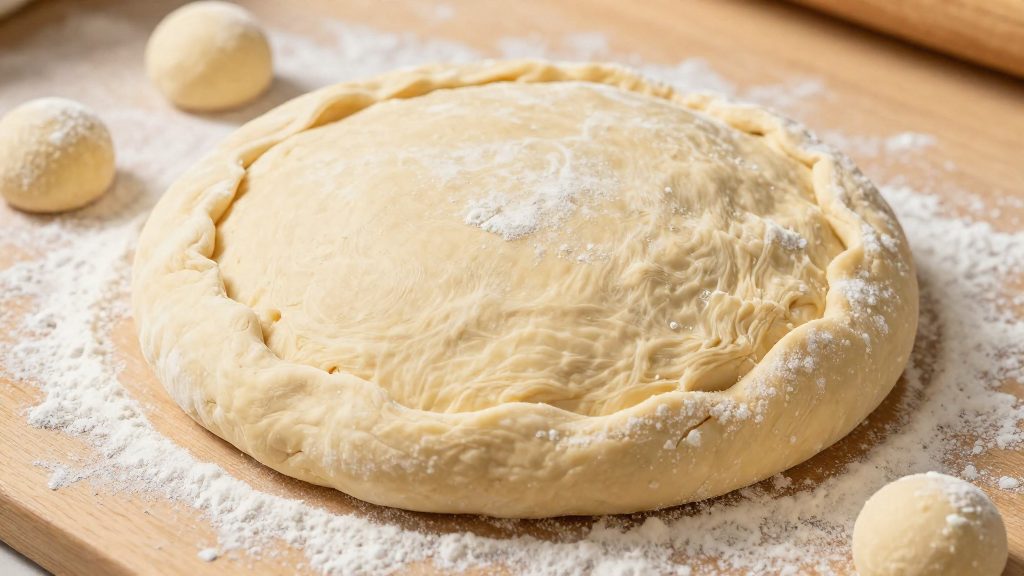
Combine the flours, yeast and salt in a bowl. Add the water and oil, then mix until no dry flour remains. Knead until the dough is smooth and elastic. At this hydration the dough is soft and sticky, so it helps to wet your hands rather than add extra flour. Judge the mixing by texture: the dough should look smooth and hold together without tearing when pulled gently.
48-hour cold fermentation
Place the dough in a lightly oiled, covered container and refrigerate it for 48 hours. During this slow fermentation, the yeast works at a low temperature, which develops flavour and structure over time. For comparison, Wikipedia (2026) notes that some New York makers refrigerate grandma pizza dough for about 24 hours, so this recipe is noticeably longer.
First rest and first stretch
Take the dough out of the fridge 1 hour before stretching. Cold dough is firm and resists stretching, so the rest lets it warm and relax. Transfer it to a generously oiled pan and stretch it gently with your fingertips. The first stretch should spread the dough across the pan but does not need to reach the corners yet.
Second rest and stretch to the corners
Let the dough rest in the pan for another 1 hour. This second rest is the second stage of the two-stage stretch: the gluten relaxes again, so the dough becomes easier to extend. Then press and stretch it outward until it reaches the corners of the pan, keeping an even thickness across the surface.
Which pan works best?
Grandma pizza is traditionally baked in a rectangular sheet pan, and the size of that pan sets the final thickness of the crust. The professional recipe documented by PMQ Pizza Magazine uses a 15x15 inch (38 x 38 cm) pan, a square format; check that your pan measures about 15x15 inches inside, since many home rimmed sheet pans are rectangular and differ in size.
The 15x15 inch (38 x 38 cm) pan
A 15x15 inch pan gives a square of about 38 cm per side. Because the dough is spread across this area, a pan of this size produces a thin, even base. Before buying, measure the interior of your oven to confirm the pan fits with room for air to circulate.
Rimmed sheet pans for home ovens
Grandma pizza is baked in a sheet pan in a home oven, according to Wikipedia (2026). A rimmed sheet pan holds the dough’s edges in place and contains the oil and cheese that spread during baking. Use a pan with a rim rather than a flat baking tray, since a flat tray lets the dough slide off its edges.
Matching the pan to the dough weight
The dough should be sized to the pan, not the other way around.
If your pan is smaller than 15x15 inches, reduce the batch in proportion. A heavier dough in the same pan produces a thicker crust, while a lighter dough gives a thinner one that bakes faster.
How do you bake it in a home oven?
Grandma pizza baked at home follows three stages: a short par-bake of the bare crust, a full bake once the toppings are on, and a brief finish on a hot surface to firm the base. The reference recipe from PMQ Pizza Magazine sets the par-bake at 500–525 for about five minutes, the full bake at 525 for seven to ten minutes, and a bottom finish of 30–45 seconds on the oven floor. Temperatures here are in degrees Fahrenheit: 500–525 °F is about 260–274 °C. The original method used a brick oven, so your results will depend on your oven’s maximum temperature and how well it holds heat.
| Stage | Temperature | Time | Purpose |
|---|---|---|---|
| Par-bake (crust only) | 500–525 | About 5 minutes | Sets the dough before toppings go on |
| Full bake | 525 | 7–10 minutes | Cooks the toppings and finishes the crust |
| Bottom finish | Hottest surface available | 30–45 seconds | Crisps the underside |
Par-baking the bare crust
Preheat the oven to the top of your range and let it stabilise before the pan goes in. Bake the crust without toppings for about five minutes, until the surface is set and no longer raw in the centre. Remove it before adding any toppings, so the base starts firm and the toppings do not sink into soft dough.
Full bake
Add your toppings, then return the pan to the oven at 525 for seven to ten minutes. Check at the early end of the range. The cheese should be melted and the edges golden. Deeper colour at the rim signals that the crust has cooked through.
Finishing the bottom
Move the pan for 30–45 seconds onto the hottest surface your oven offers, such as a preheated baking stone, steel, or the lowest rack. Use oven mitts, since the pan and the surface will both be very hot. This short contact is what gives the base its crisp finish.
Sauce, cheese and topping order
In grandma pizza, the cheese usually goes on before the tomato sauce. This is the reverse of many other pizza styles. Wikipedia (2026) describes this as the usual sequence, but it is not a fixed rule, so home bakers can adjust it to their dough and taste.
Why the layering order is not fixed
Because the order is not fixed, the choice of layering is a matter of preference rather than a requirement of the style. Some makers put the sauce down first. To find the order you like best, bake two pans from the same dough, one with each order, and compare the texture and flavour of the cheese and sauce when cut.
Topping amounts and placement
Spread the sauce and cheese evenly across the whole surface, then distribute the other toppings so that each small square cut from the pan gets a similar share. A moderate, even layer is the practical starting point. Adjust the amount on later bakes based on how the pie turns out.
Can you use sourdough?
A levain can replace commercial yeast in grandma-style dough, but the swap changes the method rather than working as a one-for-one substitution. The adjustment starts with accounting for the flour and water the starter adds to the dough.
Converting the recipe to levain
Treat the levain as part of the dough, not as an extra ingredient. Its flour and water count toward the recipe totals.
To convert:
- Weigh the levain and work out how much of its weight is flour and how much is water.
- Subtract those amounts from the flour and water in the main mix.
- Recalculate hydration as total water divided by total flour, expressed as a percentage.
Adjusting the cold fermentation
A levain-leavened dough ferments at a different pace from one raised with commercial yeast, and the sources do not specify a matching window. Judge readiness by the dough itself: check its volume and surface at intervals in the fridge, rather than relying on the clock alone.
Flavour and crumb
A levain usually changes the taste and texture of the crust compared with a yeast-only dough. Judge the result by tasting and cutting a test square. Check the base for crispness after baking, and adjust fermentation time from there, since the thin, crisp New York style depends on the bottom browning well in the sheet pan.
Frequently asked questions
Is grandma pizza the same as Sicilian pizza?
Both are baked in pans, but grandma pizza has a thinner, crisper crust than a Sicilian base, according to Wikipedia (2026).
What dough recipe should a home baker start with?
According to PMQ Pizza Magazine, one professional recipe uses about 70% hydration, with 281 g high-gluten flour, 120 g bread flour, 282 g water, 1.5 g instant yeast, 8 g salt and 12 g olive oil. The dough is cold-fermented for 48 hours before it is stretched into a generously oiled pan.
What oven temperature does grandma pizza need?
PMQ Pizza Magazine gives a par-bake of 500–525 °F (about 260–274 °C) for about 5 minutes, followed by a full bake at 525 °F (about 274 °C) for 7–10 minutes. The same recipe finishes the pie for 30–45 seconds on a brick oven floor, a step that a standard home oven does not replicate.